“I don’t believe we shall ever have a good money again before we take the thing out of the hands of government. That is, we can’t take it violently out of the hands of government, all we can do is by some sly roundabout way introduce something that they can’t stop.” — F.A. Hayek (1984)
Back in the good ‘ole days, early societies operated on principles of communal sharing. Then the Mesopotamians established the first formal monetary system in 3500 B.C.E. via clay tokens.
As civilizations grew, standardized mediums of exchange became necessary. Since then government-issued currencies came and went for over 4,000 years. Then, in 2008 A.D., Satoshi Nakamoto wrote “Bitcoin: A Peer-to-Peer Electronic Cash System”.
The paper proposed a new kind of currency: a digital currency. It was designed to be self-sustaining and not require a central bank. When you get into the weeds, its unstructured simplicity is elegant.
I. Satoshi’s Manifesto
Satoshi’s manifesto outlined the plan for a new kind of digital currency (Bitcoin) which bypassed the middleman. In doing so, Satoshi made it possible to securely make payments without a bank.
Double Spend Problem
But there’s one problem: decentralized payments don’t have a central authority responsible for keeping a ledger. This known issue is called the “double spend problem,” or the risk that someone could spend the same digital currency twice — effectively duplicating the money.
The ‘double spend problem’ is a bit like those pesky doublers at the Grand Exchange in RuneScape. (If you see someone “doubling money” — don’t do it!)
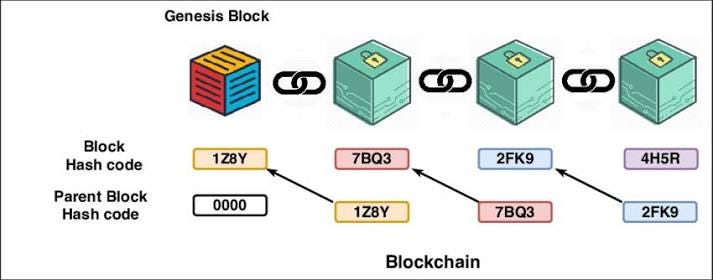
To solve the ‘double spend problem’, Bitcoin transactions are stored in a public digital ledger known as the “blockchain”. Each new block on the chain contains a complex mathematical formula called a “hash”, which is derived from the block before it.
This chart visually explains how the blockchain works. Each subsequent hash is connected to the previous. Source: Mohamad Torky via ResearchGate
Bitcoin Mining
Entire farms of computers are dedicated to trading computing power to solve the blockchain. Upon finding a valid hash for a block, that computer is awarded ✨one Bitcoin✨ (which declines over time through Bitcoin’s halving process — something we’ll get into later). This process is known as Bitcoin mining. Bitcoin mining is requires a lot of computing power (read: expensive af), making it costly (by design!) to attack the network. The rate at which new Bitcoin enters circulation, meanwhile, is determined by the protocol itself.
But once a valid hash has been found, it’s a low-CPU task for other computers to check the work. This is known as a “proof of work” in the peer-to-peer network.
If someone tried to change data in an old block, its hash would change, breaking its link to every subsequent block. An attacker would then have to redo the proof of work for that block and catch up with the rest of the network. This helps prevent fraud through a peer-to-peer network while rewarding participants who keep the system running.
This is part of the beauty of Bitcoin. In the words of Satoshi, “The network is robust in its unstructured simplicity. Nodes work all at once with little coordination.“
The way Bitcoin combats inflation is elegant, too.
Bitcoin Halving
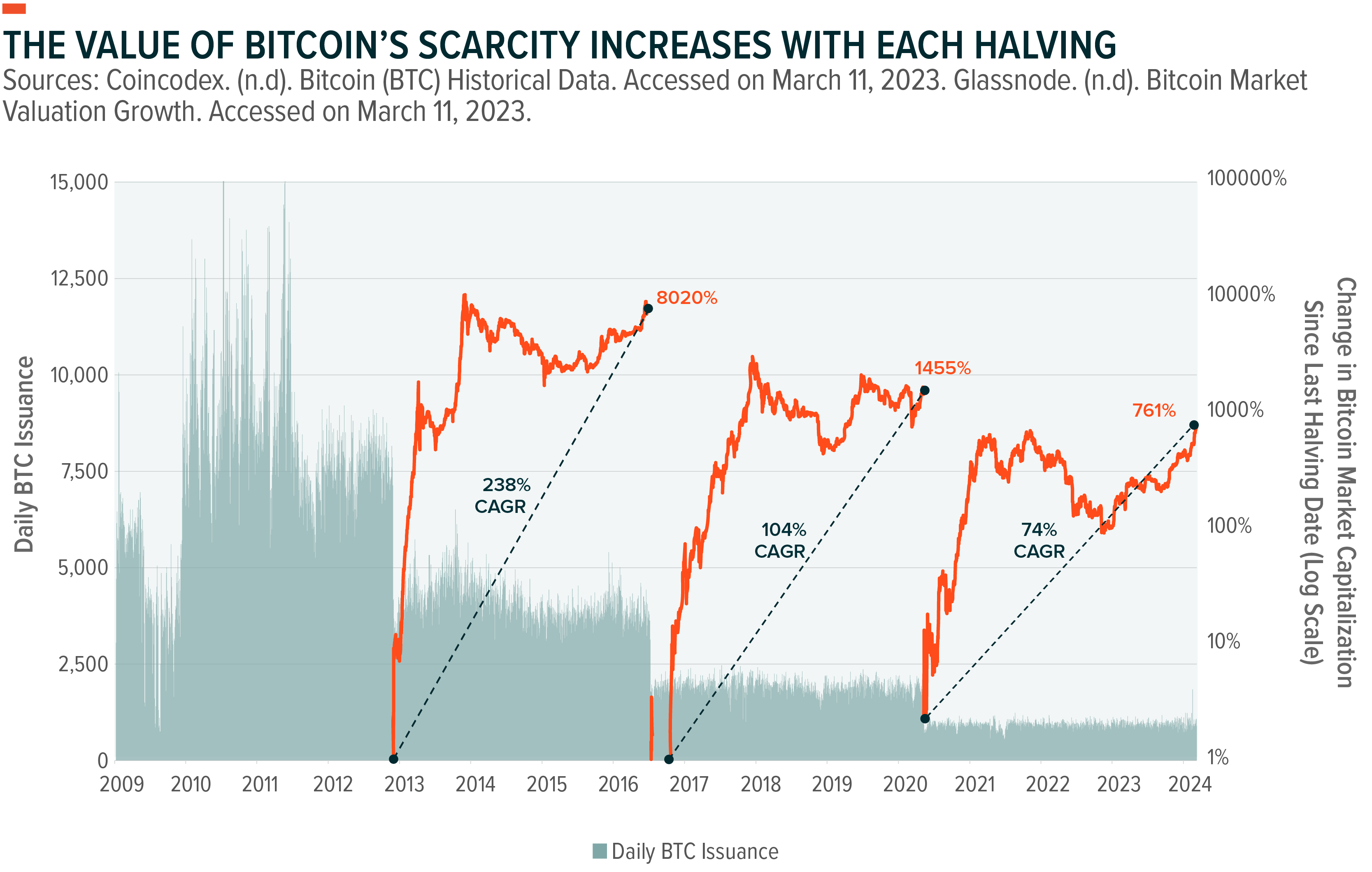
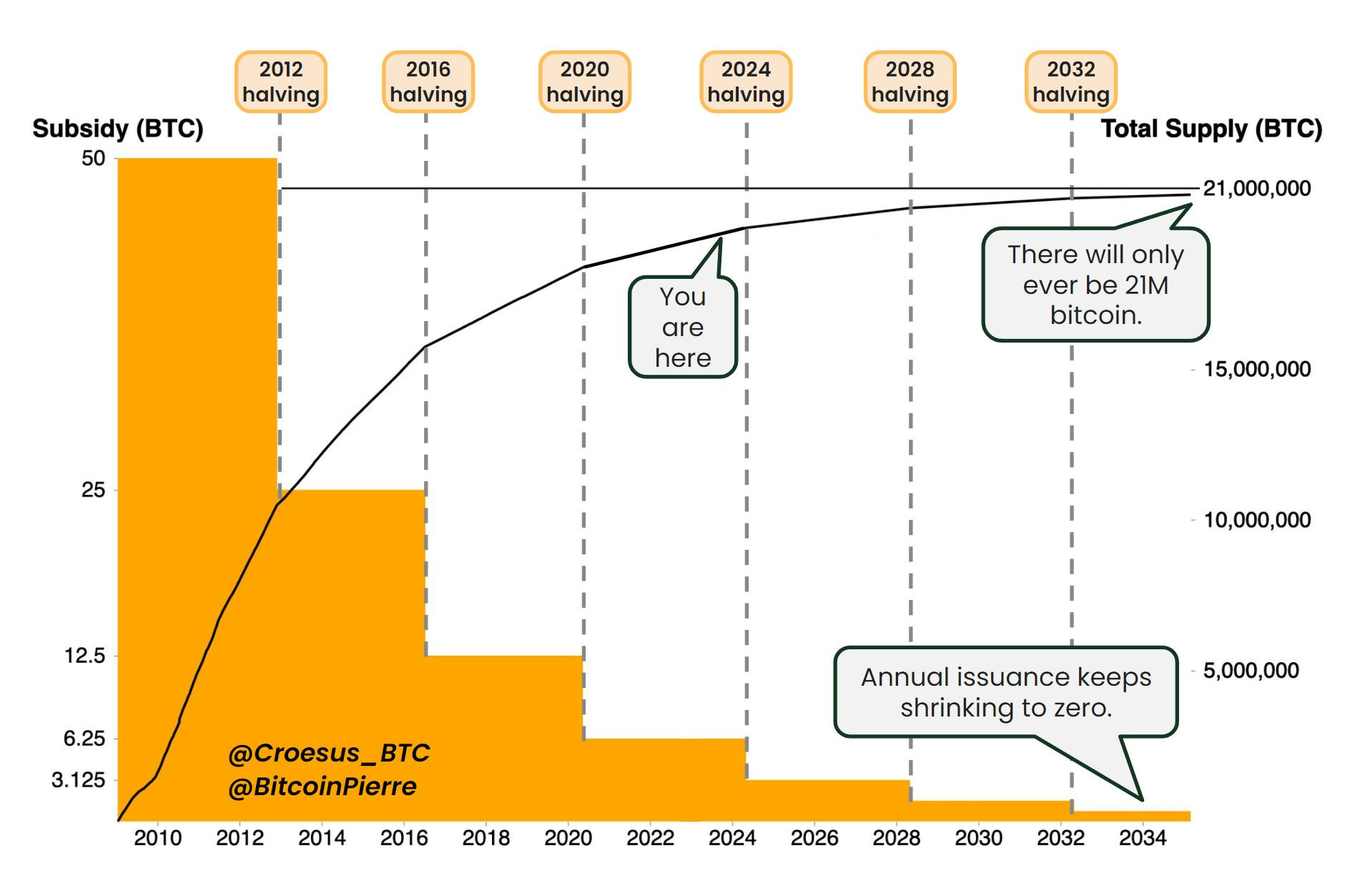
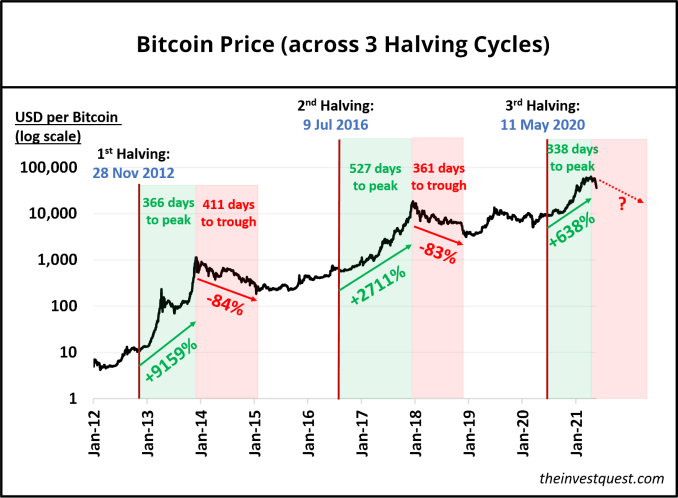
Every 210,000 blocks mined — which happens approximately every 4 years — Bitcoin “halves”, which means that the reward for updating the blockchain gets split in half. Every time Bitcoin halves, the rate at which new Bitcoin enters circulation falls, making new supply increasingly scarce.
Historically, Bitcoin goes up after halving. Global X ETFs
There’s also a strict 21 million Bitcoin limit. Bitcoin is expected to approach this limit sometime around 2140 A.D. Because the block subsidy repeatedly halves, the supply of Bitcoin approaches a maximum of roughly 21 million BTC. The number of Bitcoin that can be in circulation is asymptotic.1
Once BTC approaches 21 million, I have a theory that its value will be entirely dependent on (1) demand and (2) trust in the currency itself. Source: @Croesus_BTC and @BitcoinPierre
The U.S. Government prints more and more dollars, thus devaluing the currency.2 But because the supply of Bitcoin is capped, it’s the opposite.
Historically, Bitcoin has risen substantially during the broader market cycles surrounding its halvings. Although a halving doesn’t guarantee its price will rise. But it could — as long as:
Trust in Bitcoin remains. Bitcoin is an “anti fiat currency” because it relies on computer code rather than a central bank. Regardless, trust in the value of the currency itself needs to remain for Bitcoin to keep going up in value.
The best part about the entire system is its self-perpetuating quality. By solely relying on trusted computers, it protects the system from fraud.3 Per Satoshi: “[The computers] vote with their CPU power, expressing their acceptance of valid blocks by working on extending them and rejecting invalid blocks by refusing to work on them.”
In short… Bitcoin is awesome because it uses computer code to create a self-perpetuating system that’ll keep kicking until 2140 and beyond.
II. The Risk of Quantum Computing
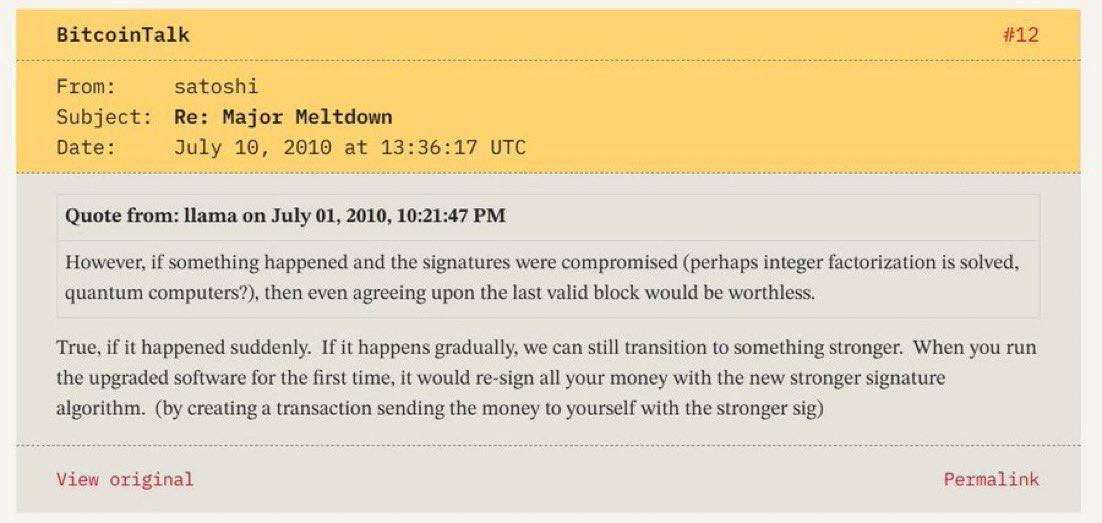
In 2010, Satoshi addressed a significant risk to Bitcoin: Quantum Computing. Satoshi said that quantum computing only poses a threat to Bitcoin if it happens all at once. Some think this could be possible with an intelligence explosion — but it’s more likely that the progression to quantum computing is a slow, drawn-out process.
"True, if it happened suddenly. If it happens gradually, we can still transition to something stronger. When you run the upgraded software for the first time, it would re-sign all your money with the new stronger algorithm."
Quantum computing (probably) doesn’t threaten Bitcoin mining. Every 2,016 blocks (~2 weeks), the network checks how fast miners solved the puzzles, and scales the difficulty accordingly. If a quantum computer joined the race and began finding blocks faster — to Satoshi’s point — Bitcoin would just get harder to mine. It’s a mechanism that prevents computers from CPU mogging each other, thus killing destroying the value of the currency.
SHA-2 is one of the most popular hash algorithms. It’s also the puzzle that Bitcoin mining requires participating computers to crack.
An SHA-2 function generates a nearly perfectly unique “fingerprint” from an input string.
For example, if you hashed the book Dune you’d get a unique 256-bit output. If you changed even a single letter in the whole book, the output hash would be completely different.4
Bitcoin wallets could potentially be at risk due to quantum computing because they use a mathematical shortcut to easily reverse public keys into private keys. A strong enough computer could theoretically get access to anyone’s crypto wallet using Shor’s Algorithm.5
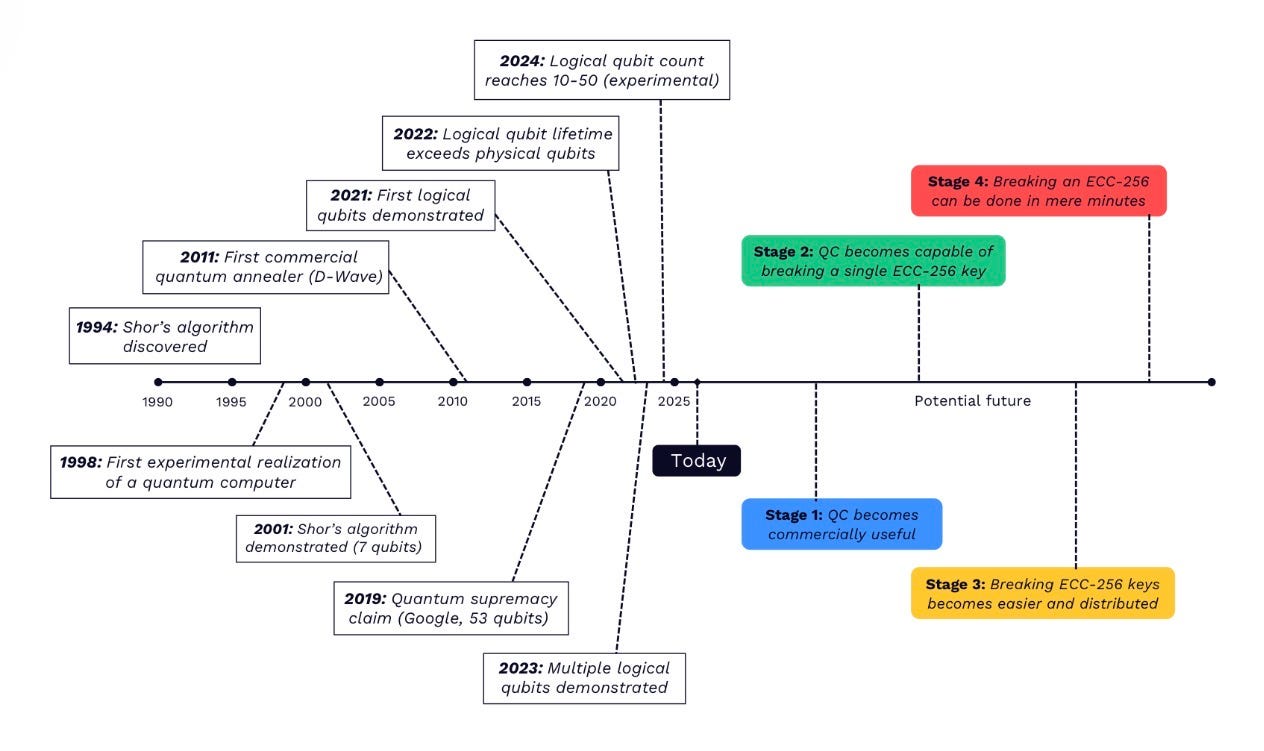
A white paper by ARK Invest is predicting that if quantum computing becomes capable of breaking ECC keys, that will challenge the viability of Bitcoin, potentially before reaching its limit sometime around 2140 A.D.6
Technically the self-sufficient nature of Bitcoin means it’s entirely possible for it to last decades, if not, centuries.
Bitcoin wallets could potentially be at risk from sufficiently powerful quantum computers because Bitcoin relies on something called elliptic-curve cryptography (ECC) — where getting a public key from a private key is easy, but recovering the private key from the public key is impossible for regular ‘ole computers. Shor’s algorithm could change that.
But then again, if Bitcoin wallets are at risk, so would most other financial institutions — perhaps the singularity will be our own Y2K moment? Quantum computing would not necessarily break Bitcoin mining itself.
Quantum computing doesn’t break Bitcoin mining, because mining security scales with computing power, making it more difficult to mine as computing power improves… unless we invent quantum computing in one instantaneous moment — in which case, buckle up.7
III. The Future of Bitcoin
As a Warren Buffett fanboy, it feels sacrilegious to suggest that buying anything other than low-cost index funds is a winning strategy. But it’d be naive to think that just because America crushed the last 250 years, it’ll inevitably crush the next 250.
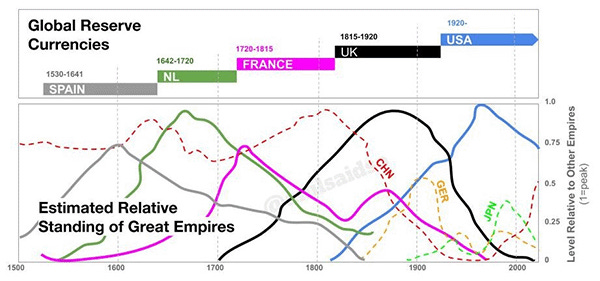
America’s growing fiscal debt and de-dollarization are becoming increasingly spooky problems — leading many “Fuck Yeah Americans” like myself wondering: Will another currency replace the dollar as the next reserve currency? Why not Bitcoin?
It’s unlikely that Bitcoin will become a new reserve currency… yet. A true reserve currency needs to be a reliable store of value, a stable medium of exchange, and a predictable unit of account. Bitcoin is volatile.
Stablecoins — cryptocurrencies pegged to national currencies — are a possible alternative, but you still run into a similar problem: de-dollarization. If confidence in the U.S dollar collapsed, so would all the stable coins pegged to it. Putting your money into stable coins isn’t protection from the dollar’s eroding purchasing power.
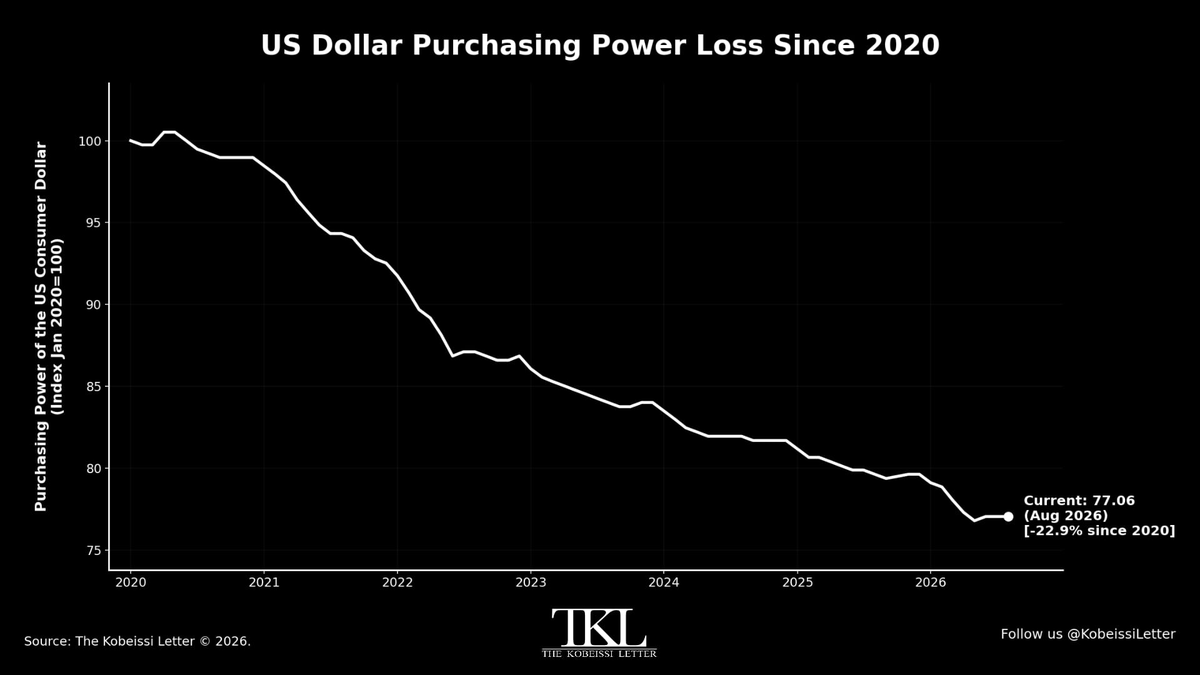
The U.S. dollar lost 23% of its purchasing power since 2020. In other words, if your assets are up 30% since 2020, you’ve effectively just broken even in real terms. Inflation has now been above the Fed's 2% target for 60 straight months, and the bond market knows this.
What’s scarier is the fact that stable coins help export inflation farther and wider around the globe.8
Will Bitcoin replace the U.S. dollar? To be honest — I’m not sure. Will the U.S. dollar be replaced by Bitcoin? Probably not (yet). It’s too volatile (for now). What about stablecoin? You run into the same issue since it needs to be pegged to a currency like the U.S. dollar.
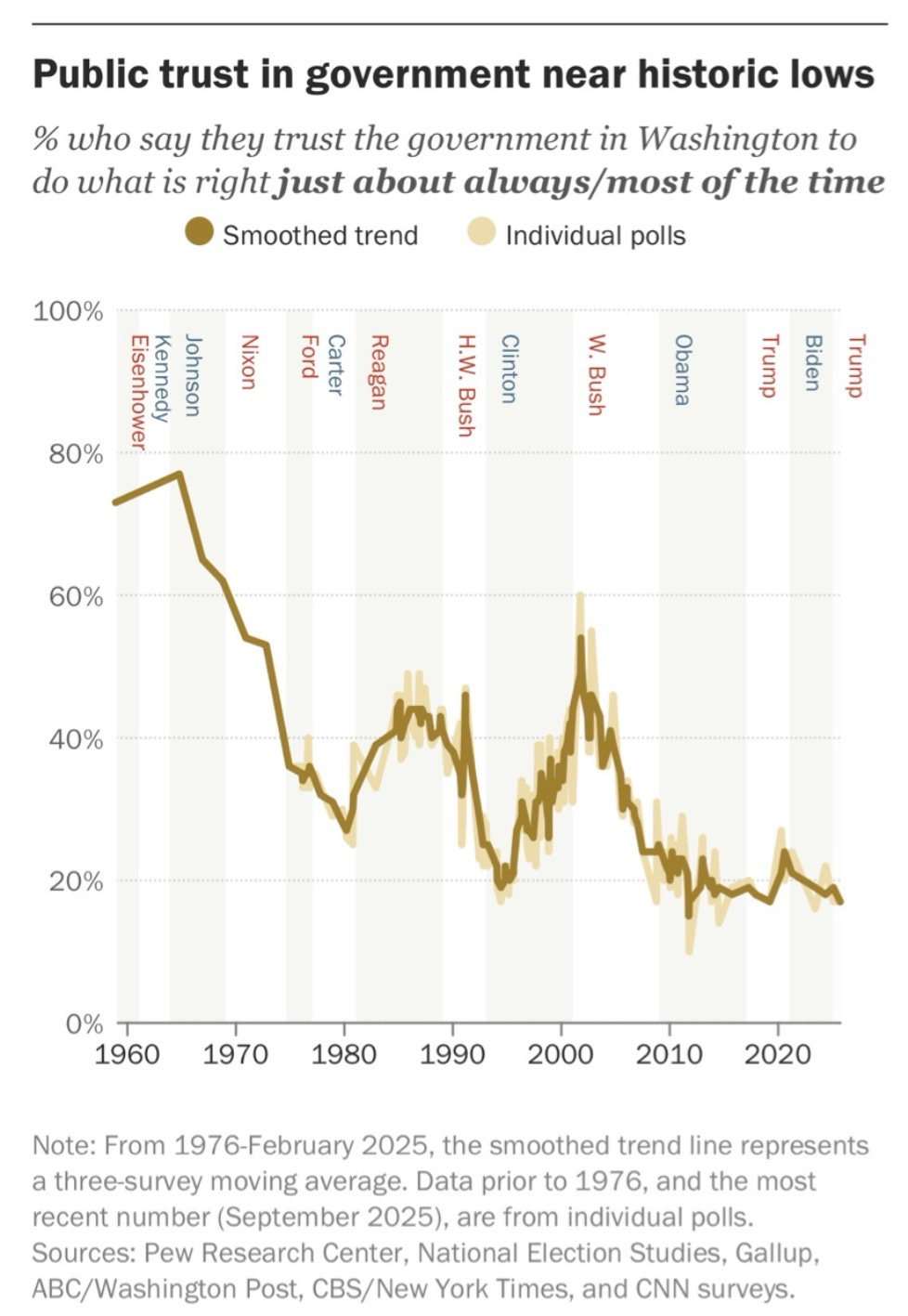
The question of whether Bitcoin could replace the U.S. dollar as the reserve currency is really a question of trust — which doesn’t look good. If the value of the U.S. dollar is a reflection of trust in the U.S. government, then we’re not looking good.
The ‘fiat’ part of the ‘fiat’ currency comes from trust in the strength of the American military machine — in other words, the value of the U.S. dollar is derived from confidence in the United States military:
“The dollar and the military are inseparably linked — military power underpins trust in the currency, while the dollar’s privileges make it easier to finance that power.” — Our Dollar, Your Problem by Ken Rogoff
America’s military and global power is a big contributor to U.S. dollar confidence — along with the size of our economy, financial markets, institutions, and the government’s ability to tax. But what happens to a currency when everyone loses hope for a brighter future? It loses value.
Trust is rarer than ever. But what will yield trust in the next decade and beyond?
If I thought that Bitcoin was the future, I’d put my money where my mouth is. Unfortunately, I don’t think that’s the case. That said, I don’t see any problem with putting a small amount of “fun money” into Bitcoin — as long as you’re OK with the possibility of losing it all. Hopefully you win some, but don’t count on it.
I’m keeping my money in the S&P 500 — a bet on America. However, being the intelligent investor that I am, I’ll be closely watching the United States military. I want nothing more than a strong military (back-to-back World War champs!!) — both because I love America and selfishly because I know the strength of the U.S. dollar is dependent on it.
But I also recognize that our military success (and failures) are a leading indicator for the future financial success of the nation and our position as a world power.
The world is completely off the gold standard, and the M2 money supply has reached new highs. But just because something is scarce (Bitcoin) doesn’t necessarily make it valuable. And just because something is abundant (U.S. dollars) doesn’t necessarily make it useless. But those certainly run hand in hand, don’t they?
Believe it or not, I actually started writing this essay on February 3rd, 2026 — I hope you had as much fun reading this as I did writing it!
While exploring Bitcoin halving, I immediately thought of a Mandelbrot set, and how it’s elegant, repeats into infinity, and becomes increasingly small the closer you get.
Like a Mandelbrot set, the boundary will theoretically extend into infinity. Source: Wiki
There’s a great explanation about the SHA-256 hashing algorithm by Lane Wagner: “What Is SHA-256?” I read this while learning about this topic, and I’d highly suggest you read it if you want to dig deeper as well.
Here’s the best way to understand Shor’s Algorithm: Imagine a game of billiards on a special, looping curve. You hit a ball from a Starting Point (P). It bounces around the curve and lands at an Ending Point (E).
The Secret (Private Key): The number of times the ball bounced.
The Lock (Public Key): The final resting spot of the ball.
ECC (Elliptic Curve Cryptography) acts as a one-way lock to secure funds. It’s easy for normal computers to turn a private key into a public key, but nearly impossible to do the reverse.
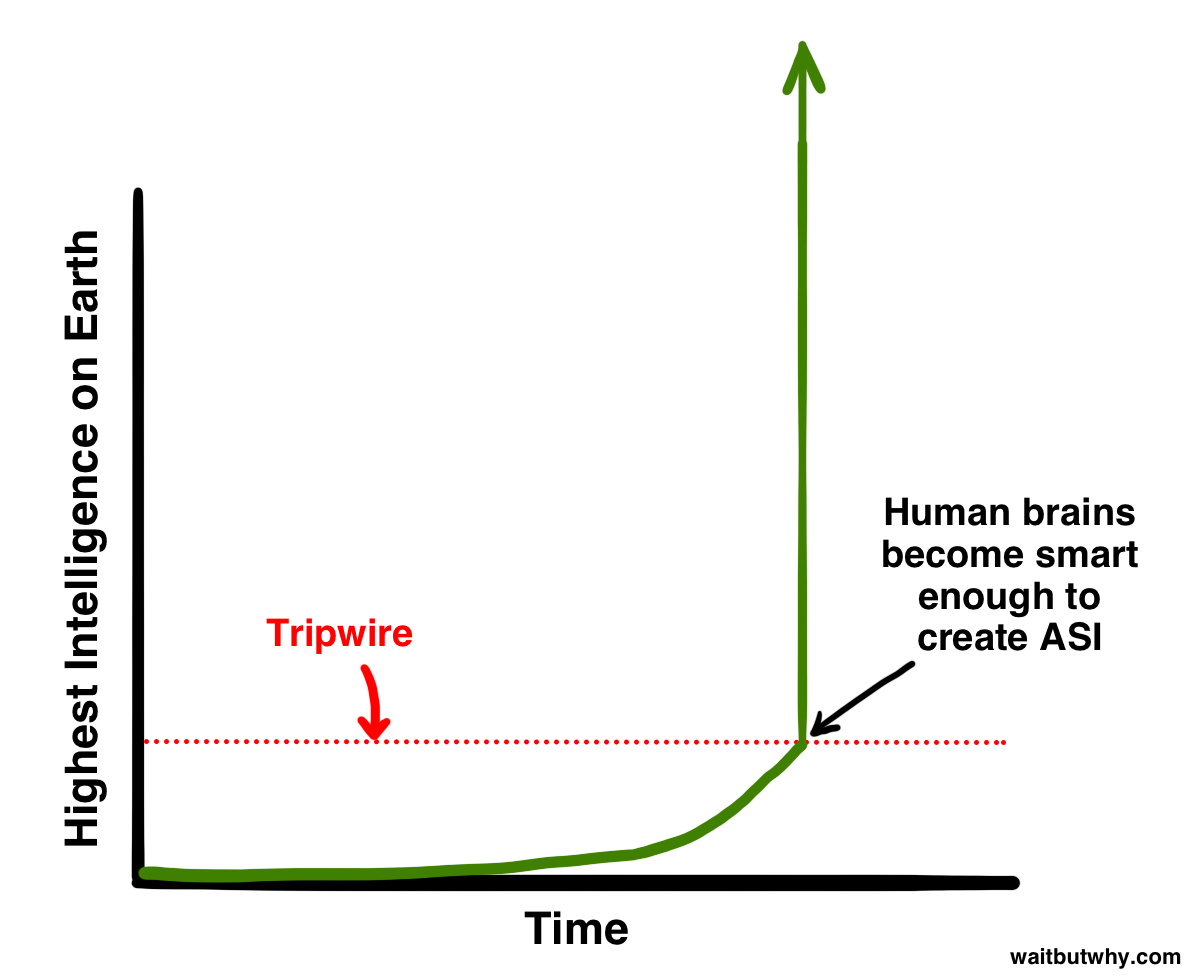
Tim Urban wrote a great piece The AI Revolution: Our Immortality or Extinction which articulate the very real possibility that recursive self improvement (RSI) in Artificial Intelligence could potentially lead to a fast takeoff scenario. If this happened, I’d have many concerns (like how the hell to escape the Terminator) — one of which is what could happen to cryptography. Again, it’s be like Y2K, but for real, and way, way worse.
Thanks for the shout out, great job exploring the perspectives on Bitcoin, I think its awesome too. Did you come across the formula for the perfect amount of Bitcoin to hold in your research?



Thanks for the shout out, great job exploring the perspectives on Bitcoin, I think its awesome too. Did you come across the formula for the perfect amount of Bitcoin to hold in your research?