Michael Jordan was cut from his freshman basketball team. Later he said, “The mental toughness and the heart are a lot stronger than some of the physical advantages you might have.”
Tom Brady split playing time with Drew Henson at Michigan. Then Brady was picked 199th overall by the Patriots. Only to be seventh on the QB depth chart, struggling to get playing time.
After the 2022 Beijing Olympics, Alysa Liu burned out from skating. She returned to skating two years later to win gold in the 2026 Milano Cortino Olympics with genuine joy — regardless of the outcome. In an interview on 60 Minutes, she said:
“I love struggling, actually. It makes me feel alive.”
Growth minded bosses are open to learning, feedback, and confronting obstacles with clear eyes.
Fixed minded bosses make everyone worried about their performance and bring down the overall team’s performance.
Growth minded companies are focused retention and unlocking the potential of their employees. They don’t look for people who “have it in their DNA”.
Instead, they recruit for learning ability.
Employees in a growth culture believe that risk taking, creativity, and innovation is supported. Even if they fail.
III. In Relationships
Romantic relationships can be hard for high achievers.
In virtually every facet of life, if you fail, the blame is all on you. But when a relationship fails, there’s three things at play:
You.
Your partner.
Your relationship.
Growth minded people believe relationships take effort. Compromise, communication, and conflict resolution are required to work through inevitable differences.
Problems can be a vehicle for developing greater intimacy. Don’t dilute yourself into thinking your relationship will be all sunshine and roses.
Get better at communicating and understanding each other’s thoughts, needs, and feelings. Don’t fall prey to the low effort belief that your partner should be able to read your mind.
IV. In Coaching
Legendary UCLA basketball coach John Wooden was famously obsessed with growth.
“You have to apply yourself each day to becoming a little better. By applying yourself to becoming a little better every day over a period of time, you will become a lot better.”
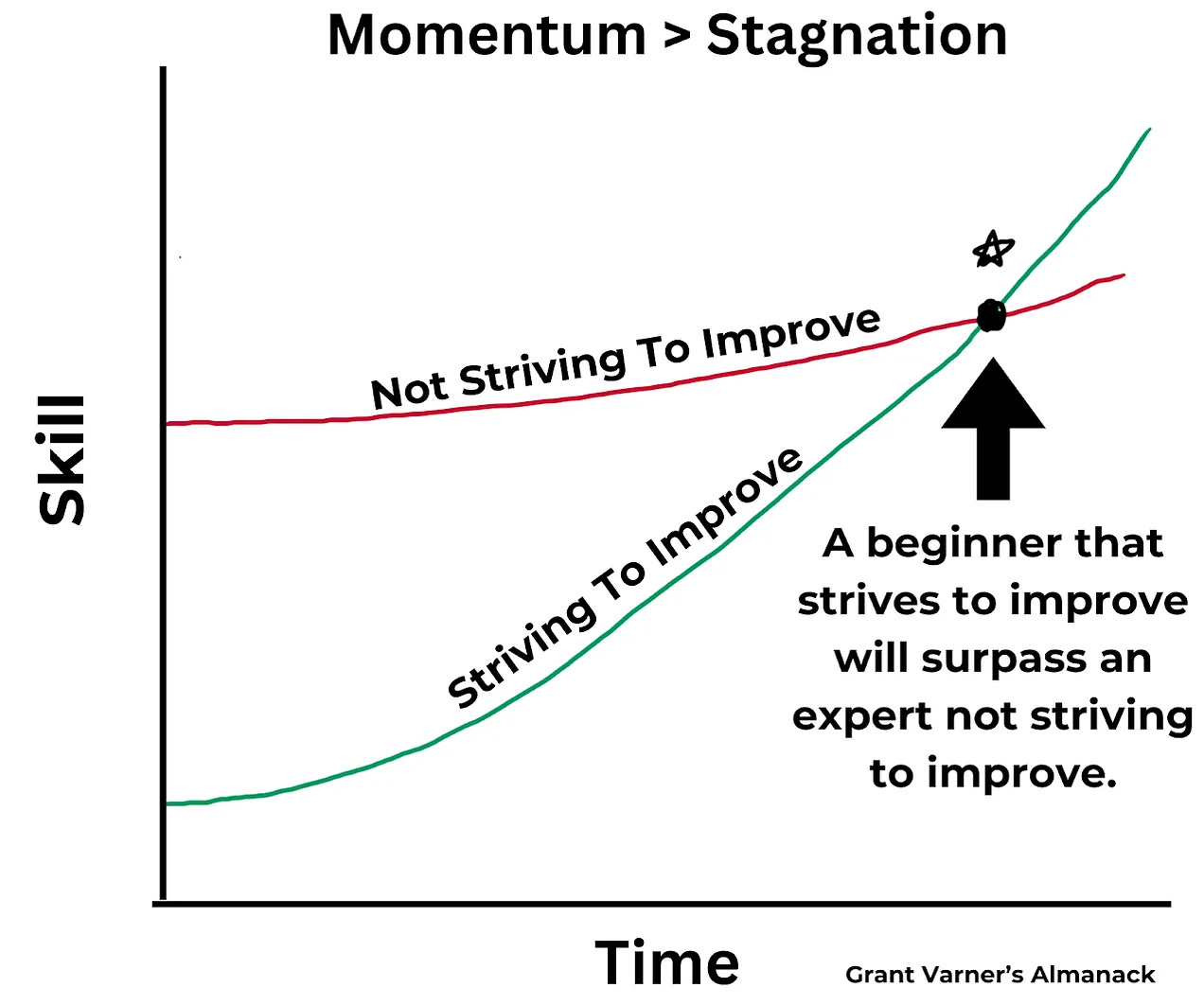
Equilibrium doesn’t exist in the physics of continuous improvement. The iterative process of improving leads to success. It includes hard work, trying new strategies, and seeking input from others.
\(Effort * Strategy * Time = Results\)
Your process dictates your outcomes. If your hard work isn’t getting result, ask yourself why your efforts aren’t effective.
And above all, be weary of success. Just because you’re successful once, doesn’t mean you will be again. Instead, ask yourself, “Did I give my best effort?” If you did, you’ve already won regardless of the outcome.
How To Change Your Mindset
The growth mindset is based on a belief in your ability to change.
You subconsciously (and consciously) keep mental track of what’s happened to you, what that means, and what you should do. Frequently audit your thoughts. Keep them if they’re serving you well. If your thought aren’t serving you, update them.
The growth minded person recognizes that people stand out because of commitment, effort, and (a little) luck.
By combining effort, strategy, and time, you’ll probably have similar results. If you aspire for results bigger than you’re seeing now, realize that you’re in a necessary period of learning. Fall in love with putting in effort and results will come with time.
Once a problem improves, it’s easy to stop doing what led to the solution.
Change doesn’t work that way. Improvements have to be supported or they’ll go away faster than they appear. One way to avoid this is by asking yourself every day, “What are my opportunities to learn and grow today?“
Change is hard. But you’ll never regret changing your life for the better.
You’re capable of doing incredible things. Go forth: Change your mindset and change your life!