“Don’t just say you have read books. Show that through them you have learned to think better, to be a more discriminating and reflective person.” — Epictetus
Reading first emerged 6,000 years ago when the ancient Mesopotamians repurposed regions of their brain reserved for speech and object recognition. They used pictorial symbols that resembled familiar objects — like animals, grain, or tools. Readers processed those using the brain’s existing object-recognition system.
If this is confusing, imagine you get plucked out of your desk job in 2026 A.D. and plopped into 3,500 B.C.E.
The same part of the brain responsible for knowing the difference between a gazelle and a lion was also responsible for identifying pictorial symbols.
Over time the brain strengthened connections between the visual mark, known object, and spoken word. When that became automatic, it freed up the human brain to think deeply about more abstract ideas.
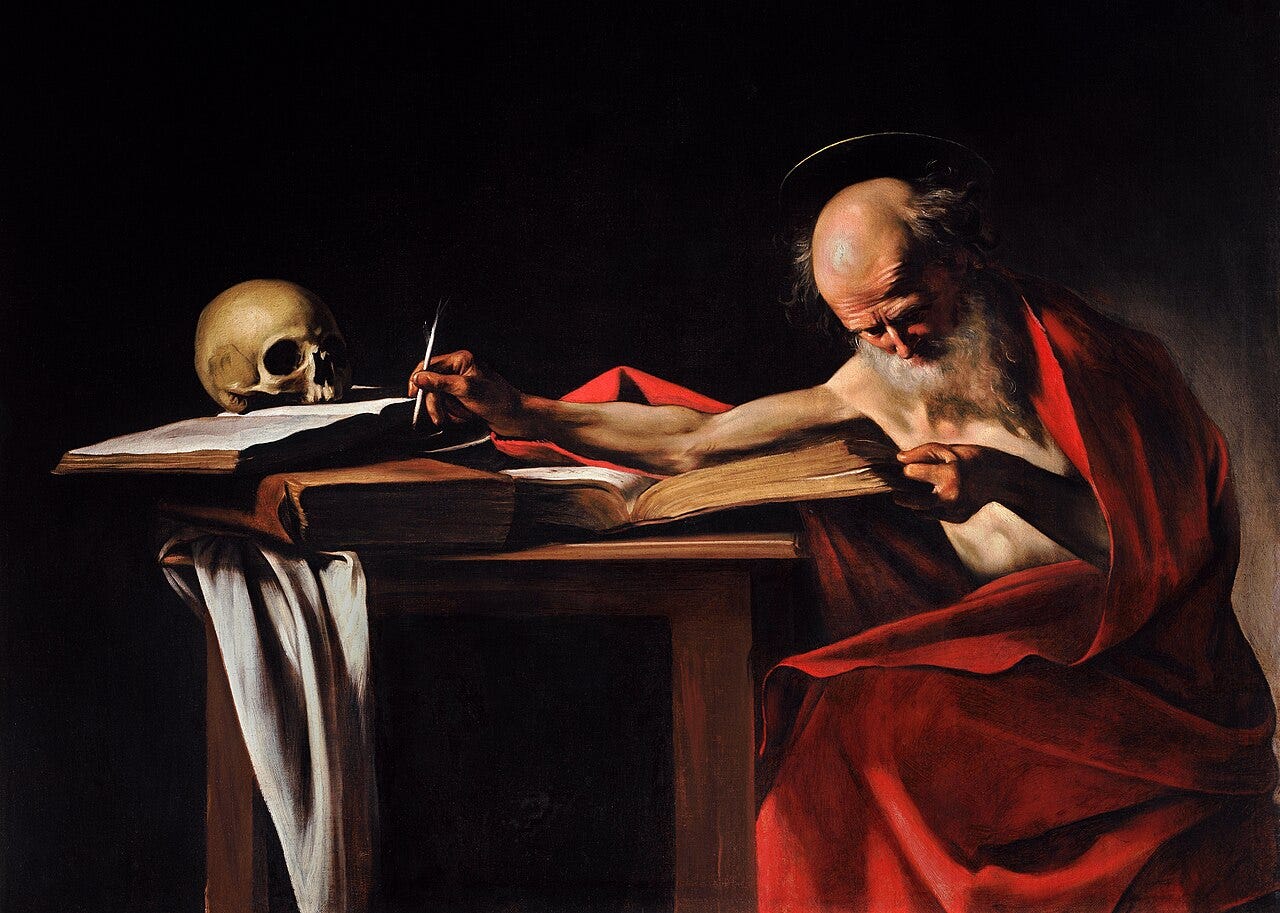
Unlike the oral tradition, writing outlives the person who conveyed that knowledge. You can return to a text and read it deeply to achieve new intellectual breakthroughs.2 This made writing a great mental scaffolding to free up brain space to develop new ideas. (It’s no coincidence that Aristotle was a master of the Greek alphabet and prolific writer.) To quote Daniel Frank:
“Writing is a form of scaffolding. Once you write about something, you can finally stop ruminating on the idea, let it go, and free up your bandwidth for other things. Everyone knows writing forces clarity in your thoughts. But the value of writing is much greater than that—most of the time, you don’t even know what your thoughts actually are until you turn on your ‘writing brain’. Being in the habit of writing makes you much more attuned to the world, forcing you to actually notice your own interesting observations and reflections as they happen. When you start taking notes, you finally have somewhere to put your random thoughts that would otherwise get lost to the wind. Slowly, without any real plan or intention, you start noticing how much these ideas relate to each other, and broader connections form in front of you that never would have happened otherwise. This also happens on a bigger scale the more you write: your posts, over time, will slowly reveal who you are and what your values are.”
As literacy spread, it contributed to political revolution, including the formation of the United States. The Founding Fathers published opinion pieces to stoke anti-British sentiment among the colonists.3 Thomas Jefferson was selected to write the Declaration of Independence because, in John Adams’ words: “You can write ten times better than I can.” The pen was indeed mightier than the sword. But is it still?
We’re living in a post-literate society
In 1962, Marshall McLuhan had the prescient prediction that we’d become what he called “post-literate.” Coined in The Gutenberg Galaxy, McLuhan used the term to describe a cultural shift where visual media replaced the print word.
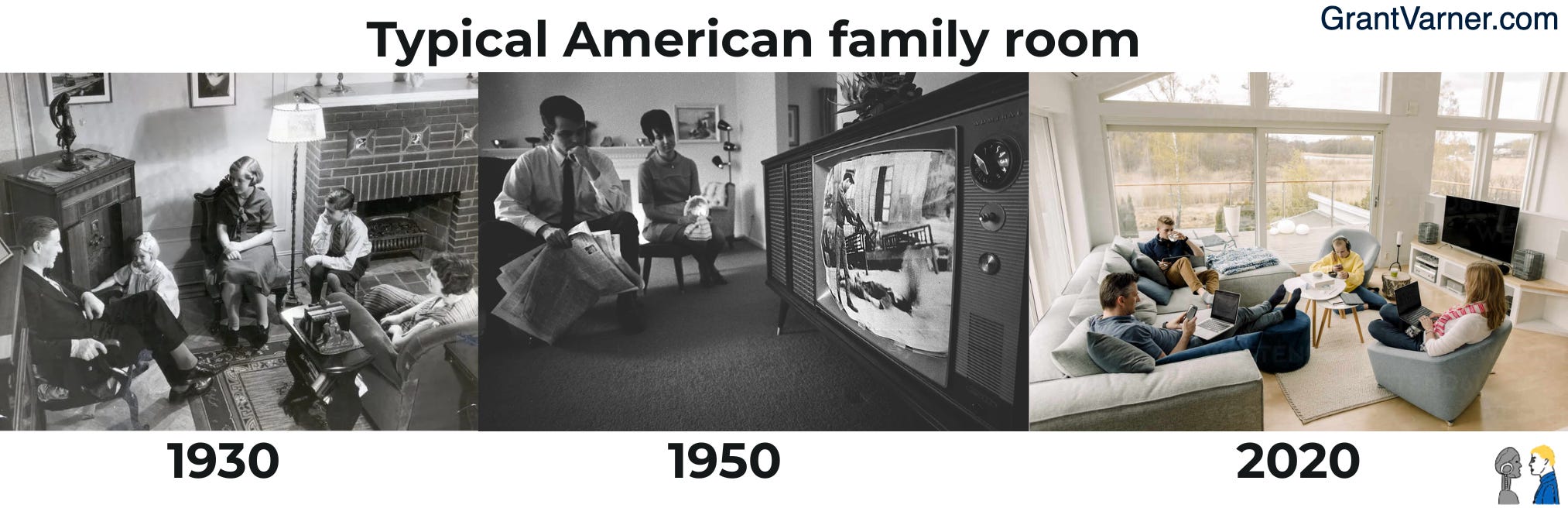
When he made this prediction, 90% of homes had a television compared to 9% a decade earlier. Rather than gathering around a radio, nearly every American living room couch faces the TV — today most attention is captured by mobile devices.
When the television came onto the scene in the 1950s, a wave of new media had entered American culture, hijacking our attention in the process. Thankfully, there was a healthy amount of friction with early TV. Television programs aired at specific times, limiting how much people could watch.
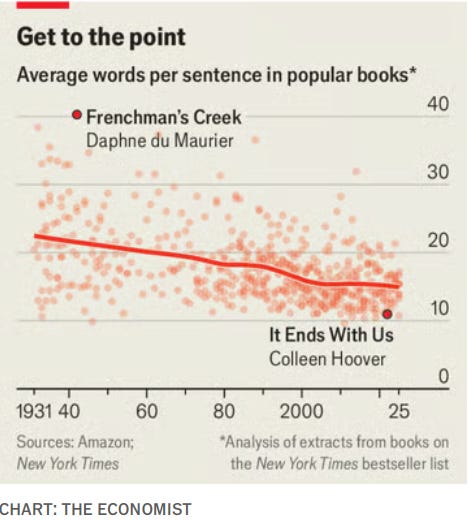
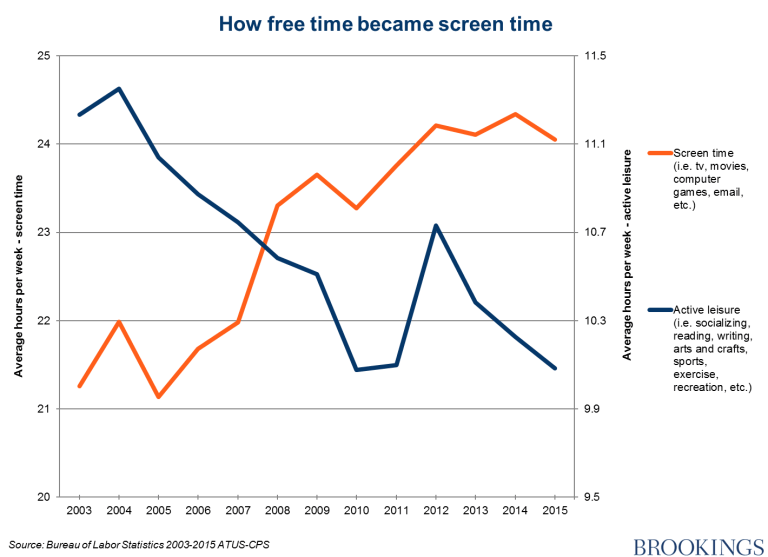
High-speed internet enabled unlimited consumption with virtually zero friction. Short-form video further accelerated that trend. We spend more time behind screens than ever, with goldfish attention spans. Leisure time became synonymous with screen time and one TikTok cycled into the next in a carousel of unlimited content.
The more you read, the easier it is to read. The easier it is to read, the more you’re rewarded with new ideas. But the converse is also true: The less you read, the more difficult it is to read. Which makes it harder to acquire knowledge.
When watching animated videos, children used the region of the brain associated with imagination half as much as they did when looking at static illustrations while listening to an audio recording. Children also used their cerebellum — part of the brain associated with learning—less when watching a video.
Although video contains more information than text, it doesn’t stimulate deeper thinking quite the same way reading does. Video thrusts so much information upon you at once, making it hard to focus deeply on any one thing — a key component of critical thinking. It’s rare to find someone willing to pause, rewind, and deeply understand a single video versus just watching it play through in its entirety.
Critical thinking is declining
Critical thinking ability in adults is declining too.
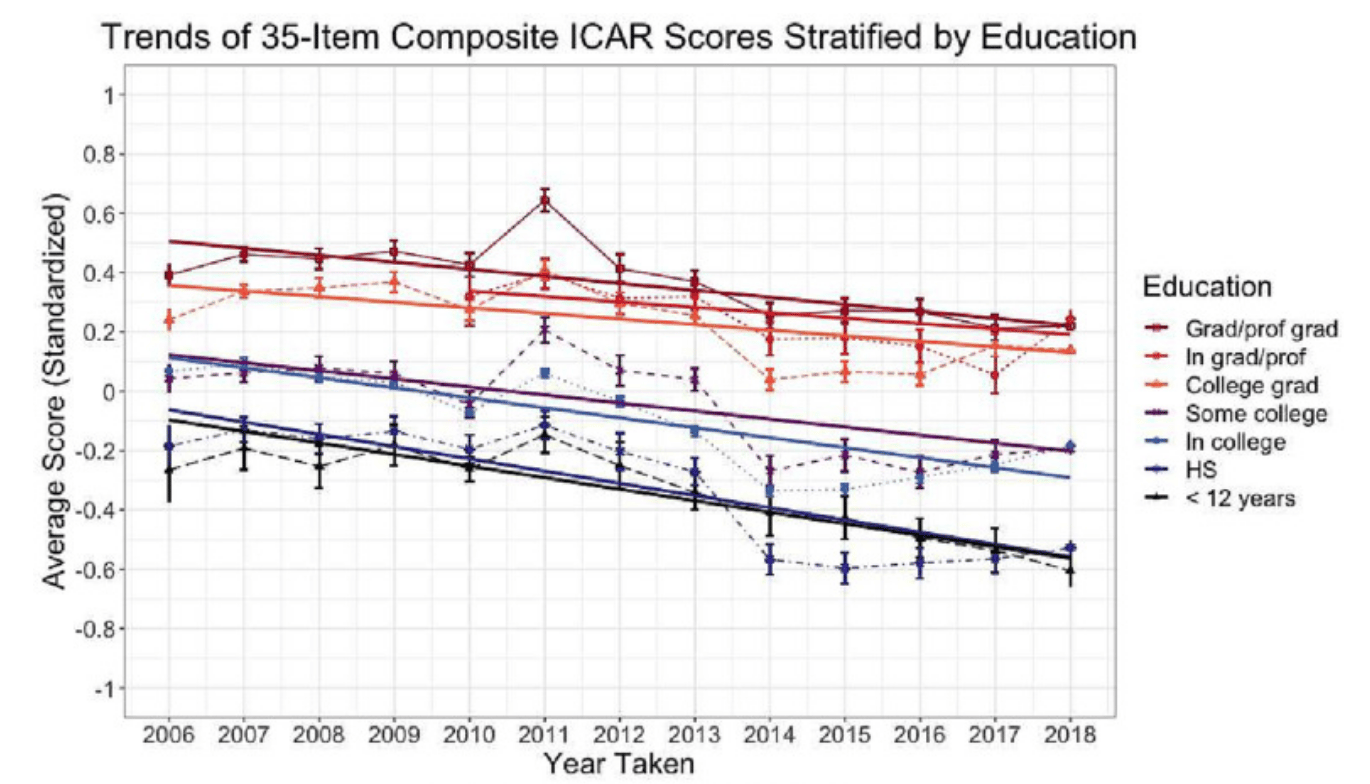
American adults’ ability to answer logic questions, reason effectively, and analyze patterns declined from 2006 to 2018. American adults also tend to have a smaller vocabulary than those with an equivalent level of education did half a century ago. Recent studies suggest that the Flynn effect — the steady rise in IQ between generations since the 1930s — has reversed over the past two decades coinciding with the start of the social media era.
Consider, for example, a recent paper published in the journal Intelligence that studied IQ scores over time in an American population. It found a steady decline in almost every intelligence metric studied as part of a 35-item assessment:
Erik J Larson, a Fellow of the Technology & Democracy Project at Discovery Institute, finds that:
“…as we construct a world that increasingly rewards computational thinking, we risk further diminishing the very aspects of intelligence that make us uniquely human. The Reverse Flynn Effect may have started as an academic curiosity, but I think it’s more of a modern warning. If we continue down this path, we may create a world that thinks in categories and abstractions while steadily losing the ability to truly understand. How we stop this slide must be one of the defining challenges of our time.”
Just because IQ rates are dropping doesn’t necessarily mean we’re cooked. Plato wrongly thought writing was the end of critical thinking. He argued that reading would “create forgetfulness in the learners’ souls, because they will not use their memories; they will trust to the external written characters and not remember of themselves.” Hindsight is 20/20, but we now know that the Greek alphabet was only the beginning of critical thinking.
“Good writing is actually good thinking.” — Paul Graham
Generative AI is threatening writing. The truth is that writing is hard. I relate to Ernest Hemingway on a spiritual level when he said, “There is nothing to writing. All you do is sit down at a typewriter and bleed.” AI promises low friction writing. But the challenge of writing is the whole point because of how it physically changes you.
“Using AI to write an essay is like taking a gondola to the top of a mountain. You don’t really know the mountain. You don’t get the satisfaction of having exerted yourself on the mountain. You aren’t shaped by the mountain. And in the case of AI, the mountaintop itself is less interesting than had you climbed it yourself.”
Even though I could’ve written this essay with AI, I didn’t. The process of writing a sloppy first draft, discussing my arguments with others, and killing unconvincing ideas is all part of the game.4 Putting every idea in an essay up to scrutiny is humbling.
Of course AI makes writing easier! It removes learning from the equation. Learning is hard work. Writing a phrase takes longer than speaking it, forcing you to slow down and reflect — hence why Paul Graham rightly say that “writing is thinking”.5
AI is stunting learning
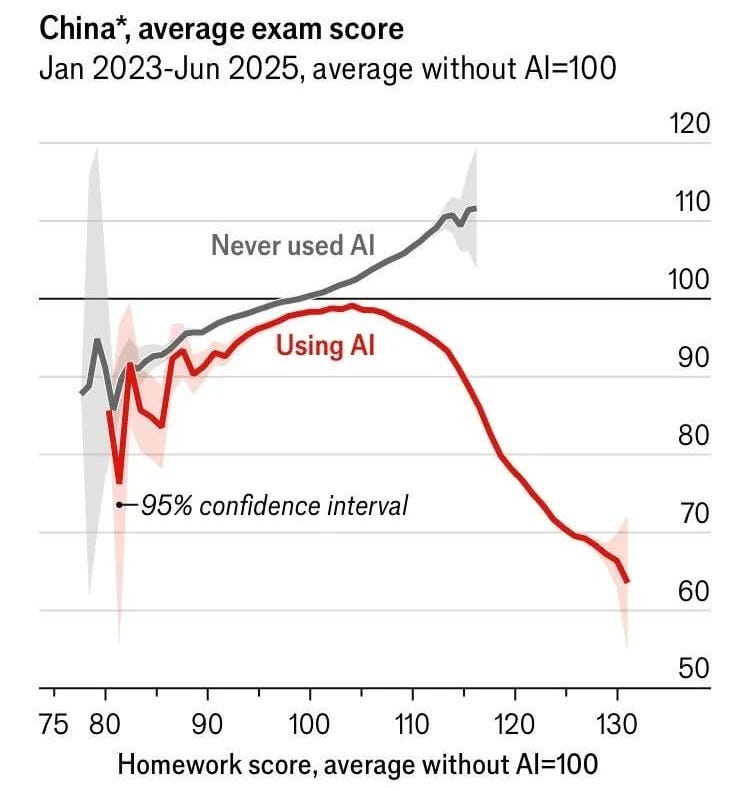
Studies are already revealing the learning penalty due to AI. Using 30 months of panel data on 26,000 Chinese students, Strömberg, Lei, and Wu observed that AI adoption raised homework scores by 18% but decreased exam scores by 24%.
The full effects of the AI learning penalty happened after two years.6 The learning losses are concentrated among students who outsourced their homework to AI.
This learning penalty is known as “cognitive stunting” — a real Catch-22 for educators. By using AI, young students are offloading their critical thinking skills to AI. But you can’t tell students to not use AI or they’ll fall behind.
Fear of cognitive decline is why I started writing this blog. In 2022 I was a Chat GPT super fan. Eventually I developed a hunch that AI was eroding my ability to think critically. Which is, in part, why I started writing online without AI. Deep thinkers overall will get more rare as more outsource their thinking.
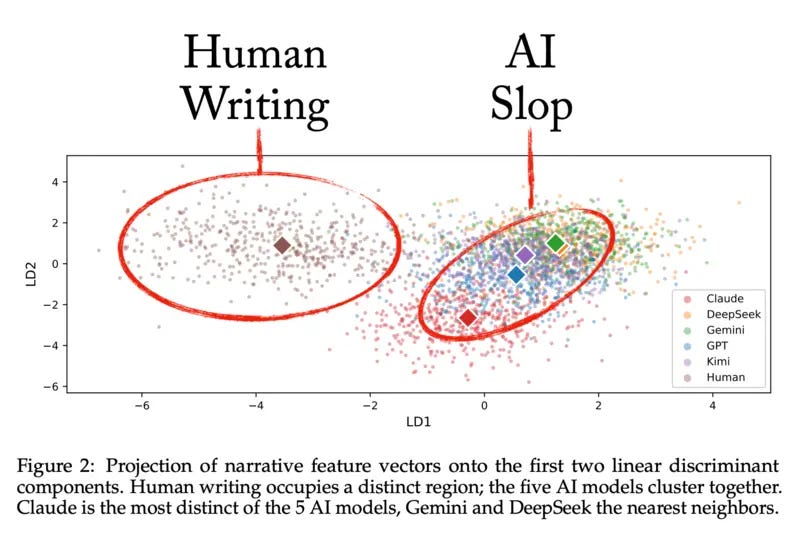
By becoming over-reliant on AI to write, you could lose your capacity to develop your own views or make judgement calls about the views of others. On the surface, AI writing looks convincing, but is frequently unoriginal, inaccurate — or both. This is exactly why primary source literacy is a necessary skill in the 21st century.
Written culture is thriving by some measures
Reading, in aggregate, is dying. But it’s also thriving among the long-tail of an increasingly smaller population. The 10% of readers who read 25 or more books last year account for roughly half of all the books read in the country.7
The most dedicated readers of today read more than those from two decades ago. But they’re counter cultural. The fact that you’re reading my essay right now tells me you’re part of this revolution.
In a video-first culture, reading is an instantly identity marker. You can quickly make friends with other readers. Someone at my apartment was reading The Laws of Human Nature by Robert Greene. So I struck up a conversation and it turns out we had a ton overlapping taste in books.
Books used to be the primary source for knowledge, memory, and wisdom. Now online influencers are the catalyst for the transmission of culture.
I was raised in the post literate era
Even though I grew up in a post-literate society, I had the advantage of growing up in a reading family. My mom read to my sisters and me every night until middle school. In high school, I had a knack for reading and writing — my favorite assignments gave me intellectual freedom to explore topics like an essay I wrote about The History of Barbecue in America.
Since then I’ve continued the hobby — including this blog, which has helped replace scrolling with writing. Achieving flow state through researching, writing, and editing feels more fulfilling than the brain fog I get from social media.
III. Bi-Literacy
“If you only read the books that everyone else is reading, you can only think what everyone else is thinking.” ― Haruki Murakami
By now it should be abundantly clear: Reading and writing are dying and becoming artisanal hobbies. So where does society go from here? Bi-literacy, the skill of the future.
In Reader, Come Home, Maryanne Wolf defines bi-literacy as the capacity to switch between two distinct reading modes:
Deep reading (physical books).
Shallow reading (digital text).
Having fluency in both frees you to reap the benefits of both in an increasingly volatile labor market. So how do you become bi-literate? By recognizing there’s a new proof of work: the Socratic method.
The Socratic method is learning
Working at the tip of the spear of enterprise AI at Salesforce, it feels like there’s a new acquisition every week — which requires me to learn new technology so quickly that ‘learning by writing’ is too slow to be an effective strategy.
One evening, before a big technical product demonstration, an old friend visited at my Chicago apartment during a work trip. I transparently said, “I’m down to hang out. But I need to chat with you about my presentation. Like a dry run.”
As I’m describing my presentation, he’s getting into the weeds. It quickly turned into Socratic dialogue: “What makes Agentforce better than Claude?” “How quickly are other customers getting value from this?” “Why should they use an MCP server?”
The following morning I gave my best demo ever — without writing a script. Suffice to say: writing isn’t the only form of learning. Socratic discourse can be learning under the right conditions.
A recent NY Timesopinion piece echoes this sentiment. Joe Cruz, a college professor says that instead of requiring his students to write, he encourages them to debate.
“I engage my seminar students through messy, searching conversation, responding to their presence in the classroom to gauge whether we’re understanding one another.”
Cruz goes on to say:
“What if we are mistaken in treating writing as the highest cultivation of thought? The evidence that supports this belief is thin at best. Writing can be useful cognitive scaffolding for memory and self-regulated learning, but the notion that it is the best process for developing thinking skills is a fairly recent idea, traceable to the 1970s writing-across-the-curriculum movement.”
My tech sales job requires me to be an expert on everything AI. I’m constantly scouring the web for the latest. But in order to deliver that message to customers, I need to deeply think about the product, how we’re going to market, the customer, and a whole lot more.
Think deeply about the market for enterprise AI. Write to learn about where the market is headed. Refine those ideas based on customer feedback.
Deliver that message to others. And it can be anybody — though it’s best when they’re immersed in the same problems you’re working on that you can riff ideas with them.
By combining the best elements of the literacy- and post-literacy, you can make yourself more valuable in the job market.
We’re running out of good ideas to train on. Each large language model needs new data to train on. But we’re hitting the data wall. And most of the ‘new’ things on the internet is AI-generated, which creates some wild modeltraining challenges.
Most of writing is revision. Typical training data for writing only have finished pieces. But the most training data sets lack the drafting, editing, and revision steps that actually lead to a compelling work.
Creative writing isn’t objectively verifiable like math or coding. If you’re one of the thousands of LLM post-trainers judging the output of a model, how do you assess that? How do you balance a models’ bias for conformity against the variance of uniquely human writing?
The evidence is compelling: reading is becoming more concentrated. So what am I doing writing? The same reason why I exercise. Because it’s good for me.
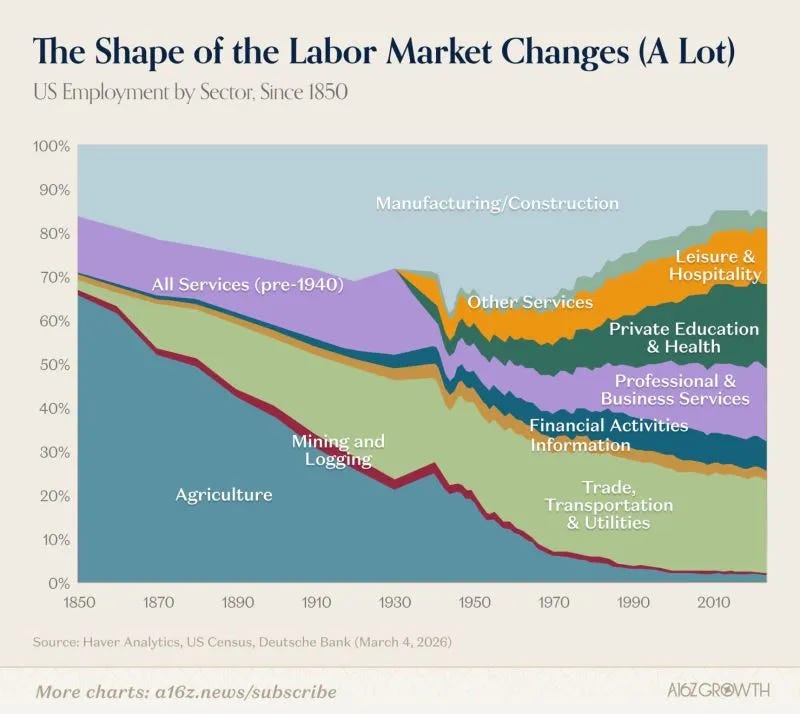
“In the future, I suspect writing will become a practice more like a workout than part of regular work. Physical fitness as a conscious discipline was unnecessary until relatively recently because human life and work were intensely physical. Go back only to, say, 1870, and you will find that more than three-quarters of American workers were in professions requiring strenuous labor, such as farming, forestry, fishing, mining, manufacturing, and mechanical trades. Today, that proportion of the workforce is less than 15 percent.”
The central theme of Ben Franklin’s life was progress: humanity improves based on a steady increase of collective knowledge. I share this opinion. Writing is a selfless act where you pour your soul out to intellectually enrich others. I feel responsible to share my knowledge to make my small sphere of influence a better place.
That, in a nutshell, is why I write.
That doesn’t mean writing will continue to gain mainstream prominence. In fact, I don’t see the trend towards a new mainstream oral tradition reversing ever. But creators who are at the forefront of the oral media will continue to be writers.8
Rather than an admission of defeat, I’m considering this a new chapter. For many years I was resistant to the prospect of video because I was too pretentious to succumb to the oral tradition.
That doesn’t mean I’m giving up on writing. Nor do I plan on memorizing The Odyssey or The Iliad, like the bards of old. The oral culture needs writers willing to wrestle with challenging ideas before verbalizing them — I’d like to be one of them. You should be one of them too.
Welp… this essay ended up a lot longer than I expected. But I had to write it. I hope you had as much fun reading it as I had writing it! (Assuming you didn’t read an AI summary 😜).
Fewer people are reading, but I have no doubt that reading is lindy given that it’s been around for 6,000+ years. The practical application of scaffolding your ideas mean it’s unlikely that it’ll never completely disappear. It’s more likely that writing will become an artisanal technology, solely used among intellects who value original thought.
I saw this in The American Experiment. I recognize the irony of citing a video documentary series in an essay about the death of writing. I just happened to watch it during the 4th of July this year and loved it. Check out the book if you want!
Shoutout Rakshith for discussing the ideas for this essay via Socratic discourse in our apartment patio. Real-world example of the bi-literate mind in action… appreciate you!
When society originally transitioned from orality to literacy, only a small minority with access to education could read. Once again, reading is clustered among a small minority.
Today's quotable Varnerism: “Unlike the oral tradition, writing outlives the person who conveyed that knowledge. You can return to a text and read it deeply to achieve new intellectual breakthroughs.” Another keeper!
The acquisition of timeless wisdom through reading is one of life’s greatest joys, but it is also fundamental to developing a capable individual and broader civilization.




![OC] 40% of Americans read zero books last year. The top 10% account for half of all the books read in the country. : r/dataisbeautiful](https://substackcdn.com/image/fetch/$s_!NbGz!,f_auto,q_auto:good,fl_progressive:steep/https%3A%2F%2Fsubstack-post-media.s3.amazonaws.com%2Fpublic%2Fimages%2Ffb5bca78-765a-41fd-aab8-40d0de378dee_2420x1364.png "OC] 40% of Americans read zero books last year. The top 10% account for half of all the books read in the country. : r/dataisbeautiful")


Today's quotable Varnerism: “Unlike the oral tradition, writing outlives the person who conveyed that knowledge. You can return to a text and read it deeply to achieve new intellectual breakthroughs.” Another keeper!
The acquisition of timeless wisdom through reading is one of life’s greatest joys, but it is also fundamental to developing a capable individual and broader civilization.