Social Skills + Specific Knowledge
Why social skills + specific knowledge is the most profitable skill stack in the next decade.
I. The Architecture Of A Bee Hive
Hobby Farms, a blog about bee keeping, defines the unique “jobs to be done” in a bee hive. Each job is different, requiring a specific bee with a unique skillset.
When everybee does their job, the hive thrives with a “workforce capable of pollinating thousands of acres of flowering plants, producing upwards of 100 pounds of honey per year.”
The life of a bee resembles the career of a human, with one big difference: Humans can learn unique, differentiated, and valuable skills which give you the opportunity to make more honey (…I mean money).
II. Skill Arbitrage
Being world-class acquiring specific knowledge will set you apart from AI (and bees) who are great at narrow specializations. Doing so will make you valuable, irreplaceable, and increase your income.
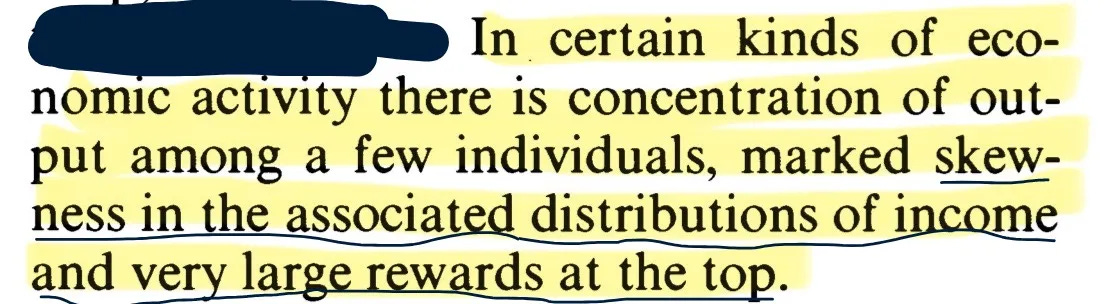
A 1981 study in The American Economic Review coined the term “Superstars”, or a small number of people who earn an enormous amount.

The reason is because there’s a steep demand curve for the best. Everybody wants to hire the best. Few want to hire average. Whereas average gets paid chump change, the best gets paid well.
III. Automation Of Entry Level Jobs
Failing to get really good at something means bouncing from one cookie cutter role to the next as AI repeatedly replaces your job.
Last May, I wrote How To Not Lose Your Job To AI, in which I detailed how:
“Specific knowledge is information that cannot be taught at scale. Pick up and capitalize on specific knowledge because this is what AI cannot spit out answers for.”
Ironically, the examples of specific knowledge I used in that essay have already been automated with AI — just 10 months later. Which is why specific knowledge is at the bleeding edge of technology and creativity — learned from self-education rather than formal education.
IV. The Fallacy Of Formal Education
Career mobility gets wrongly associated with formal education. “You want this job, therefore you need to get that degree.”1 This is a fallacy because education gives you the exact same credentials as everyone else.
Malcolm Harris, author of “Kids These Days” observed that the business world’s faith in higher education has declined:
“Wages for college-educated workers outside of the inflated finance industry have stagnated or diminished, with real wages for young graduates down 8.5 percent between 2000 and 2012.”2
What’s more is that a 2023 study of 70,000 small business leaders found that 90% of business thought colleges aren’t giving students the skills they need to succeed.

As a result, “business” has become the nation’s most popular major. Which makes sense. It’s broad enough to get your foot in the door at a corporation where you can get the real training to succeed in today’s job market.
V. Social Skills + Specific Knowledge Is The Most Valuable Skill Stack
Every corporate employee has to acquire a specific skillset on the job to be a high performer. This requires specific knowledge — a unique kind of knowledge that cannot be taught during corporate training.3
Most of the knowledge I use in my job at Salesforce, I learned on the job. The only challenge is that specific knowledge lives in the brain of all your coworkers across the company.
If we were bees, we’d have zero issue sharing that information for the betterment of the hive. But because we’re self interested humans, we’re hesitant to give up valuable knowledge to (a) someone we don’t like, and (b) someone who doesn’t have anything of value to offer us in return.
As a result, social skills is becoming the lubricant that helps you share useful information, win as a team, and accelerate your career.
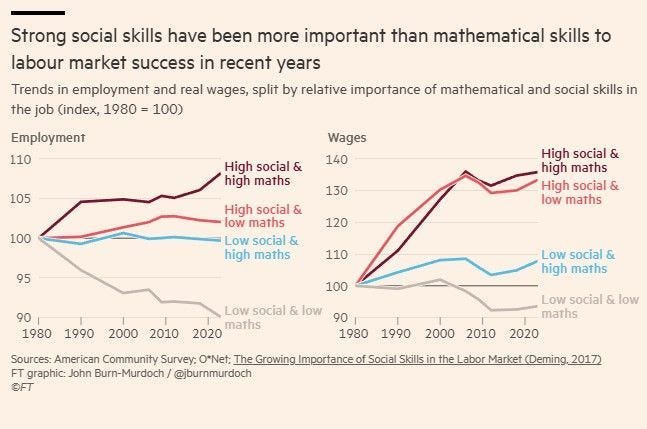
I’m nerding out over a working paper by David J. Deming called “The Growing Importance of Social Skills in the Labor Market”. The thesis is this:
“The labor market increasingly rewards social skills. Between 1980 and 2012, jobs requiring high levels of social interaction grew by nearly 12 percentage points as a share of the U.S. labor force. Math-intensive but less social jobs — including many STEM occupations — shrank by 3.3 percentage points over the same period.
Employment and wage growth was particularly strong for jobs requiring high levels of both math skill and social skill. To understand these patterns, I develop a model of team production where workers “trade tasks” to exploit their comparative advantage.
In the model, social skills reduce coordination costs, allowing workers to specialize and work together more efficiently… Using a comparable set of skill measures and covariates across survey waves, I find that the labor market return to social skills was much greater in the 2000s than in the mid 1980s and 1990s.”
Social skills is the lubricant that helps workers “trade tasks”. It’s similar to how nations use comparative advantage to trade with other nations, thus taking advantage of each other’s different factors of production, technology, and natural resources. Or, if you’d rather play Settlers Of Catan, it’s like finding ways to optimize your natural resources through trade — typically with others players who aren’t a d*ck to you during the game.
Workers that will excel in the decade ahead will be have the following skills:
Social Skills: Being a likable, high EQ person makes you an easy partner to “trade” knowledge with.
Specialist Skills: Having some unique, useful knowledge that you can “trade” to others.
A tech salesperson who’s easy to work with and has deep product knowledge is a no-brainer to bring into any deal cycle. They’ll make more money than someone with neither a depth of knowledge nor social skills.
VI. A Rising Tide Lifts All Ships
Around 120 million ago, bees evolved alongside pollen rich flowers. Today they both play an irreplaceable role in the Earth’s ecosystem. There’s a lot we can learn from bees about the power of teamwork.
By working well with others, you and your colleagues win as a team. 1 + 1 = 3. A rising tide does indeed lift all ships.
End result? Every makes a whole lot of honey (…I mean money).
The obvious exception to this is in professional fields like the medical field (doctors, nurses, pharmacists, etc.), and other professional fields where a credential is required (CPA : Accounts :: J.D. : Lawyers).
Sandy Baum and Jennifer Ma, “Trends in College Pricing 2014,” The College Board, 2014, p. 17.
Specific knowledge was first defined by F.A. Hayek from his 1945 paper, “The Use Of Knowledge In Society” as knowledge that is fragmented, local, and impossible to centralize.
“Today it is almost heresy to suggest that scientific knowledge is not the sum of all knowledge.
But a little reflection will show that there is beyond question a body of very important but unorganized knowledge which cannot possibly be called scientific in the sense of knowledge of general rules: the knowledge of the particular circumstances of time and place.
It is with respect to this that practically every individual has some advantage over all others because he possesses unique information of which beneficial use might be made, but of which use can be made only if the decisions depending on it are left to him or are made with his active cooperation.”