"Man is a tool making animal." — Benjamin Franklin
We learned to control fire 3 million years ago. Then came agriculture 12,000 years ago. Then came the steam-powered engine 300 years ago. Then came computer transistors 50 years ago.
Artificial General Intelligence — an idea first introduced to humanity by way of Talos forged by Hephaestus — can be reduced to a simple equation: Intelligence = Data x Compute. This is known as the “scaling hypothesis”.
Believers think the scaling hypothesis is an irrefutable law. If scaling laws are true, we’ll create Artificial General Intelligence in short order. With enough data centers and pre-training, the march to AGI is inevitable.
Philosophically, this is exactly why John Carmack said that, “AGI is not millions of lines of code. It’s tens of thousands.” It’s not unreasonable to imagine one wicked ‘smaht guy could write the script for Artificial General Intelligence.
For others, myself included, this bitter lesson is a tough pill to swallow because it’s leading to the obsolescence of human knowledge. We continue to feed the Large Language Models more data, more compute. They gobble it up and keep learning faster than we do. “The models, they just want to learn,” Ilya said.
“The models, they just want to learn.” — Ilya Sutskever
But did we ever stop to consider what AGI would mean philosophically? What if humanity’s greatest achievement rendered ourselves useless?
The internet fed our endless drive to learn. Now it feeds AI many times over. And it does not sleep. It does not take breaks. It gobbles up everything and gets smarter. Now we’re building more data centers, feeding it more synthetic data, so that it can beat more intelligence benchmarks… for what?
The thought of a singularity makes me simultaneously excited, nervous, and afraid. I’m excited about how the machines of loving grace could save humanity. Nervous about what could happen if we don’t pace the frontier. And scared of the possibility that man could serve machine, not the other way around.
Despite my fears, I’m scaling pilled. Artificial General Intelligence (AGI) is inevitable — the only question that remains is ‘when?’
After hitting the sauna with my buddy Colby (what’s up Colby), he asked me when I think we’ll reach artificial general intelligence. Per a 2013 survey of hundreds of AI experts, AGI will happen within our lifetime.
Median optimistic year (10% likelihood): 2022 A.D.
Median realistic year (50% likelihood): 2040 A.D.
Median pessimistic year (90% likelihood): 2075 A.D.
It’s more likely than not than we’ll have AGI in 15 years. The 90% median answer of 2075 means that if you’re a teenager right now, the typical AI expert is almost certain AGI will happen within your lifetime.
…Unless AI progress stalls out and we enter our third AI winter.
Skeptics are actually calling for the death of scaling laws. Here’s how it would play out:
“Now you’ve put in all of these inputs, but they haven’t yielded AGI yet. I think these inputs probably would yield an intelligence explosion, but if they don’t, we’ve exhausted our current scale-up of the share of our economy trying to make AI. If that’s not enough, then you have the slow grind of things like general economic growth, population growth, and so on. Progress slows down.
Therefore, the chance of advanced AI happening is relatively concentrated in the next 10 years [between 2024 and 2034] compared to the rest of the century, because we can’t keep going with our current rapid redirection of resources into AI. That’s a one-time thing.” — Carl Shulman
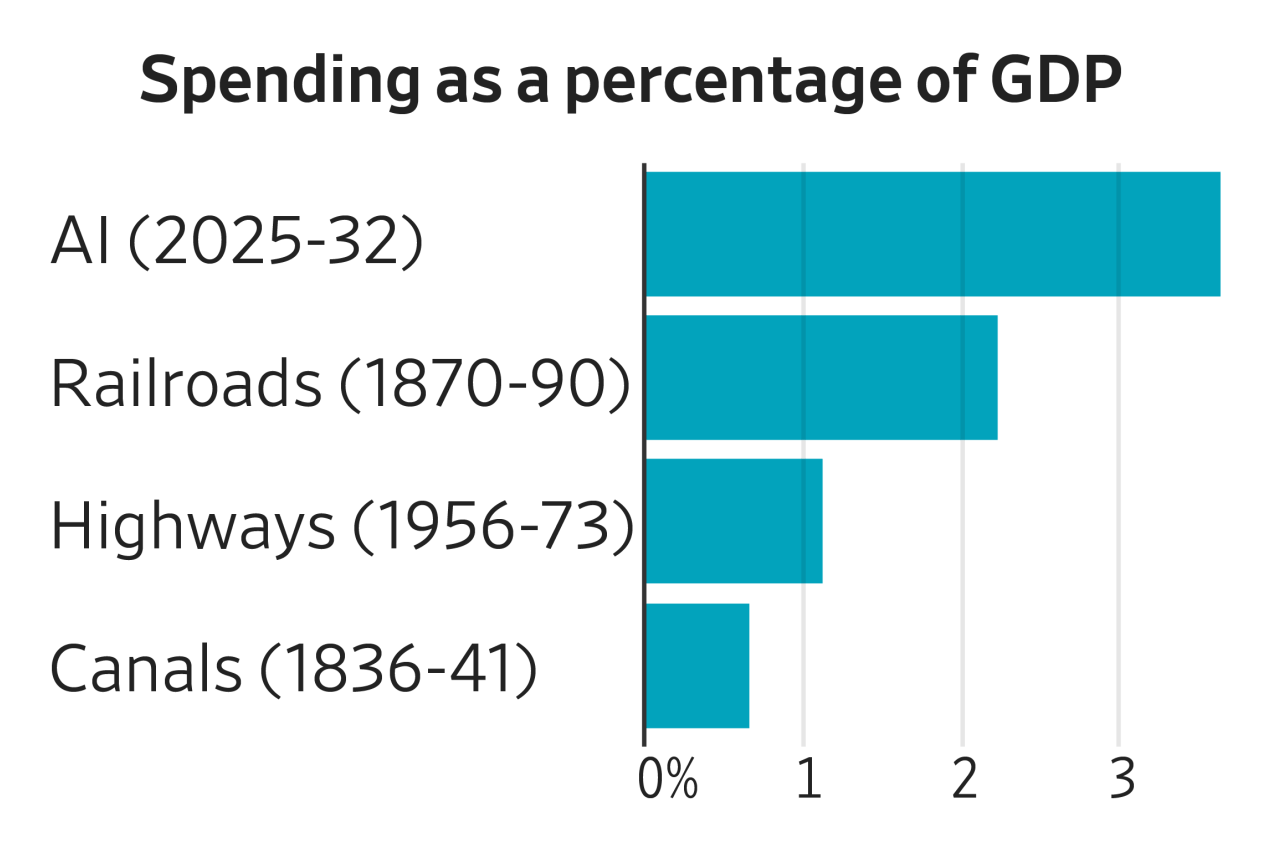
America is betting bigger on data centers than on railroads, highways, or canals. These scaling laws better be true! | Wall Street Journal
America’s betting the farm on the “compute” side of the Intelligence = Data x Compute equation. What happens if it doesn’t pan out?
I see two possibilities:
We get Artificial General Intelligence within a decade.




What a great question by that Colby guy, seems like a smart fella!