
The Simplest Way To Make More Money
The most fool proof way to make more money.

When I was in 7th grade, my Middle School science teacher had one of those corny posters about the iceberg of success hanging up in her classroom.
While she yapped about how the Mitochondria is the powerhouse of the cell, I’d zone out. And day dream about football, girls, and what was for lunch.
What struck me is everything underneath the tip of the iceberg. I was equally amused as I was skeptical. Did success really require hard work, persistence, late nights, and rejections?
At 12, I had no idea. I hadn’t done anything impressive yet. My idea of “success” was running up a kill streak a in Halo: Reach.
A decade and a half later, I’ve come to realize that success does require all those things under the iceberg.

There’s a joke among tech sellers that the best salespeople can never turn it off. They’re always selling.
Whether it’s trying to convince their novice buddy to snowboard at a bachelor party (true story). Or negotiating a flippin’ sweet Valentine’s date to the Field Museum followed by China Town.
I even see it in myself. I’m a Solution Engineer. Which means I’m solutioning all the time, even when I don’t mean to.
There’s a great Mediterranean spot near us called Pita Inn, with a great Kofta Kebab sandwich. Whenever I order it with added potatoes + tabbouleh on the phone, they take the order, and I’m on my merry way to Flavor Town. But when I order in-person, Jerusalem-style isn’t an option.
I spent a full 30 minutes on the way home from church convincing my wife that their Point-Of-Sale (POS) system was the issue. And how they could potentially fix it, resulting in a better customer experience, and heightened loyalty.
See what I mean?
Holding all else equal, the more hours you dedicate to your craft, the better you are. And the better you are at your craft, the more money you will make.
This chart may over simplify the concept. But all else held equal, the more you work, the more money you’ll make.
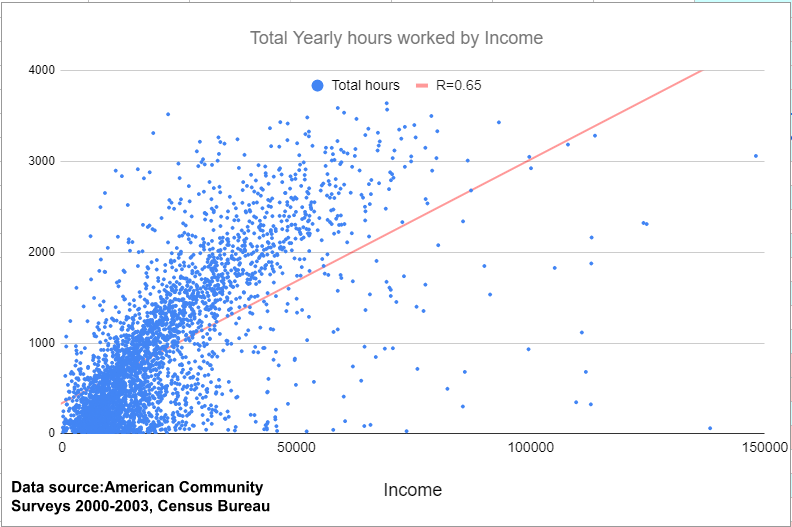
Mastery is one path to higher earnings. Just like the corny iceberg of success poster from 7th grade, mastery requires a lot more beneath the surface. You’d never know how hard the best sellers work when you see them in action because they make it seem so… smooth.
To the outside observer (me), it’d seem like they’re naturally born to sell. And maybe they are. But reason why they’re so good is they’ve spent hours perfecting their craft. Even when they’re not “working”.
And their earnings show it.
It’s best to combine multiple skills into a combination that’s so uniquely you that you’ll be irreplaceable.
The late Scott Adams advised his blog readers to become very good (top 25%) at two or more things. By being very good (though not necessarily great), you will be successful.
Decide what you want to get better at — which is often a moving target over time. And pursue mastery of those things with dogged persistence. Like an olympic athlete competing for a gold medal.
Newton’s First Law of Motion (inertia) states that an object at rest stays at rest. And an object in motion remains in motion, unless acted upon by an external force. Your career is subject to Newton’s First Law.
Inertia works for you when decades of hard work in a specific career path make you highly employable. It works against you when it’s wildly challenging to break into a new industry.
The beauty of work ethic is that it pays compounding results in the future. By working your ass off and parlaying your early wins today into bigger wins tomorrow, your career will compound over time.
With time, all your hard work behind the scenes will pay off.
I’m 29. I’m early in my journey of growing my career, building wealth, and finding joy through it all. I often forget that hard work is the greatest asset to accomplishing all three.
If my 12 year old me could give 29 year old me some advice, while staring at the iceberg of success, it’d be this:
Success is the tip of the iceberg. It’s the result of all the things you don’t see. Stick with it. Keep working hard.
Thanks for reading.
— Grant Varner