

Welp… here we are! Two years of writing later. I owe it to myself and you to unpack my online writing journey, inspired by Joe Hovde’s hundredth post.
One thing all the great writers I look up to have in common is that they’ve put in their reps. A breakdown of my annual blog posts compared to other writers I look up to will reveal that I still have a long (but fun!) road of improvement ahead of me.
Your writing output matters
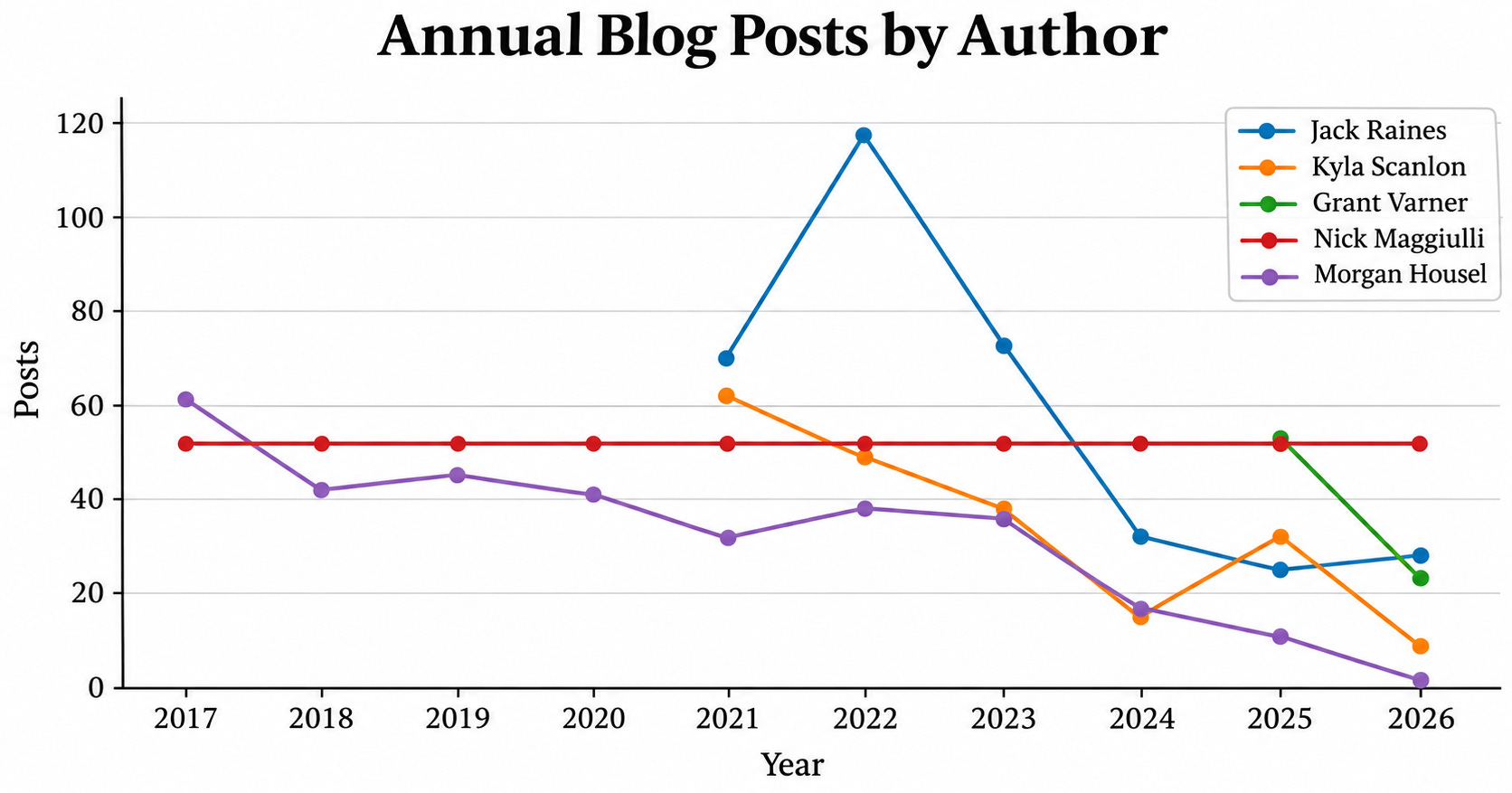
My biggest takeaway from this chart is that your writing output matters.1 Morgan Housel said it better than I ever could (probably because he put in the writing reps):
“There’s no better way to learn writing than repetition. You have to perform the craft to hone the craft. It was a great way to learn just that much volume and repetition.”
Viral posts lead to more subscribers
Looking at posts individually, I had a nice spread of views per post. The full breakdown of my most viral posts is:
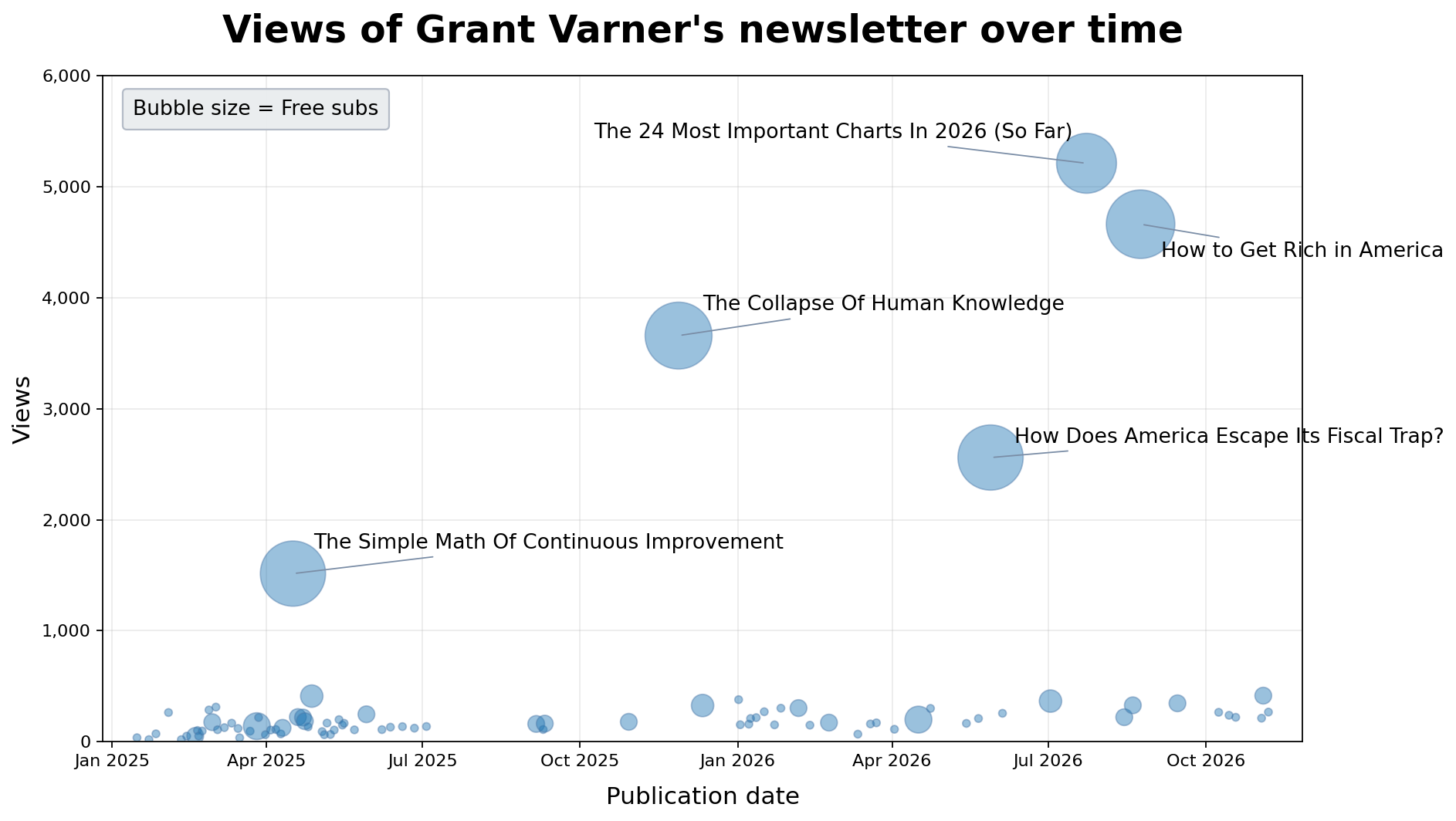
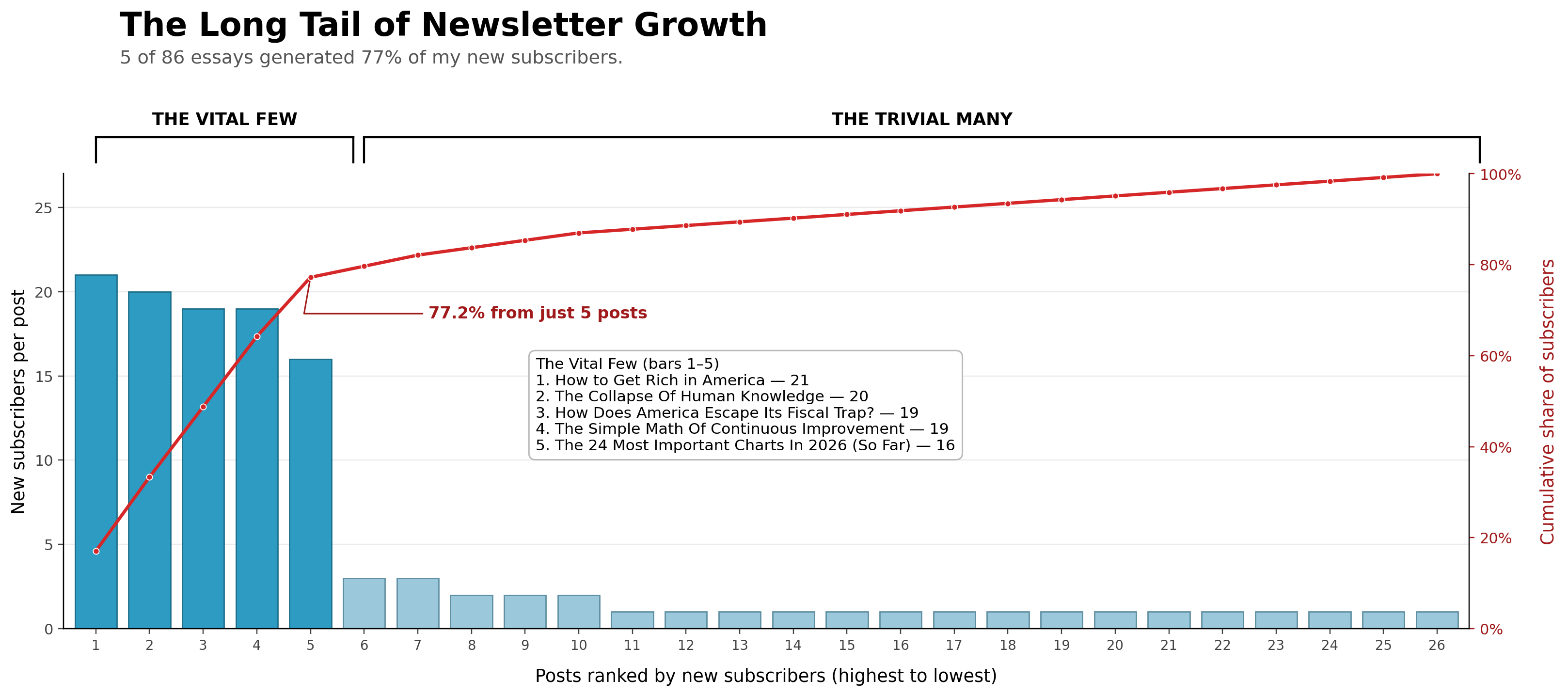
One obvious trend is that more views correlate with more subscribers from that post. This is exactly why I think ‘Shares’ is the most important leading indicator of organic newsletter growth from your posts. Unless you already have a strong distribution channel, getting your post shared is the single best way to grow your subscribers.2 Speaking of which… 👇
Subscriber growth analytics get interesting because there are several channels that you can acquire subscribers from.3 Personally, I’m most interested in which posts get subscribers because that’s a strong signal of quality. Five posts got me 95 new subscribers. By contrast, my 81 other posts only got me 28 subscribers.
Writing is a marathon, not a sprint
Getting good at anything — and especially writing — is a marathon, not a sprint. It’s easy to burn out trying to write a large number of high-quality essays. Better to write at a pace you can sustain.
This is particularly important because (1) I’m married (2) I work a demanding job and (3) I’m married. I only see my free time decreasing over time.
But I still want to get really good at writing. There’s a simple equation to represent my skill at writing: Focused Effort x Time = Skill.4
I could bust my ass by putting in crazy hours of focused effort to reach 10,000 hours in just a couple of years — at the risk of burning out. Or I could spend less time but dedicate myself to the craft for the long term — for at least a decade. That way, I can improve without burning out.
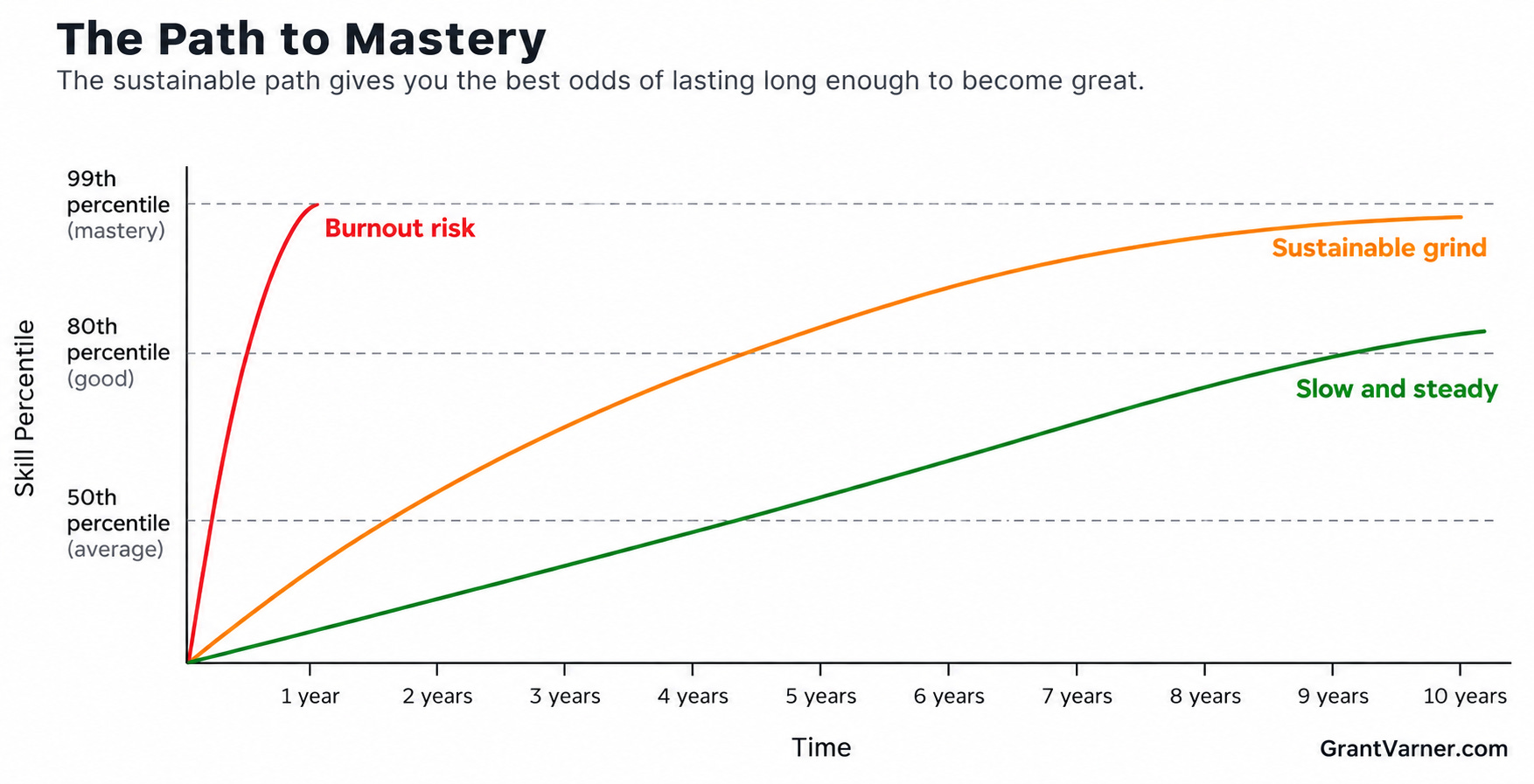
And that’s the goal! Keep my writing output manageable so that I can optimize for longevity. Here’s to another two-plus years of writing online! 🍻
As always… thanks for reading!
— Grant Varner
What I’m up to lately
It feels like every day I read an AI research paper that makes me feel like we’ve fully achieved recursive self-improvement (RSI), and the singularity is just around the corner. Other days, I read a different paper and feel the exact opposite. This paradox was exhausting… until I watched The AI Doc: Or How I Became an Apocaloptimist on Netflix.
I liked how the documentary didn’t take a hard-line stance of ‘AI boom’ or ‘AI gloom’. It felt more relatable to me than just about anything else I’ve read or seen about AI in the last year. 10/10 would recommend!
It’s getting colder here in Chicago, so my wife and I are looking forward to going back to Gus’ Sip & Dip in Chicago for their beef dip sandwich with au jus and cheese curds. Just make sure to get there right before they open up (4 p.m. on weekdays, noon on weekends).
To quote Mark Hanna (played by Matthew McConaughey) in Wolf of Wall Street, those are rookie numbers! I gotta get my writing repetitions up to improve my writing craft.
I’d be remiss if I didn’t credit Nick Maggiulli for his help throughout this process. He reposted two of my articles to his 34,000+ newsletter subscribers. Each time, my website experienced a spike in web traffic:
Interestingly, three posts went viral organically:
For a full breakdown of Substack metrics, I’d recommend this documentation on Substack’s website: A guide to Substack metrics
Where Focused Effort is measured in hours and Time is measured in years.
Interesting breakdown and some great insights as usual. I once saw on a Youtube comment, of all places, that reading is diet and writing is exercise, and of course we need both. I l also like the authors you chose to include in your analysis. What all of them have in common in my mind, it that they are all excellent at talking about things that are mostly old and known, in a very new and simple and interesting way (this influence comes through in your writing as well).
it's also interesting for me to be able to list authors who I 'look up to', who are much younger than me. This is true of Jack and Kyla in particular. I discovered Jack's stuff a few years ago and I think that was instrumental in me starting to put pen to paper. This reminds me that I need to pick up both of their books. I'll order your book too, whenever you get around to writing it. Nice post. Nice job with the consitency!
Congratulations on the progress! And great reflections. Wild to see that straight line of @Nick Maggiulli ’s consistency over the years…Cal Ripken of financial newsletters