

I often get asked how I landed a Solution Engineering job at Salesforce.
The fact that you’re aspiring for a role like this tells me you’re already on track to do great things in your career. But this recurring question is also an indication of a knowledge gap that I can (hopefully) fill for you.
Even if you aren’t dead set on becoming a Solution Engineer at Salesforce, this roadmap can help you become a sought after candidate for any position in tech.
1. Don’t immediately focus on applying; instead start learning.
Sign up for a Trailhead account. And download the Trailhead iPhone app. Complete Trails, rack up points, and get badges.
Rather than wondering what you should learn, go out and learn what genuinely tickles your curiosity. That will take you far in this job search and in your career.
Get at least Ranger status (100 Badges/50,000 Points). This is typically the minimum threshold for Hiring Managers of entry-level SE jobs to take you seriously.
Next, get Salesforce certified. Start with the Salesforce Foundations exams. They cost $75 each and there’s six of them.
Buy a practice test and study guide from Focus On Force, and get studying!
I got hired with Salesforce Sales Foundations (an easy cert) and Agentforce Specialist (a hard cert).
Because the role requires continuous learning, you need to commit to continual learning and certifications.
2. Let others know what you’re learning.
I learned firsthand that getting a tech job is hard in this brutal market. A VP Sales at my last job told me how to get noticed.
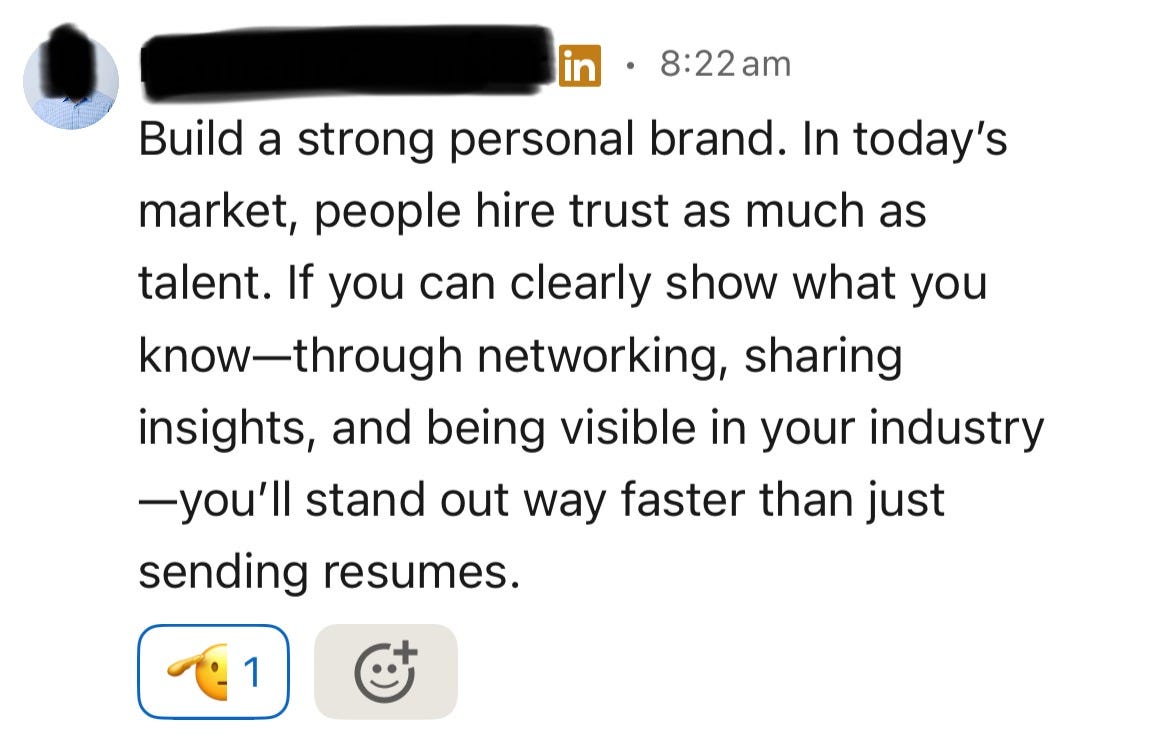
Since you’re actively doing Trailheads, write about what you’re learning on LinkedIn.
This will build trust with hiring managers at scale and help you get noticed faster.
If you’re not sure what to write about, you can:
Write about the topics on job descriptions for roles you want.
Summarize the Trailheads you’re learning. Look at my profile if you want some examples.
Publish your Ranger status and certifications on LinkedIn.
3. Go to in-person networking events.
Going to an in-person networking event?! It sounds old school. But it works.
Join your local Salesforce groups by looking in the Community section of Trailhead.
If you live in a dense city, like Chicago, where I live, there will be a lot. If you don’t live in a dense city, find the nearest city to you.
Go to the events. Learn. Get to know the partners. Exchange LinkedIn profiles. And post about what you learned on LinkedIn.
Follow the Salesforce Marketing Managers on LinkedIn (Kyren Wong, Kaela Altman, Joel Primack). They will post about virtual Community Meet Ups, which you should attend.
4. Talk to hiring managers because they make hiring decisions.
Don’t waste your time on informational interviews (including talking to me). I don’t make hiring decisions. Hiring managers make hiring decisions.
Don’t waste your time reaching out to recruiters, either. If a hiring manager wants to hire you, you’ll breeze through the phone screen anyways.
Do you see a theme? Get in front of managers by sending LinkedIn DM’s with your new Salesforce-optimized profile.
Diversity is a guiding principle at Salesforce. There are managers of many backgrounds and walks of life. Find someone whose background is similar to yours and reach out.
Here’s an example of a good cold networking message:
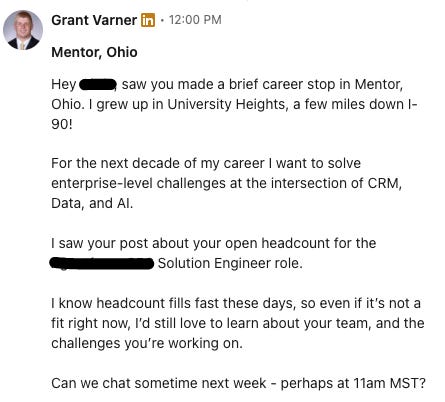

Don’t reach out to 2nd line and 3rd line managers, either. Hiring managers aren’t as keen about new hires that have been passed along to them by their boss or their boss’s boss.
Measure your success by how many coffee chats you set up with hiring managers.
5. Interview like a pro.
The pinnacle of Salesforce’s SE interview process is a 60-minute panel demo presentation. It’s meant to condense the entire SE role into a concise evaluation of your ability to demo.
This was the slide deck I used for mine.
You’ll also get paired with a current employee on the team you’re interviewing for.
Meet with them daily to validate your thinking, course correct you, and ensure that you’re on the right track. They will steer you the right way.
The panel demo presentation is how they decide whether you’re a “yes” or “no” decision, so make it count.
6. You can do it.
When it comes to tech sales, it’s less a matter of “if” you’ll get a job, but more so a matter of “when” you’ll get a job.
Once you’ve proven you have the hard qualifications by posting your learnings on LinkedIn, you have enough to get your foot in the door.
Now you have to prove it by selling the best product out there: you.
How To Connect With Me
Thanks for reading. If you still have questions, don’t hesitate to reach out.
— Grant Varner
This is quite interesting, slightly surprised that you put Trailhead & community events at the center, isn't the SF ecosystem so mature that you can probably build+prove expertise by doing projects etc. with solution partners and the like as well? I know Hubspot definitely hire a lot of Solution Partner folks and there are a lot of them so seems plausible?
Nice post! Curious, why did you decide to move from sales to se?