

I. Beating The House
Gonzalo García-Pelayo became a millionaire playing the roulette wheel.
In the early 1990’s, he gathered & analyzed roulette wheel data at the Casino Gran Madrid.
With enough data, he figured out how small imperfections in each roulette wheel tilted the odds in favor of landing on a few specific spots. Whereas a spot on a typical roulette wheel has a 1-in-37 chance of hitting, he found that some had up to a 1-in-30 chance of hitting.
He used this strategy to win over $1.5 million. Gonzalo monetized on specific knowledge he had acquired.

II. Specific Knowledge
Specific knowledge is a unique, personal expertise that can’t be taught. It’s built through passion, innate talent, and curiosity — the type of stuff they don’t teach you in school. It’s important to understand specific knowledge because it can help your market value reach astronomical heights. But first, where’d that term even come from?
Frederick Hayek popularized the idea of ‘specific knowledge’ in 1945 with his article The Use Of Knowledge In Society. His thesis is that many types of knowledge are fragmented, local, and impossible to centralize.
“Today it is almost heresy to suggest that scientific knowledge is not the sum of all knowledge.
But a little reflection will show that there is beyond question a body of very important but unorganized knowledge which cannot possibly be called scientific in the sense of knowledge of general rules: the knowledge of the particular circumstances of time and place.
It is with respect to this that practically every individual has some advantage over all others because he possesses unique information of which beneficial use might be made, but of which use can be made only if the decisions depending on it are left to him or are made with his active cooperation.
We need to remember only how much we have to learn in any occupation after we have completed our theoretical training, how big a part of our working life we spend learning particular jobs, and how valuable an asset in all walks of life is knowledge of people, of local conditions, and of special circumstances.
To know of and put to use a machine not fully employed, or somebody’s skill which could be better utilized, or to be aware of a surplus stock which can be drawn upon during an interruption of supplies, is socially quite as useful as the knowledge of better alternative techniques.
And the shipper who earns his living from using otherwise empty or half-filled journeys of tramp-steamers, or the estate agent whose whole knowledge is almost exclusively one of temporary opportunities, or the arbitrageur who gains from local differences of commodity prices, are all performing eminently useful functions based on special knowledge of circumstances of the fleeting moment not known to others.”
Hayek is saying that there’s highly unique forms of knowledge. On a supply and demand curve, these kinds of knowledge are in low supply. If that unique knowledge also happens to be in high demand, then you have a niche you can capitalize on to increase your earnings.
If you have deep & rare knowledge in something that’s not commercially in demand — like knowledge of Pokemon cards, your market value won’t be that high. Likewise, if you have expertise in something saturated — like a bachelors degree — your market value likely won’t be as high, either. The sweet spot is having expertise in area that’s both high demand and low in supply. That’s where the price for your time (your salary) will be highest.
Because everyone has different backgrounds, experiences, and hobbies, everyone has specific knowledge that’s unique to them. The acquisition of knowledge is straightforward — by pursuing your hobbies and genuine interests. For example, when I was a kid I loved building LEGOs. Today, there are YouTubers who document their LEGO builds. There are also authorized LEGO resellers who’ve built businesses that combine their passion for LEGO with a profession.
If a young Grant Varner wanted to start a project like this, I’d have to combine multiple forms of specific knowledge to be successful. Like how to start a brick (pun intended) and mortar retailer. Or how to edit videos. Here lies a valuable lesson:
Combine multiple forms of specific knowledge to increase your market value.
And I’m not talking about getting another masters degree. I mean specific knowledge, the kind you acquire by going down rabbit roles by your own volition.
The AI boom in tech is a great example of the commercial opportunity of specific knowledge.
III. Market Value in Tech
I’ve worked through several innovation cycles within the tech industry: First, it was IoT (Internet of things). Next, it was CDP (Customer data platform). Today, AI (not gonna define that) is all the rage. It can pay really well if you can find a genuine interest for long enough to develop legitimate experience.
Many companies have a desire to use AI to become ‘agentic enterprises’. But tech talent for people who actually understand enterprise AI is scarce. As a result, Forward Deployed Engineering jobs are up 1,165% because AI Agent deployment is hard to do. There’s a lot of money out there for anyone willing to put in the time to learn.
Just look around. Tech companies are dropping millions to hire AI native grads. Which is bananas — but hey, that’s supply & demand. Some AI researchers are even negotiating $250 million pay packages, as if they were pro baseball players. There’s a ton of opportunity in agentic AI. Merely being in an AI exposed role can accelerate your earnings.
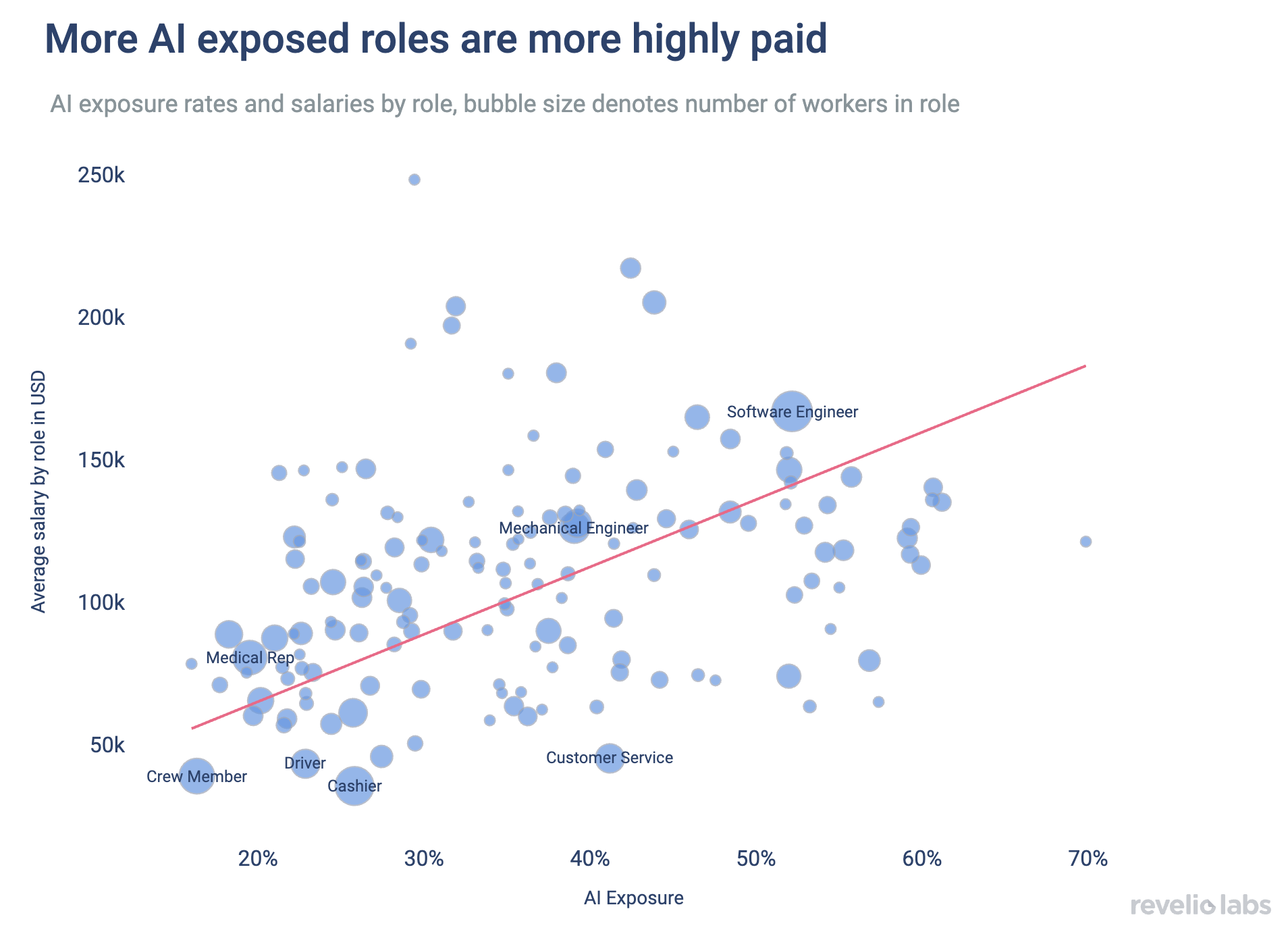
This knowledge on the bleeding edge of new technology is just one example of the vast sum of information floating around out there, that’d be highly profitable to have. By acquiring nuanced knowledge in specific areas you can increase your earning potential. Many of the skills needed in AI today are new. Just about anyone with a laptop and the desire can land a lucrative role.
So there’s a lot of money to be made in the ‘AI gold rush’. How do you get in on the game? The 2025 Future of Jobs Report by the World Economic Forum suggests that while hard technical skills are useful, marketable, and lucrative — so are a growing number of soft skills.
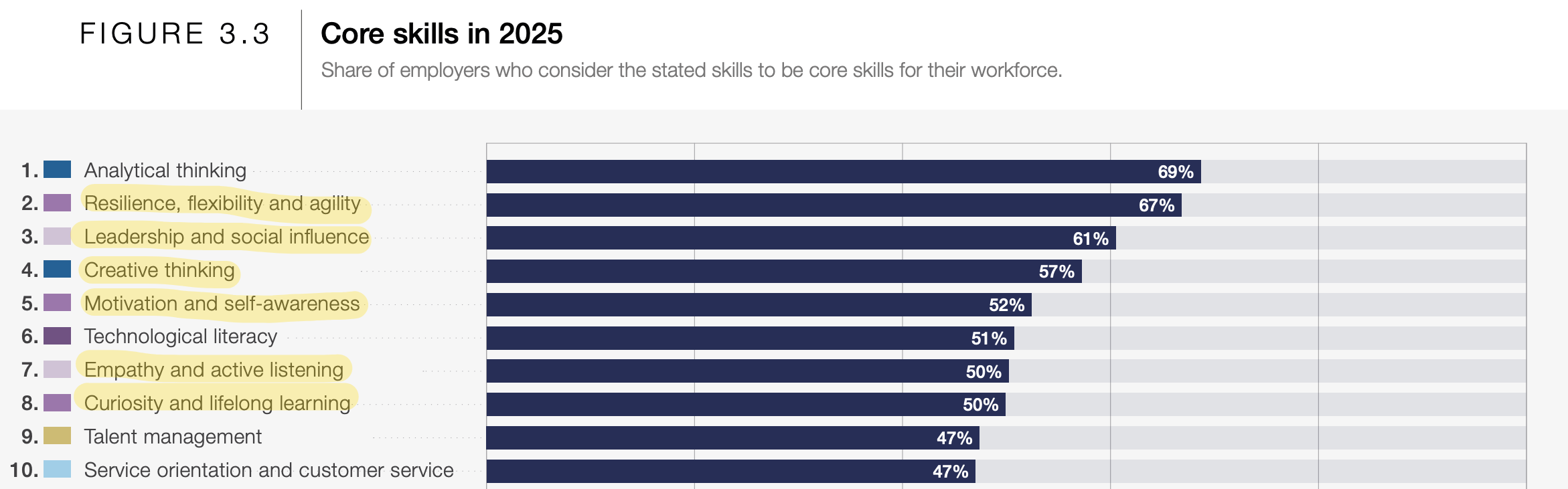

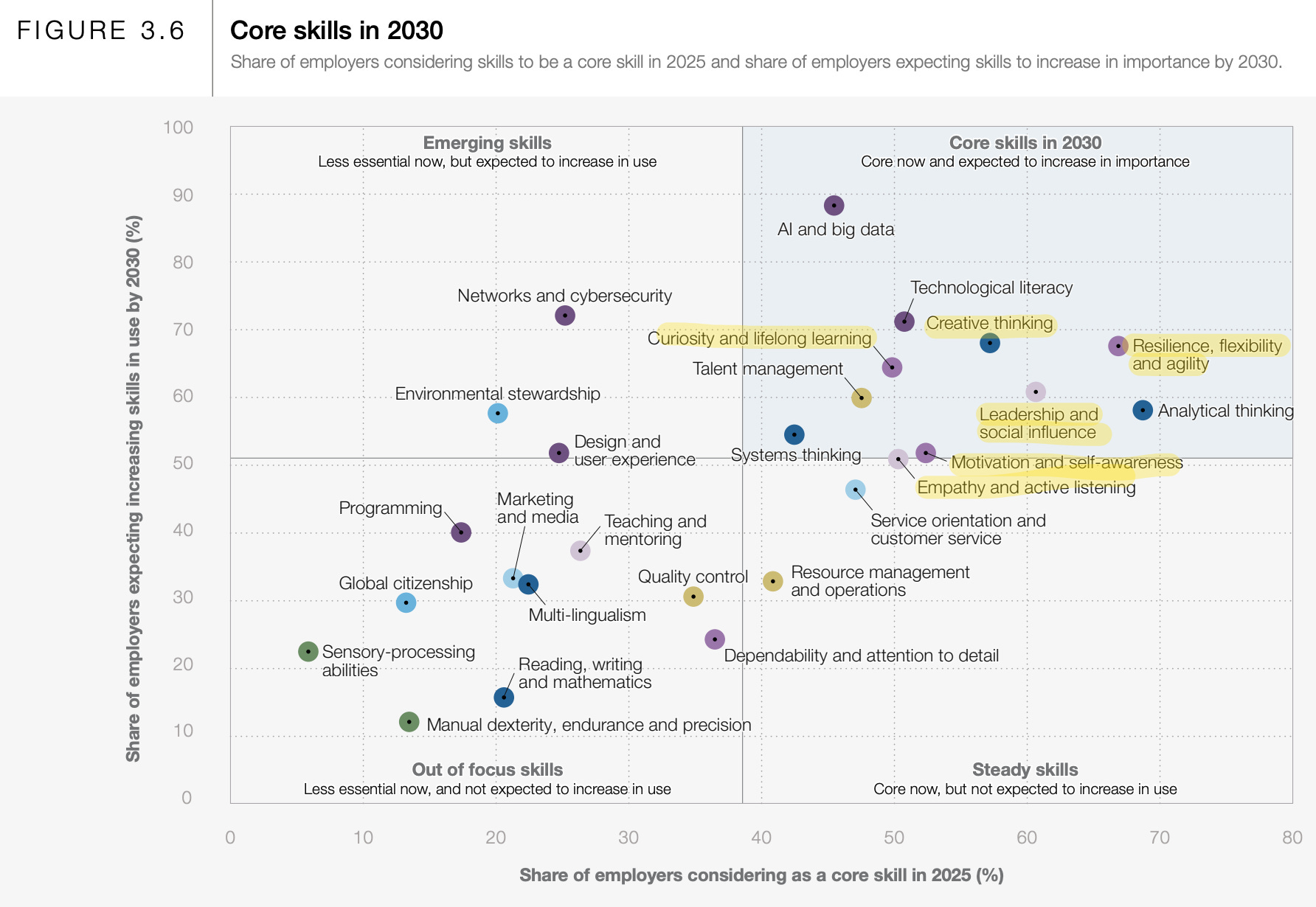
This report has been my North Star for how I’m thinking about the future of skills. Tech hiring managers are seeking the ability to learn new technology fast, rather than actually knowing those technologies right now. Having an aptitude for curiosity and lifelong learning (which also happens to be the #8 on the 2025 future If Jobs Report) is also a top priority, too. 1
And it makes sense. AI’s made it possible for big tech companies to shorten their release cycles, making it more important than ever to learn new tech fast.
To my surprise, creative thinking is also an in-demand skill on the report. Tech is evolving so fast that you need technically fluent people good at communicating a story both orally and in the written form. What’s more, the emergence of AI writing suggests that being capable of writing convincingly about technology will become more rare with time.
IV. To Sum It All Up: Work Hard
Career advice today is harder than ever. Some parents who work in tech are encouraging their kids to go into the arts. Others think the trades might be a path that’s safe from AI. Regardless of path, Thomas Jefferson was spot on when he said, “I find that the harder I work, the more luck I seem to have”. When in doubt, working hard will yield opportunities in the long run.
Even without a clear game plan, if you work hard, you’ll learn new skills and acquire specific knowledge.
Gonzalo García-Pelayo, the roulette winner from earlier, used the information he acquired to become a millionaire. Though unconventional, that’s how it works. Acquire information. Use that information to earn. Rinse and repeat.
It reminds me of that scene from Ocean’s Eleven, where Rusty (played by Brad Pitt) asks Danny Ocean (played by George Clooney) why he’s targeting a particular casino for a Las Vegas heist.
Rusty: …I need the reason. Don’t say money. Why do this?
Danny: Why not do it? ... Because the house always wins. Play long enough, you never change the stakes, the house takes you. Unless, when that perfect hand comes along, you bet big, and then you take the house.
V. Going All In
Roulette is a gamble. So is life. The more information you have, the better your bets will be.
The Venture Capital model relies on a few massive winners. 1, maybe 2 startups out of 20 will generate most (or all) of a fund’s returns. Life works the same way. A select few key bets during your life produce asymmetric returns.
When you get that high conviction feeling about something, put all your chips on the table and go all in. Because that’s when you get outsize returns.
Thanks for reading.
— Grant Varner
Ultra Learning (2019) by Scott Young was a prescient book that lays out the road map for learning new things fast. I wrote a review of it, and it’s worth checking out.

Good point about emphasizing hard work. It really is a skill to stay optimistic in the face of uncertainty. A virtue I admire in others. Keep it up 💪.
Use what you know to your advantage.