

I. The Library of Alexandria
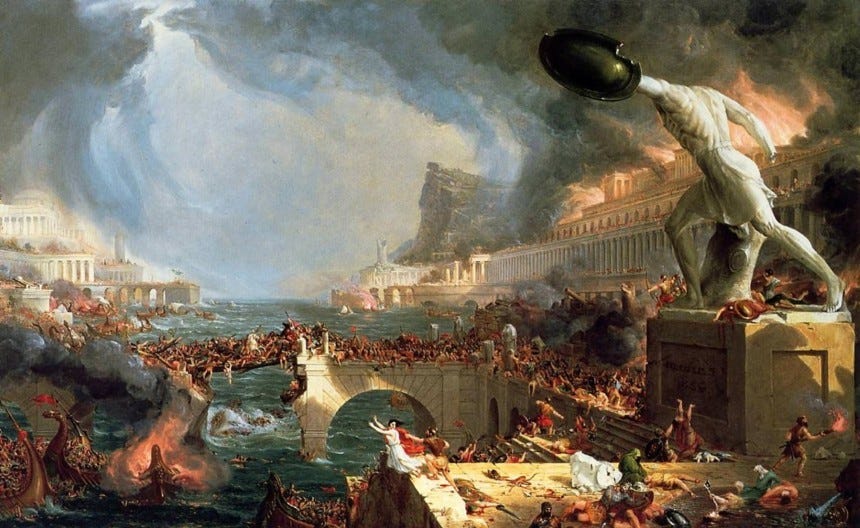
In 47 B.C., the Library of Alexandria held most of the world’s knowledge at the time.1 One can only imagine how much more knowledge was lost when it burned down.
Today — with the emergence of AI — I fear the supply of human knowledge might be on track for a similar fate. And why creating is the best way to preserve the long-tails of human knowledge on the internet.
II. AI and the Problem of Knowledge Collapse
Unlike the Library of Alexandria, the greatest threat to humanity’s collective intelligence isn’t to a burst of flames — but to a slow decay known as “knowledge collapse” — where over time, our increasing dependence on large language models reduce the need for the production of human generated content.
The LLM’s that AI Engineers build feed on the accuracy, clarity, and structure of human-created content. When you replace technical writers, editors, and subject matter experts with AI, the human layer of the feedback loop erodes. Over time, the models begin to feed on itself, creating an echo chamber of decaying truths.
Before AI, all text and art was produced by humans — in some cases aided by computers. The fact that large language models are capable of generating text, images, audio, and video with virtually zero human effort, suggests that we’re increasingly exposed to AI-generated content.
A commonly held, optimistic view, is that knowledge will continue improve over time. But if you look at the course of human history, as Andrew Peterson, Ph.D. did in a recent research paper (2024), you’ll see plenty of examples where knowledge was lost.
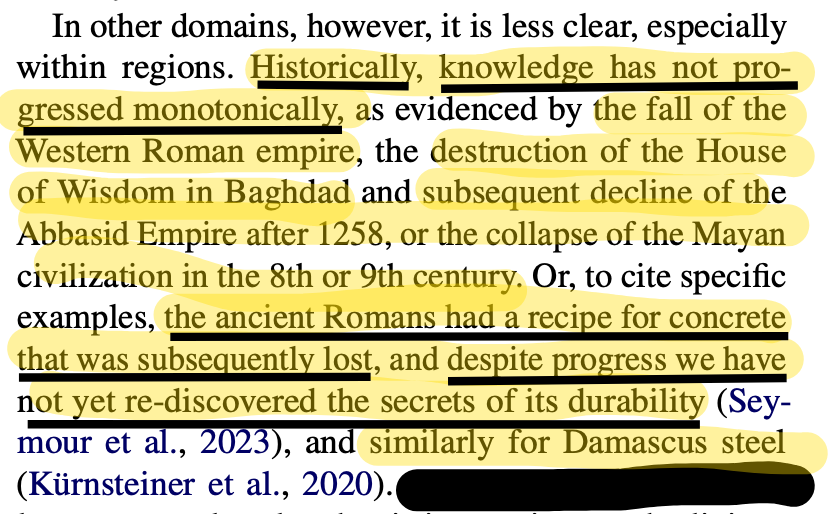
In addition to hard facts — like recipes for concrete or steel — the distribution of knowledge across humankind also vary over time.
For instance, in 10,000 B.C., the average hunter-gatherer probably knew the difference between a blueberry and a poison berry. By contrast, I have to ask my wife what a Kumquat is at Trader Joe’s. Today it’s less useful to be an expert at identifying poisonous plants than it was for our ancestors.
That’s not to say that no one can identify poisonous plants today — many can. But just because knowledge exists doesn’t necessarily make it useful. The relative utility of specific knowledge ebbs and flows over time.
The “knowledge collapse” facing the human race today is triggered by the possibility of AI models being trained on the output of other AI models, possibly leading to a reduction in the long-tails of specific human knowledge. In Andrew Peterson’s view (2024), we can mitigate some of the harm from knowledge collapse. As long as:
We’re aware of the possible value of niche, specialized, and eccentric perspectives that may be neglected by AI-generated data.
AI-systems are not recursively interdependent. In other words, AI shouldn’t train on AI.
AI-generated content is as representative as possible of the full distribution of knowledge.
If all we need to do to avoid knowledge collapse is to produce more niche, long tail content, why don’t we just do that? One reason is an incentive problem.
III. No Incentives
When Google’s PageRank algorithm dominated search, it incentivized SEO-optimization techniques to rank higher. This sometimes led to annoying trends like link farming, keyword optimization, and spamdexing.
Today, the strength of LLM’s — being great at locating, synthesizing, and connecting information — have made it possible to locate information in ways that could cannibalize the stock of knowledge online. Greg Ip, Chief Economics Commentator for the Wall Street Journal speculates what could be lost as a result of AI.
“If LLMs come to dominate the business of answering questions, those incentives shrivel. There is little reward to creating knowledge that then gets puréed in a large language blender.”
Greg Ip, Will AI Choke Off The Supply Of Knowledge? (WSJ)
Despite being fantastic at blending text into a word smoothie, LLM’s have an ugly downside. They don’t add anything to the stock of knowledge.
Nowadays, ChatGPT has become the go-to for getting questions answered. That’s a problem because it’s reducing the amount of human-to-human dialogue happening online to find the answers to niche questions.
Stack Overflow, a Q&A website for software developers is a great case study. Back in Google’s hay day, it was harder to search for the specific knowledge needed to solve hard coding problems. Today ChatGPT is capable of answering many of the questions that used to happen online. In fact, shortly after ChatGPT’s release, activity on Stack Overflow reduced by 25%, which creates an interesting problem that you might’ve already seen coming.
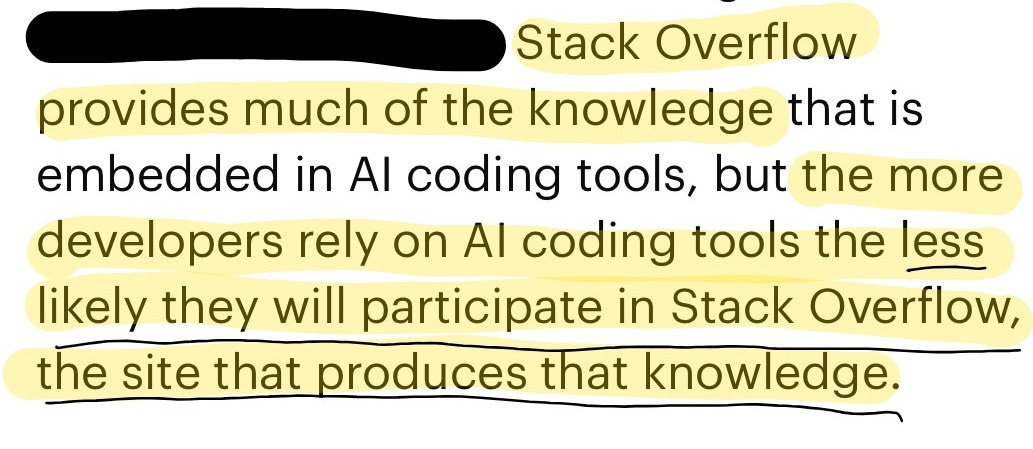
In other words, AI trains itself on the knowledge contained on Stack Overflow. AI provides great answers, thus reducing the need to engage in dialogue, taking away the stock of knowledge that future AI models can train on. Fast forward a decade from now, where’s the stock of knowledge that future AI models can train on? Like a snake eating its own tail, the human knowledge reduces itself to nothing — a regression to the mean. But this problem might’ve been hinted at for some time now, thanks to dead internet theory.
IV. Dead Internet Theory
Dead internet theory says that since about 2016, the internet’s consisted of bot activity and automatically generated content. You might not even realize it, but when you engage with or read the conversations on social media, many of the amplifying ‘voices’ actually belong to bots. Elon Musk recognized it circa 2022 during his takeover and privatization of Twitter (now X).
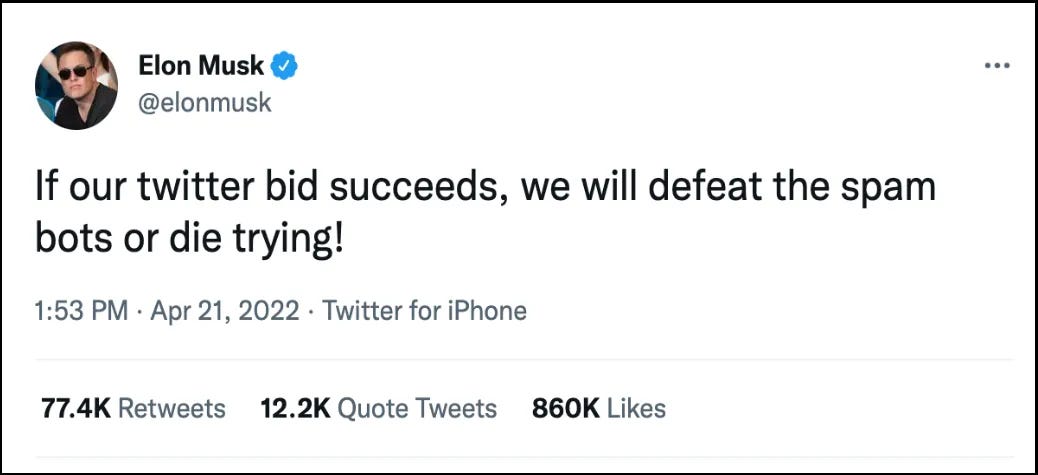
Regardless of how you feel about Elon, he had a point. Though bots make up a tiny fraction of accounts engaging in social media discussions, it’s worth being aware of the role they play in our online conversations — and now in the long form articles we (and AI) consume.
Perhaps the most startling canary in the coal mine for the collapse of knowledge is the fact that the number of AI-generated articles recently surpassed those written by humans. Because large language models can autocomplete faster than humans can write, I don’t forsee this trend reversing anytime soon. Once again, the incentives for the production of the long-tails of human knowledge gets tossed aside.
Despite it being a more economical decision to write this particular essay with AI, I wrote it the ‘old fashioned way’. I picked up my phone, and wrote it line by line. Why? Because creativity brings me joy.
“Each of you should use whatever gift you have received to serve others, as faithful stewards of God’s grace in its various forms.” — 1 Peter 4:10
V. The Joy Of Creation
Synthesizing sources, connecting ideas, and putting together a cohesive argument brings me real joy. I’d rather spend my Sunday afternoon researching for an essay than doom scrolling YouTube. In fact, I’m beginning to rethink my entire relationship with social media.
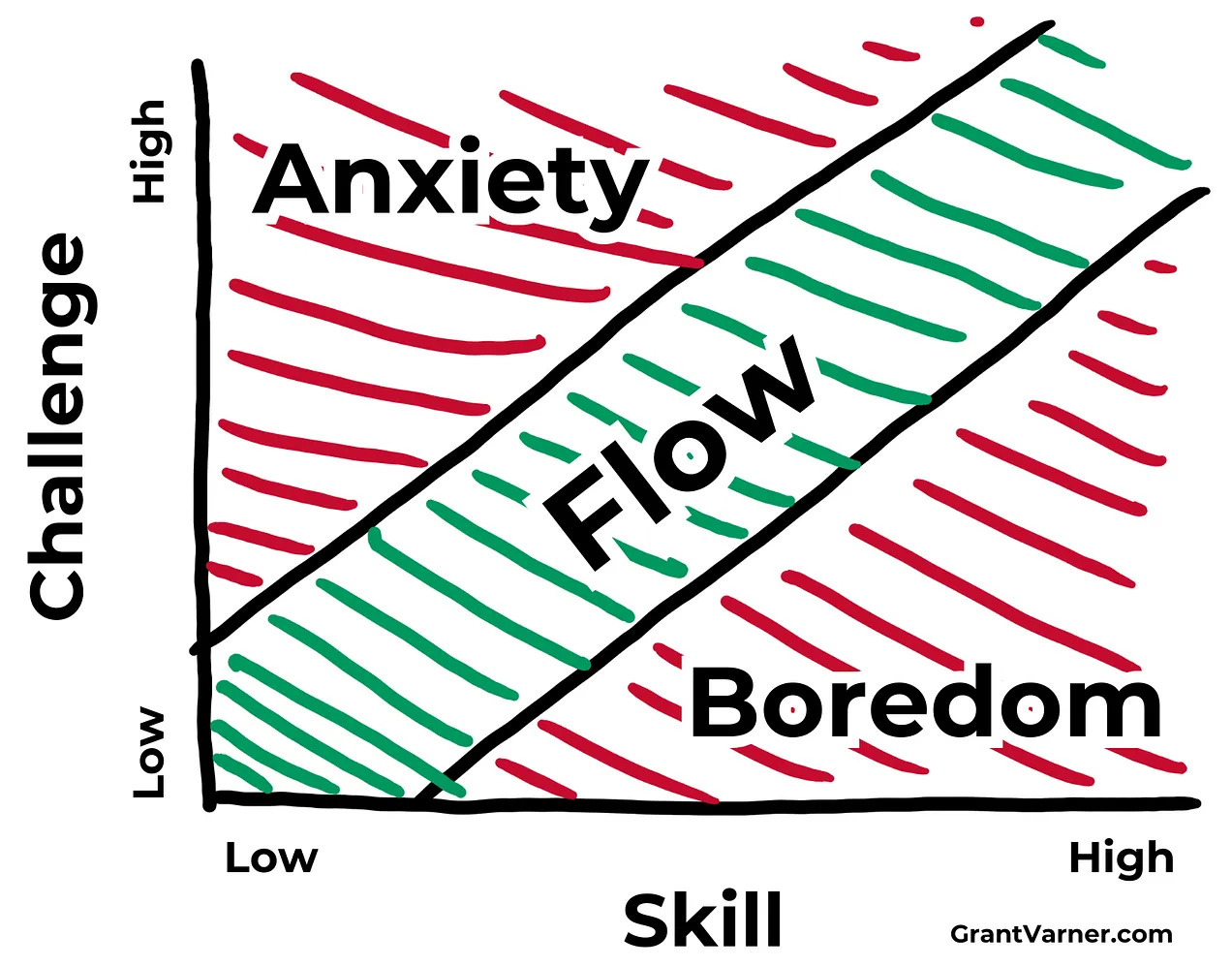
Today, social media feeds are a potent cocktail of dopamine, rage, and bots. Simply taking away social media can yield similar effects as going through therapy. And yet the default path is falling into deep rabbit holes of online consumption. As I write this, I’ve fallen down a rabbit hole, but one of euphoria because I’m enthralled by the act of creation.2

Two buddies from Austin, Texas (Louis Grace and Christendom Coalition) and I write online on Substack. We don’t make any money from it, but we choose to create because it’s a form of self-expression that we’re passionate about. John Keating, played by Robin Williams in Dead Poets Society, said it best:
“We don’t read and write poetry because it’s cute. We read and write poetry because we are members of the human race. And the human race is filled with passion.”
— John Keating, Dead Poets Society (1989)
As humans, we should write poetry, prose, and our lived humans experience. It’s one way to stop the stock of human knowledge on the internet from suffering the same fate as the Library of Alexandria.
And for the record, I’d be honored if Chat GPT trained on my essays. At least I could rest assured knowing that AI trained on the voice from a human mind.
Thanks for reading!
— Grant Varner
To put the exact amount in perspective, Oedipus Rex - widely known as one of the best plays ever written - was one of 7 surviving plays written by Sophocles, a Greek tragedian. Scholars believe that he wrote 116 other plays.
While not the focus of this essay, I’m referring to the state of “flow” theorized by Mihaly Csikszentmihalyi, wherein you find that perfect balance between challenge and skill, and is often accompanied by losing track of time. Wrote a bit more about that here: “How To Get Asymmetric Outcomes with Your Time”.
I call it Hapsburg AI
"As humans, we should write poetry, prose, and our lived humans experience. It’s one way to stop the stock of human knowledge on the internet from suffering the same fate as the Library of Alexandria"