

At a Chicago meetup for readers of Scott Alexander’s Astral Codex Ten, we talked about falling birth rates.1 In my small group, the conversation kept returning to the practical solutions to the fertility problem: Where could we afford enough space for kids and still live close to work and family?
U.S. fertility was already falling in the 1800s
Census data put U.S. fertility at about seven births per woman in 1800 and just over two by 1940.
In 1800 95% of Americans were farmers. Back then another child meant another pair of hands for the farm. The shift away from an agrarian society is one explanation for why American families got smaller.
What does “modernity” explain?
In Terra Incognita: The Economics of a Shrinking World, the authors suggest that modern life makes a third child more costly, thus making it easier to choose to stop trying after two kids. Our group wanted to know what about our own personal situations mattered most.
“Modernity”, per Terra Incognita: The Economics of a Shrinking World, is the catch-all term for everything that’s to blame for the fertility problem nowadays. We collectively found issue with this argument because it doesn’t actually point to one specific thing!
As Lyman Stone points out in We Actually Know a lot About Fertility Decline:
“At a bigger level, we need a better theory of social change. People often have theories that go like this:
Mechanistic Cause—>Mechanistic Effect
Cool, right?
A more plausible model of the world, however, is:
Probablistic Cause→Probabilistic Effect Which Sets Conditions For a Complementary Probabilistic Cause→Probabilistic Effect”, and so on…
Stone’s point is that several different changes can reinforce one another. Which makes me wonder which technologies have changes the cost of raising kids.
Fertility is higher in some Amish and Hasidic communities
Our group wondered whether having relatives and neighbors nearby makes it easier to start a family earlier or have more children — earlier and in higher quantities!2

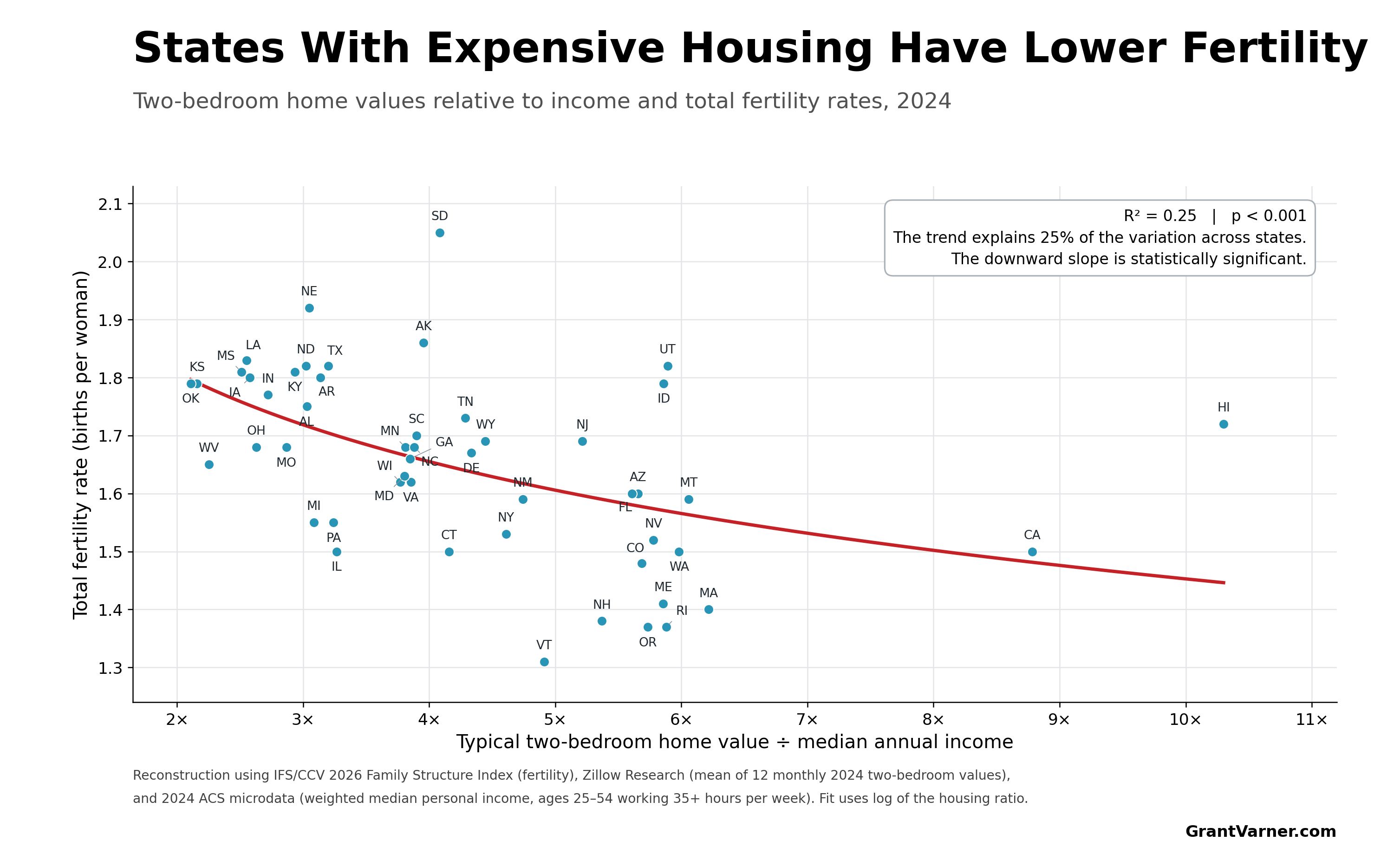
States with less affordable housing tend to have lower fertility
Housing was the most common reason why everyone in my discussion group have put off having kids.
Most of us live near work. But our parents live in the suburbs or in other cities. Moving closer to family could also mean changing jobs.3 We also agreed that space is a concern. Most of the group lived in an apartment juuust big enough for our spouses and us. We pretty much collectively agreed that being in a slightly bigger space was a prerequisite for having kids.
In 2024, states where two-bedroom homes cost more relative to income tended to have lower fertility rates. The fitted trend accounts for about 25% of the variation in fertility rates across states.
The tradeoff we kept coming back to
The tradeoff our group kept coming back to was simple. Moving closer to family could make it easier to raise kids, while moving farther from work could make the rest of life harder.
Grant’s personal observations
My buddy Louis has described me as an “intellectual cosplaying as a football player”. He’s right. I felt equally at home among the truth-seeking rationalists as I did among the squat racks at South Loop Strength.
Drop a comment if you have anything to add, refine, or general feedback on this essay. I’m always open to improving the quality of my thinking. 👇
As always… thanks for reading!
— Grant Varner
You might also like…


I didn’t want to clutter this blog post with every single source of required reading/listening. So here they are!
Terra Incognita: The Economics of a Shrinking World (Jesús Fernández-Villaverde and Patrick Norrick)
The Great Fertility Collapse (EconTalk podcast)
We Actually Know a Lot About Fertility Decline (Lyman Stone)
The Fertility Crisis Isn’t Just for Rich Countries (City Journal)
By contrast, everyone in my small group (myself included) lived away from our parents who mostly lived in the suburbs of another city or state. We each recognized that living in the suburbs would be a better situation for having kids, yet we each had our own reasons for staying downtown.
For me, the allure of downtown is a short commute to Salesforce Tower. Last year, I commuted two hours each way, three days a week. It grinded me down until I was a shell of myself.
For example, my family has deep roots in Columbus, Ohio. There are a ton of jobs if you work in the healthcare industry. Some if you’re in real estate or finance. But for my career in B2B SaaS sales, there’s less of a market. All those jobs typically gravitate to so called “tech hubs” — places like New York, San Francisco, Chicago, Denver, and Austin — where tech talent clusters.
Its partly a crises of expectations like you mentioned. Plus many of us reflect at our own coming of age with resentment.
American daycare and public schools have proven themselves untrustworthy. If having kids means I must send them there, I would rather save $$$ for private school.