

In the 1960’s the late John Hayes, a psychology professor at Carnegie Mellon wanted to know how long it took to become elite at your craft.
He developed a list of 500 musical masterpieces from 1685 and 1900 — written by famous composers like Beethoven, Bach, Mozart.
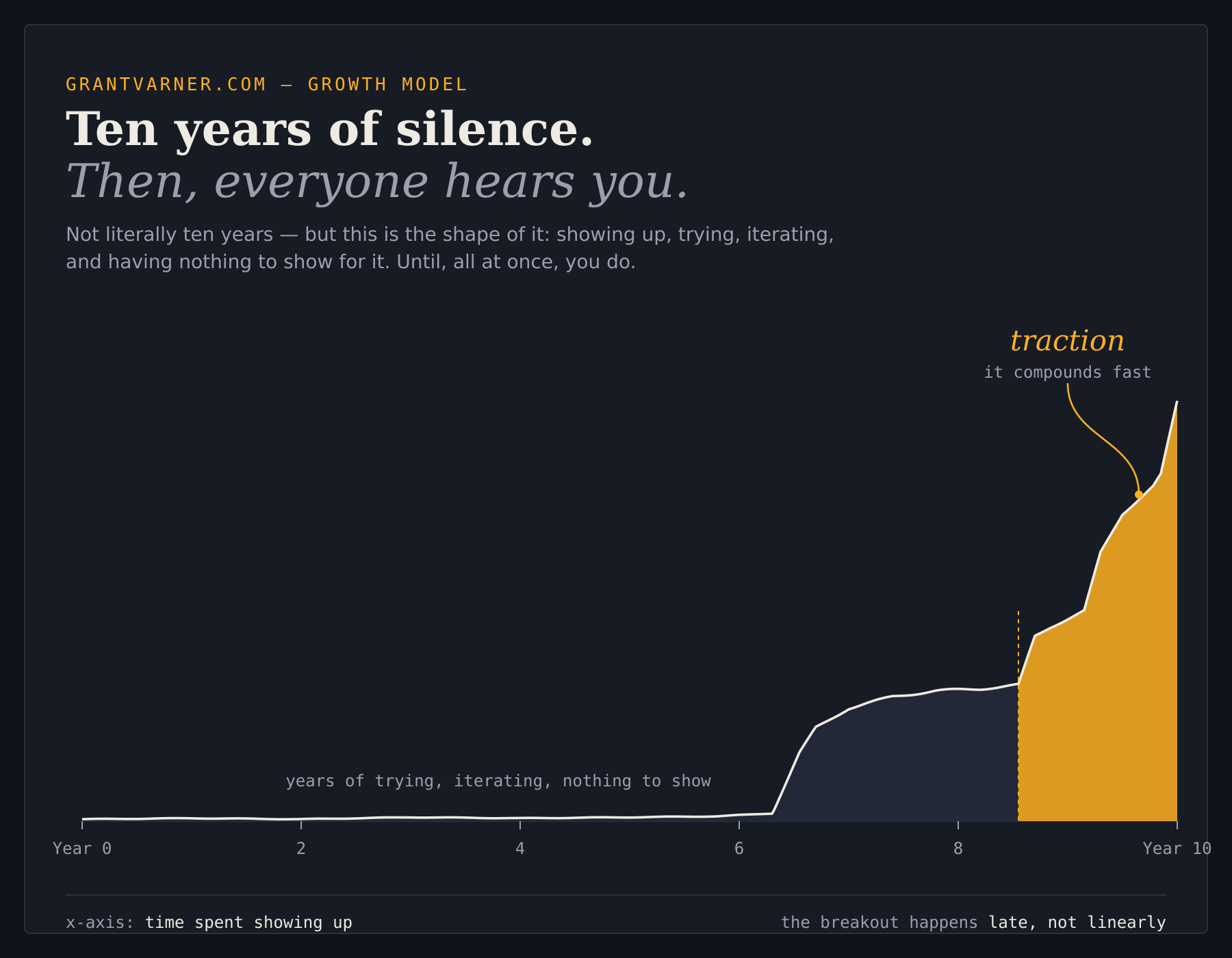
In almost every case, it took a decade of producing music with zero recognition until they made a masterpiece. Hayes called it “ten years of silence.”1
Blogging is a perfect example…2
The Myth Of Overnight Success
Most bloggers write for ten years with little recognition to show for it. All of a sudden, they become an ‘overnight success’. But the luster of the New York Times best seller shines so bright that it’s easy to forget the decade of practice required to get there.3

To Nick Maggiulli’s point, overnight successes rarely happen overnight. It takes a decade of iteratively improving your craft with deliberate practice.
Every time you hit ‘publish’, ask yourself, “What’s one thing that would’ve made that better?” With enough repetitions, you’ll write well enough that someone who isn’t your mother will want to read it.4
If you’re good (and a little lucky) 5% of what you create will be truly remarkable.5
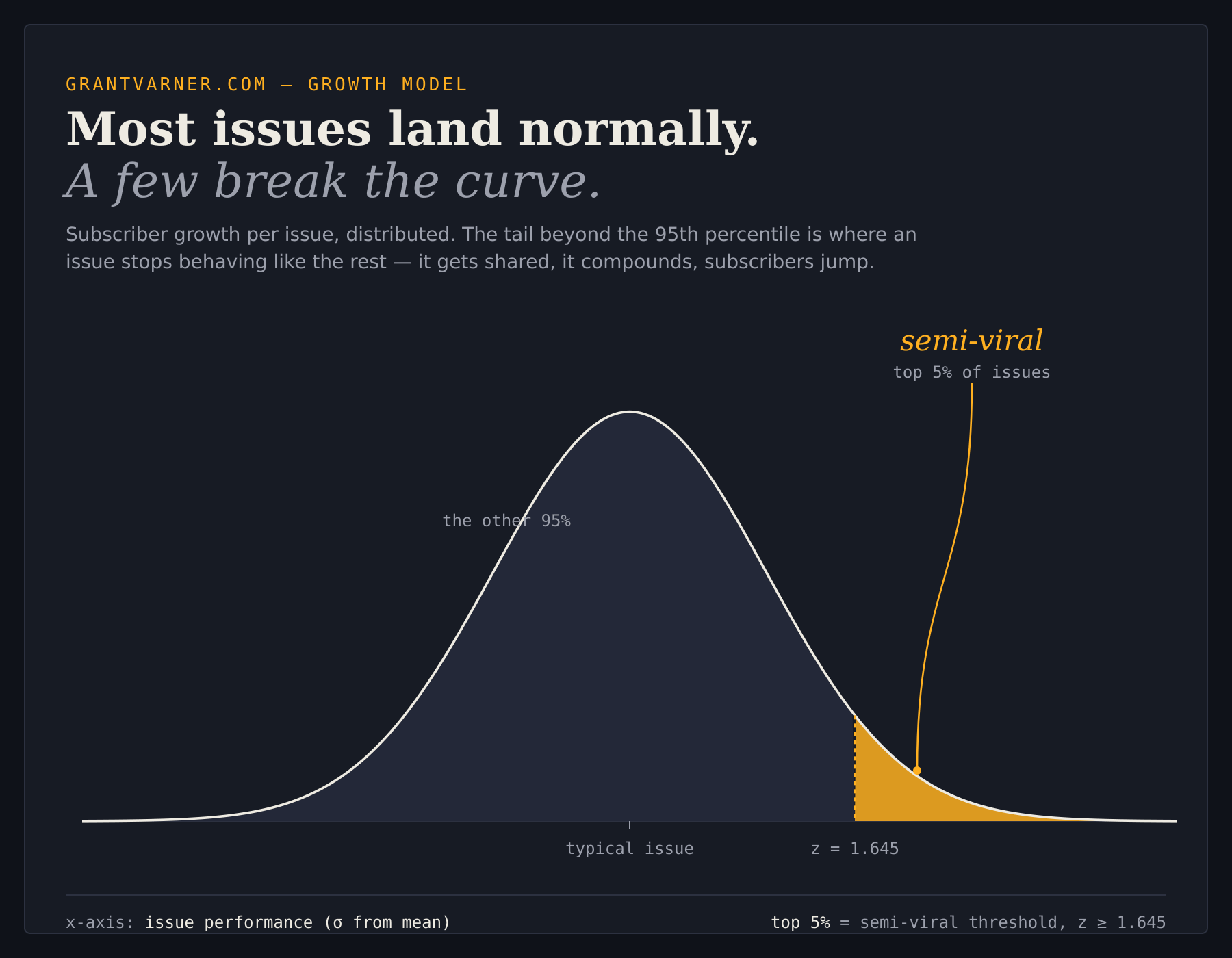
Every time you create a breakthrough work of art, your goal posts shift and find yourself right back to where you started — striving for better.
Eventually you’ll create several things that are remarkable. If you’ve ever played time trials on Mario Kart, you’d relate to competing against the ghost of your past self.
You’ve won anytime you’ve gotten just a little bit better than last time.

Quality Is The Goal
The goal of any creative endeavor is to improve your average output quality. Some days you succeed. Other days you don’t. There’s always room for improvement, no matter how good you get.
Japanese products have a reputation for quality. Even though they never advertise their quality, everyone just knows they’re high quality. The product is the marketing engine.
Writing works the same way. Social media algorithms are an idea meritocracy. AI has lowered the bar of average to the floor. It’s never been easier to stand out as a writer.
If something goes viral it’s usually pretty good. If you’ve created something remarkable, you’ll find out pretty quickly.
Create something you’d nerd out for, written exactly how you’d want to read it. When you create something you’d like, other people often like that thing too.
Subscribers Signal Quality
A subscriber is a signal of quality — put another way, it’s a signal of trust.
But fixating solely on subscribers leads to audience pandering, worse writing, and ironically, less subscribers.6 Failure to maintain a consistent level of quality erodes trust.
Sacrifice quantity to maintain quality. And in the age of AI, there’s not nearly enough quality to go around.
When your ten years of silence are finally over, things settle down, you land right back where you started… the cathartic act of creating a masterpiece.
Thanks for reading!
— Grant Varner
Every composition was written at least a decade after the musicians began taking their work seriously. There were only 3 exceptions — written in year 8 and 9.
In a follow up studies of poets and painters, he found the same result.
Whenever I binge read a blog, I love when they pull back the curtain to explain their process. Here’s some of my favorites:
Noah Smith’s writing advice and How to write a successful Substack by, you guessed it, Noah Smith
Lessons on Success and Deliberate Practice from Mozart, Picasso, and Kobe Bryant by James Clear — and the inspiration for this post.
I admire Nick Maggiulli’s work because he documented his 10+ years of hard work on his blog — culminating in The Wealth Ladder, one of my favorite books.
Editors Note: I also admire Jack Pembrook, who has a great YouTube video about how he created for ten years before finally getting traction.
Thanks for reading, mom (and dad)!
Update 8/15/26: I learned that Sturgeon’s Law describes this exact phenomenon. “90% of everything is crap” and only 10% is truly remarkable.
Goodhart’s Law proves it’s universality once again.
Loving your pieces, Grant. I remember reading somewhere long time ago that 7 years is the minimum period to learn a craft. By doing some maths, it seems most people have time to master about 7 of them (assume you start at ~20). Have you ever heard anything like that?
It would be boastful to call myself elite at my work but with over 11 years experience as a literacy specialist which followed 2 years of intensive training & supervised practicum in the Orton Gillingham methodology, I would say I’ve gotten pretty darned good at teaching my students to become strong readers: improving their comprehension, building their fluency and increasing their vocabulary. Furthermore, I would argue that the titles my name bears—M.Ed (Master’s degree in education, thank you John Carroll University!) and CALP (Certified Academic Language Practitioner, thank you IMSLEC & ALTA!) mean far less than the quality of results gained. I loved the You Tube video about how Japanese products do not market their quality. They let the product speak for itself. I am humbled when families thank me for helping their child. It’s what I do! But when hear their words of gratitude and see how their child is flourishing in school, that is a big win for all.
Thanks for the shout out, Grant. I do love reading your blog! One of my biggest hopes for my 3 kids was always that they would love reading and writing. All of those books read aloud and hours spent writing at the kitchen table in Cleveland were well served. Keep at it! Xoxo