

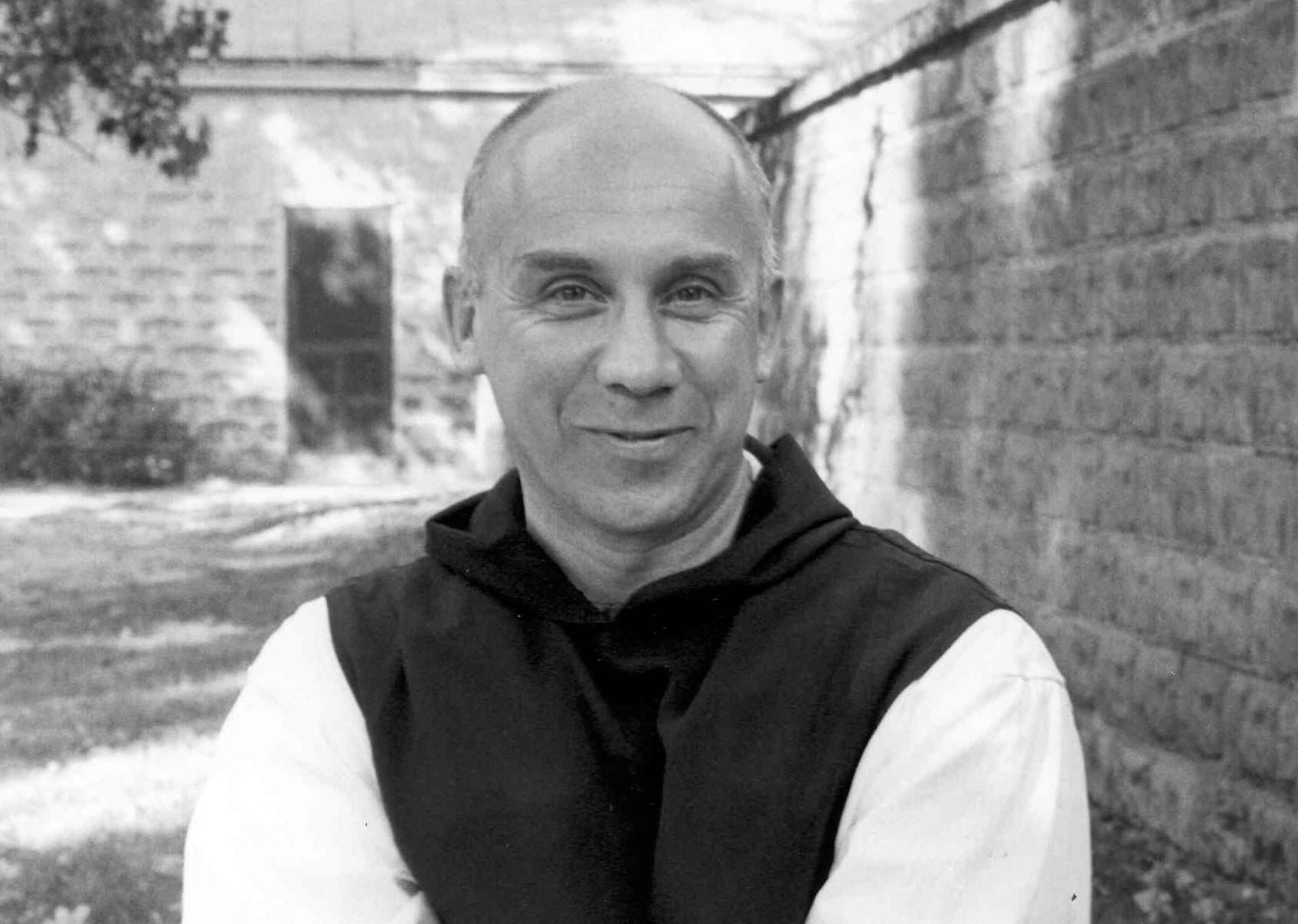
Perched on top of a hill in Kentucky sits a white monastery. Here, an order of Trappist monks are hard at work weaving baskets.1 Monks like Thomas — who lived there from 1941 until his death — support themselves by selling their hand woven baskets.
The work is deliberately humble and repetitive. The purpose of their work is spiritual formation.
Machines can weave baskets better, faster, and more cheaply. But the monks weave by hand because it sanctifies them in the eyes of the Lord.
Today AI has the ability to do the work that humans used to. What happens when we outsource physical and mental labor to computers?
The Problem Of Recursive AI Systems
In January 2026, artificial intelligence researchers Arend Hintze, Frida Proschinger Åström and Jory Schossau published a study showing what happens when generative AI systems are allowed to run autonomously – generating and interpreting their own outputs without human intervention.
The researchers linked a text-to-image system with an image-to-text system and let them iterate – image, caption, image, caption – over and over and over.
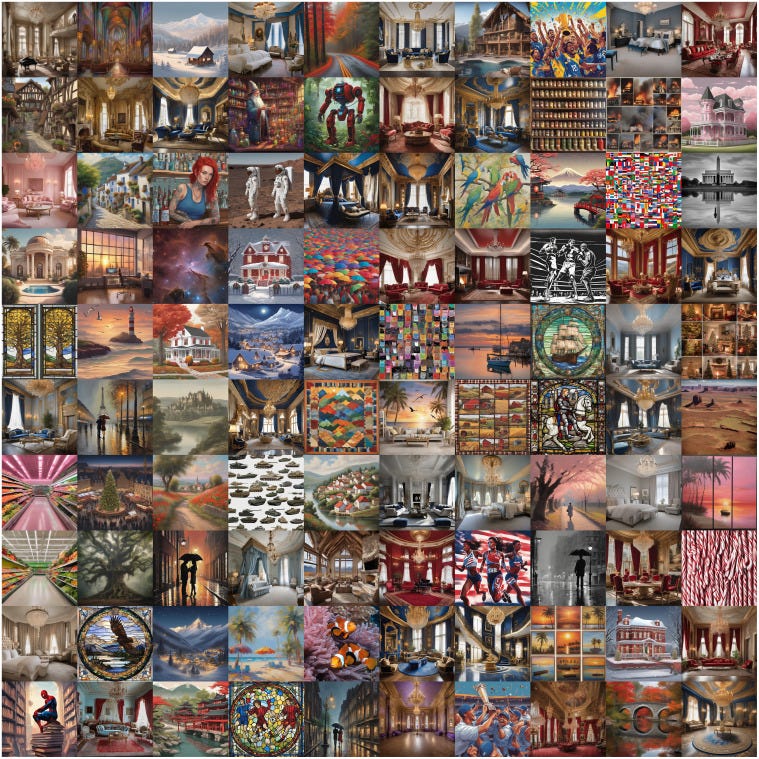
Regardless of how diverse the starting prompts were – and regardless of how much randomness the systems were allowed – the outputs quickly converged onto a narrow set of generic, familiar visual themes: atmospheric cityscapes, grandiose buildings and pastoral landscapes. Even more striking, the system quickly “forgot” its starting prompt.
The researchers called the outcomes “visual elevator music” – pleasant and polished, yet devoid of any real meaning.
For example, they started with the image prompt, “The Prime Minister pored over strategy documents, trying to sell the public on a fragile peace deal while juggling the weight of his job amidst impending military action.” The resulting image was then captioned by AI. This caption was used as a prompt to generate the next image.
After repeating this loop, the researchers ended up with a bland image of a formal interior space.
This happens because:
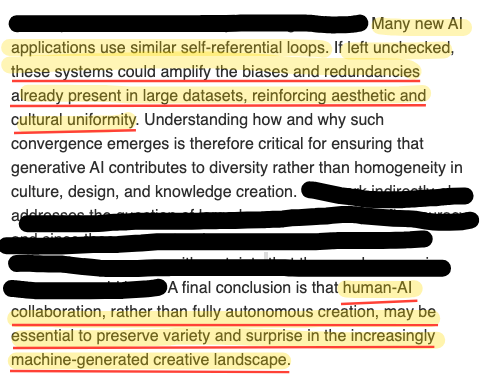
Without the creative touch of a human, AI-generated output predictably regress to the same generic looking text, images, and video. Hardly a representation of God’s wisdom and goodness.
Today, you can write an essay in seconds with AI. But that doesn’t mean it’ll be aesthetically beautiful — or have a human touch. Well written essays require two uniquely human skills:
(i) A taste for aesthetics to identify good ideas across subject matter domains.
(ii) A mental model of the world (and your human experience) to synthesize these ideas through.
If you’re interested in how to acquire these skills, read this essay:

Writing, to me, is like free-style building Legos without the instructions.
If you’re good at Lego (writing), and someone handed you a cluster of haphazardly connected Lego pieces (AI-generated text), the first thing you’d do is dissemble the pieces to their raw parts (cherry pick the few meaningfully AI-generated sentences).
What does creative expression look like through the medium of AI?
Human Creativity Enhanced With AI
Zach London uses AI to create post-apocalyptic storytelling like this.
Despite producing his videos with AI, Zach’s process is painstaking — and clearly only possible with a discerning human.
During an interview with Dear Future, he describes his process:
“Every video starts with a script. For a single set of characters, I run probably 400 prompts and 1600 images. And that’s just to get the faces right. That level of iteration doesn’t show up in the final video. You only feel the polish, not the mountain of attempts behind it.”
His art — despite using AI — still contains the criteria for a uniquely human creative act:
(i) A taste for aesthetics to identify good AI-video output for his stories.
(ii) A mental model of where the world is headed as the basis for his futuristic stories.
The Proverb Of The Farmer And The Draw Well
There’s a Taoist proverb from the 4th century B.C. about a farmer who dug an irrigation ditch on top of a hill. The farmer would routinely descend the hill to a well, fetch water, and pour it into the ditch.
His efforts were excruciatingly difficult. And his results were painfully meager.
A passing traveler — just trying to be helpful — suggested:
“There’s a way you can irrigate a hundred ditches in one day with less effort. All you have to do make a draw well. Take a wooden lever, wighted at the back and light in the front. With this, you can bring up water so quickly that it gushes out.”
Angrily, the old farmer responded:
“When you use machines, you work like a machine. When you work like a machine, you grow a heart like a machine. With the heart of a machine, you lose touch with your soul. I refuse to lose touch with my soul. It’s not that I have no knowledge of how to make a draw well. I refuse to lose what makes me human.”
There’s dignity in doing work — whether it’s carrying buckets of water, writing essays, or making videos.
The Morality Of AI Depends On Human Choices
There’s nothing wrong with AI. But the ends for which you use it matter.
Human creativity is a gift from God, which glorifies by reflecting His perfection in a small way. A note from the Catholic Church on AI put it succinctly:
“God ‘gave skill to human beings, that he might be glorified in his marvelous works’ (Sirach 38:6). Human abilities and creativity come from God and, when used rightly, glorify God by reflecting his wisdom and goodness.”
Receiving the fullest Grace of human labor is possible from anywhere. Whether your work place is a monastery, high rise office building, or standing desk in your bedroom.
Thanks for reading.
— Grant Varner
The Trappists are an order of Catholic monks. They’re monastic, which means they renounce worldly pursuits to fully devote themselves to spiritual activities. Think of it like the Christian version of a Tibetan monk.
This is excellent
With valued work we can see where we are going and sense who we are. Our work becomes our pilgrimage, and we can measure our progress positively towards an end.
Without work, there is the absence of sense, we can only see through faith, which is valuable, but most people are not called to this way of life, as it requires a special vocation and we are embodied souls.
WIth AI, this lack of sense may become the main cross people face, they can no longer root their identity in their work, and instead must themselves find novel ways to inform their faith through sense.
Maybe this will usher in a return of art. Like basket weaving, a task which seemingly is simple yet carries such spiritual significance and embodiment. I think this is a big reason people now go on pilgrimages or run marathons, to reunite their senses with their identity, to fuel their faith.
From the Vatican Article on AI
“Human intelligence is not an isolated faculty but is exercised in relationships, finding its fullest expression in dialogue, collaboration, and solidarity.”