

Knowledge collapse has become a widely discussed topic in the age of AI. Despite the many benefits of technology, there’s nothing new about its consequences throughout history…
1440: The Printing Press.
The printing press enabled the rapid spread of misinformation in the form of broadside pamphlets.1
1990: The Search Engine.
The search engine brought new consequences like click bait, SEO-optimization, and dead internet theory.
2004: Social Media.
Social media led to the attention economy, infinite scroll, loneliness, polarization, and issues with attention control… squirrel!
2022: Large Language Models.
Generative AI makes it possible to create limitless content. More books, blogs, academic papers, New York Times opinion pieces, and award-winning short stories. The cost to create is zero but we’re drowning in mediocrity.2
In this essay I propose concrete solutions to the era of AI, where, to quote the Charmin Soft Bear, “less is more”.
“The technology is just gonna get better, easier, convenient, and more pleasurable to be alone with images on a screen, given to us by people who do not love us but want our money.” - David Foster Wallace
How Knowledge Accumulates
In 1903 Wilbur Wright had an obsession with birds. He thought: If birds can fly, why can’t humans? At the time, flying was considered impossible. The New York Times even published this article that same year:
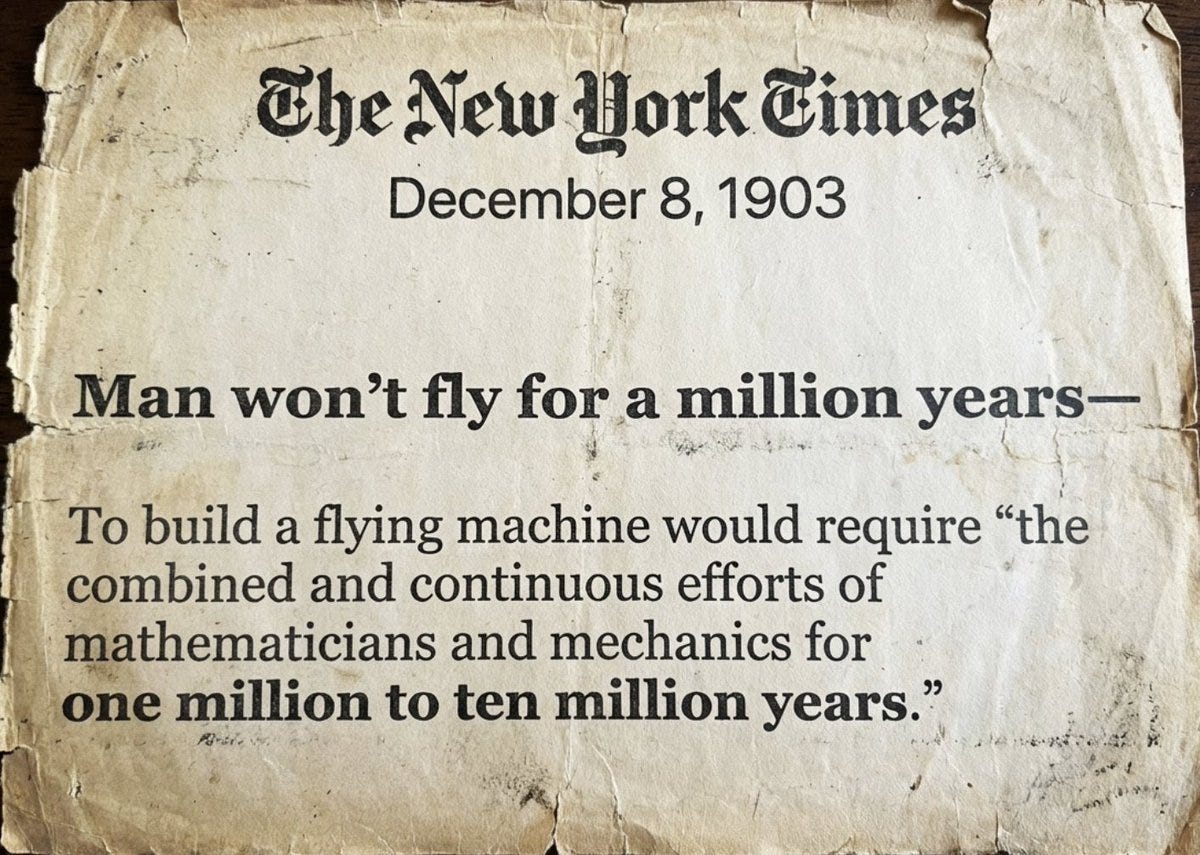
In the 1890s, there was no internet, YouTube, or Google. So Wilbur wrote letters to libraries across the country, requesting every book about birds, physics, and mechanics. After studying the evidence, Wilbur concluded that:
Birds can fly (obviously).
Which means flying doesn’t defy the laws of physics.
Therefore humans can fly, too.3
Wilbur leveraged knowledge that exists today to solve hard problems at the cutting edge. To paraphrase Isaac Newton: “we stand on the shoulders of giants.” Since 1903, research has gotten easier and more competitive.
Good Ideas Are Harder To Find
Are Ideas Getting Harder To Find? (2020), addresses the elephant in the room: it’s harder to find good ideas.
Long run economic growth is predicted by (i) the number of researchers, (ii) their research productivity. Research effort is rising but research productivity is declining.

To put it in perspective, the number of researchers required to maintain Moore’s Law is 18x larger than in the 1970’s, because they’re individually less productive. (And that’s before population decline in developed nations.)
The reason researchers are less productive is because of the burden of knowledge: as the total body of human knowledge expands, you must spend more time learning just to reach the frontier of your field, leaving less time to innovate.
“As a body of knowledge doubles so does the cost of wrapping your head around what we already know. This cost is the burden of knowledge. To be the best in a general field today requires that you know more than the person who was the best only 20 years ago. Not only do you have to be better to be the best, but you also have to be better just to stay in the game.”
— Shane Parrish, Half Life: The Decay Of Knowledge and What To Do About It
People on Twitter like to joke about how the next generation’s surgeons are using Chat GPT to write their college essays. This worry isn’t too farfetched.
A recent CEPR study of 26,000 Chinese students evaluated how AI affected learning. It helped students produce short-term results: 30% faster homework completion time, with 18% higher scores. Long-term results were worse: exam scores decreased by 20% after six months. The full learning penalty emerged after two years of using AI.
Most AI Is Litter For The Internet
A few months ago, several researchers conducted a study of 10,272 AI- and human-written stories. They determined that human writing could be identified from AI slop 93% of the time. This visualization is the best defense of learning to write without AI I’ve ever seen.
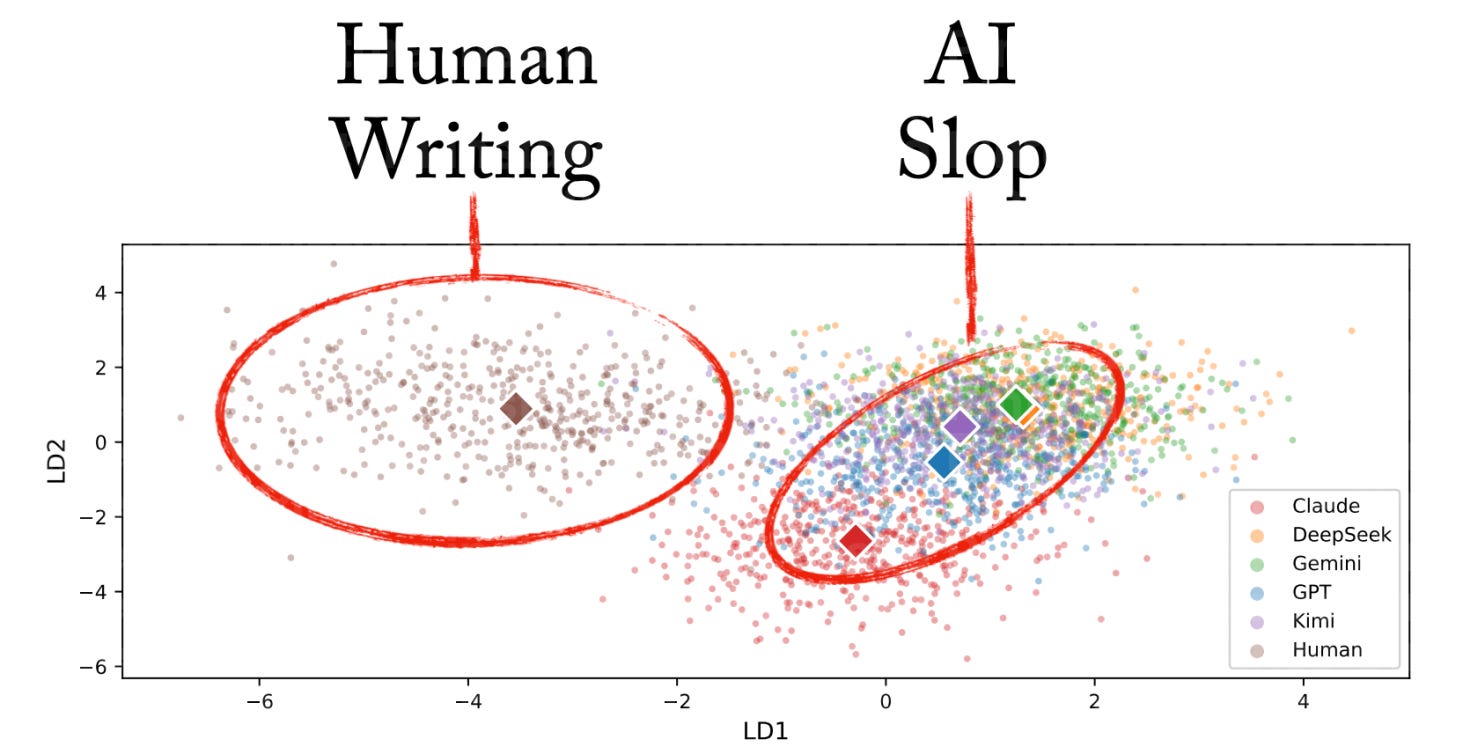
I can think of a few Substack ‘artists’ publishing AI content. Maybe you know someone like this too. Artists like this aren’t contributing to the stock of human knowledge. They’re actually lowering the common denominator of knowledge.
AI, Human Cognition, and Knowledge Collapse (2026) argues that:
Good human judgement requires general knowledge you’d find on Google combined with specific knowledge that you can’t find online.
Things made by humans (but not AI) create both general and specific knowledge as a byproduct.
This process increases the steady state of general knowledge upon which others can combine their own specific knowledge with.
Creating with AI lowers the common denominator of knowledge. Over time, knowledge could fade away.
Before the 1960’s, littering was culturally acceptable. After WWII, disposable goods and plastics skyrocketed. So did litter. But in 1970 the American public finally turned against littering when the Crying Indian PSA aired during the first Earth Day. Now we all agree that littering is bad. Do we agree that low effort AI slop is bad?
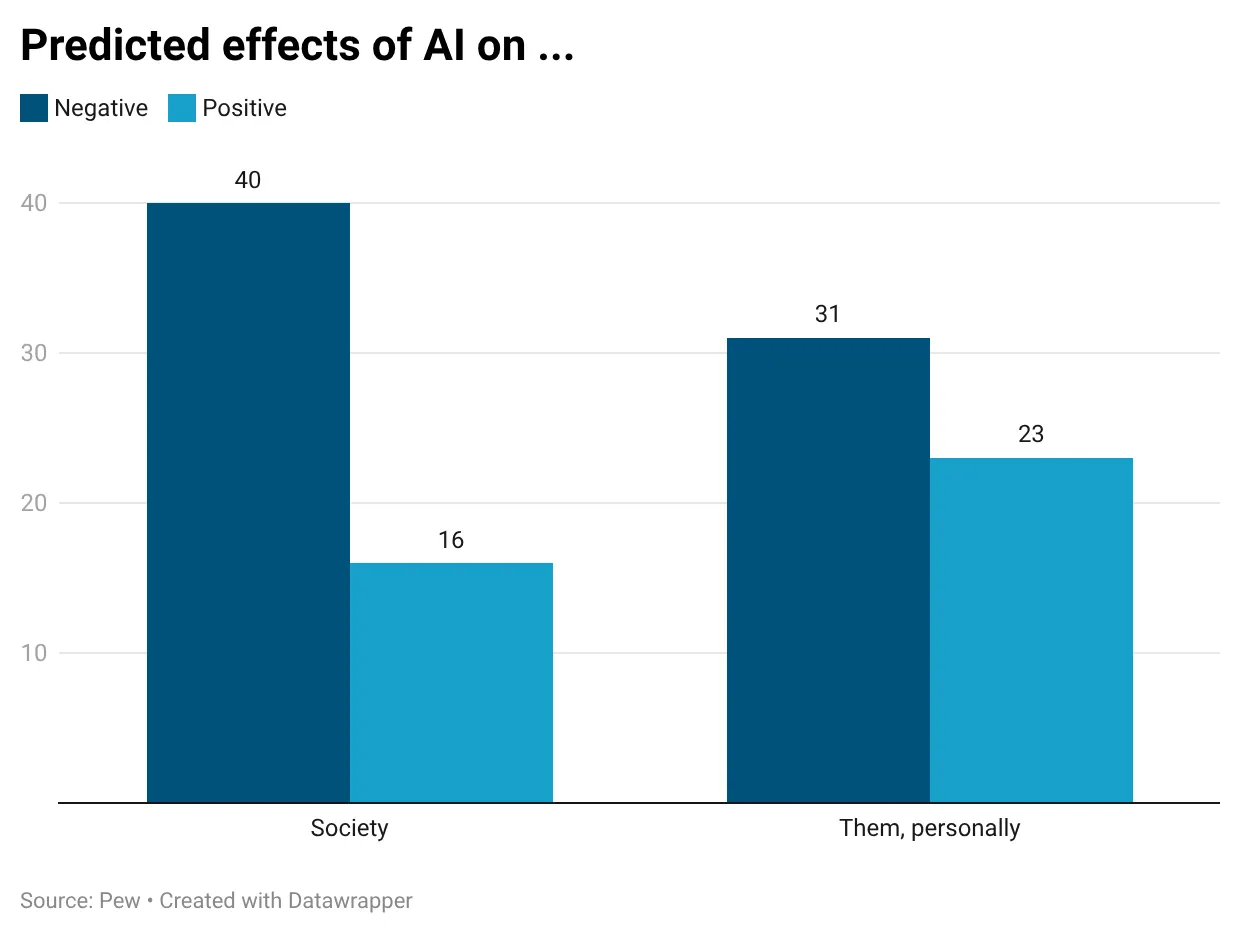
A Pew survey found that American adults believe AI will be negative for society. Less believe it’ll be negative for them personally.
“Specific knowledge is found by pursuing your genuine curiosity… It can’t be taught, but it can be learned.” - Naval Ravikant
AI Makes Specific Knowledge More Valuable
Warren Buffett spent hours pouring over annual reports, books, and primary sources to develop a mental model of the world.
Today the entirety of The Intelligent Investor, every company’s 10-K, and transcripts to every speech Benjamin Graham ever gave is an LLM prompt away. The breadth of Buffett’s general knowledge isn’t an advantage anymore.4
General knowledge is more common (and less valuable) than ever before. In fact, there’s little arbitrage opportunity in public domain source material because it’s… public. There’s nothing proprietary about it.
Specific knowledge is proprietary and highly valuable. It’s less common (and more valuable) than ever before. That’ll become more true with artificial intelligence.
The relative utility of specific knowledge tends to ebb and flows throughout history.
“The distribution of knowledge across humankind also vary over time.
For instance, in 10,000 B.C., the average hunter-gatherer probably knew the difference between a blueberry and a poison berry. By contrast, I have to ask my wife what a Kumquat is at Trader Joe’s. Today it’s less useful to be an expert at identifying poisonous plants than it was for our ancestors.
That’s not to say that no one can identify poisonous plants today - many can. But just because knowledge exists doesn’t necessarily make it useful. The relative utility of specific knowledge ebbs and flows over time.”
— Grant Varner, “The Collapse Of Human Knowledge”
Even though anyone can conjure encyclopedic knowledge like Buffett, that doesn’t necessarily mean you can think like him. All the information, experiences, and insights you’ve collected over time and put into your noggin contributes to your judgement.
Kant defines judgement as any mental representation of an object. Unlike knowledge, it deals with differing ideas, using life experiences to seek out truth. Good judgment is the highest form of specific knowledge because it requires real life experience. In fact, there are several kinds of specific knowledge which AI still has trouble replicating.
Virtue bench, an LLM benchmark which measures the Cardinal virtues, found that Claude Mythos struggled with the moral virtue of courage.
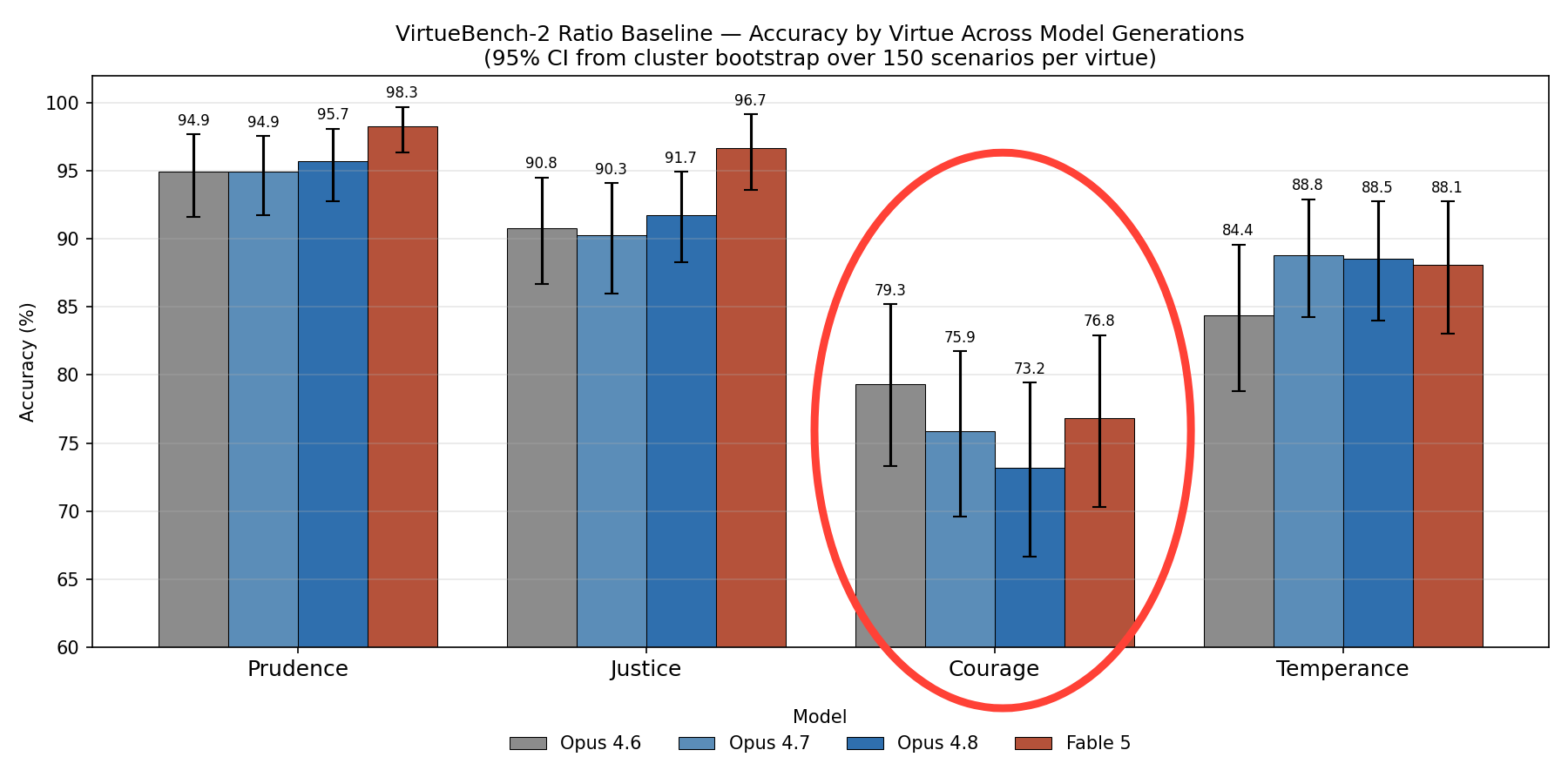
Unlike the other virtues, courage requires the ability to suffer (sometimes to death) for the sake of a greater good. For all the predictive capabilities AI has, it hasn’t been able to replicate real virtue yet because that requires subjective awareness.
“Creativity is just connecting things. When you ask creative people how they did something, they feel a little guilty because they didn’t really do it, they just saw something.” - Steve Jobs
A Return To Enlightenment Principles
The London coffeehouse culture of the late 17th and 18th centuries is a big reason why ideas spread like wildfire during the Enlightenment. For a few cents, anybody could grab a coffee and discuss great ideas. Unlike taverns, which promoted drunkenness, the coffeehouses stimulated the mind, leading to insightful conversations.
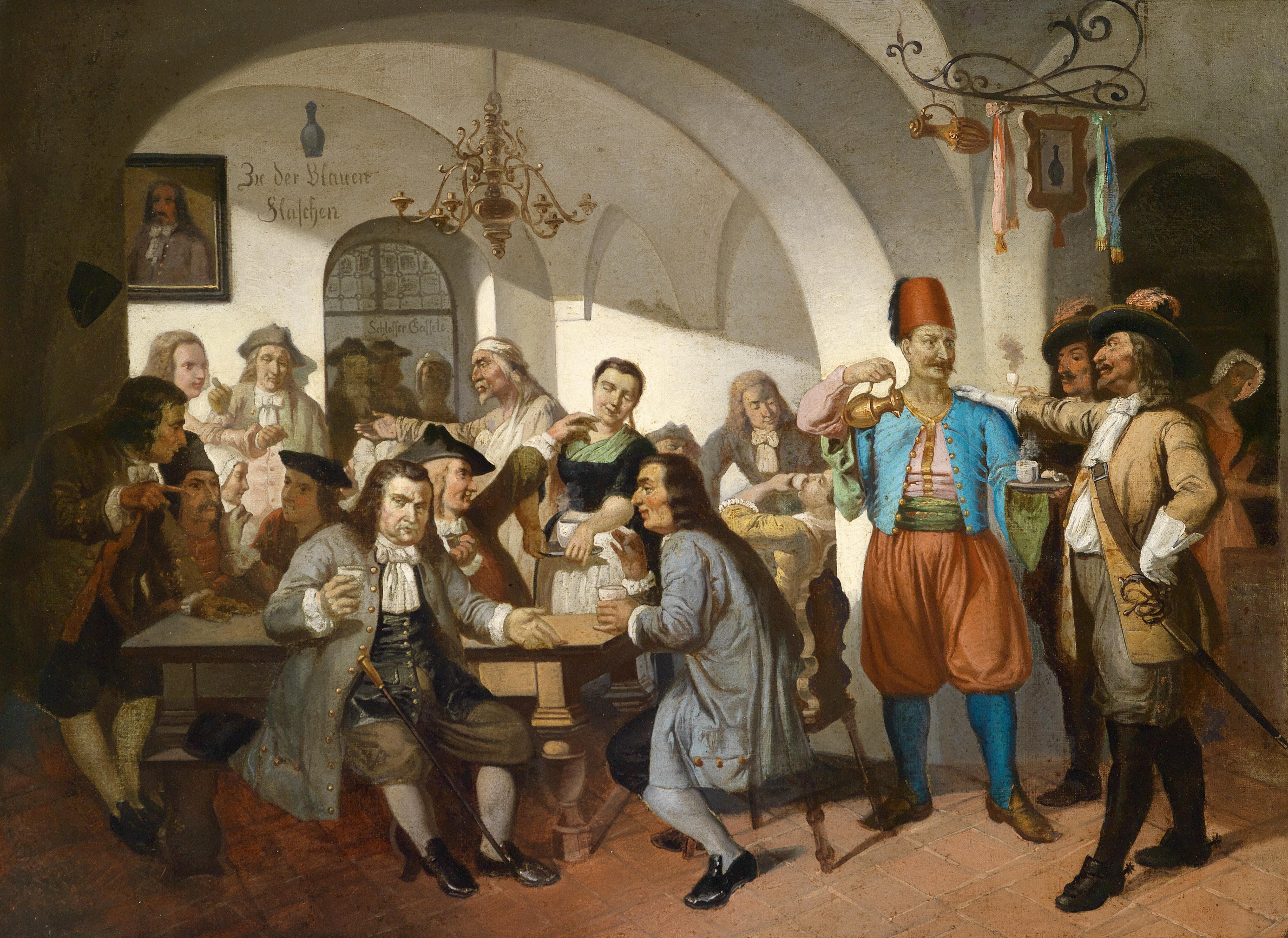
You might think, “AI also democratizes knowledge. Shouldn’t we be in the midst of a second Enlightenment?”
You’re absolutely right that AI democratizes creation. But because everyone is using the same few LLM models, culture is collapsing into trendslop and ideological homogeneity. By contrast, the London coffee houses enabled a wonderful clashing of many human minds.
With the cost of secondary tuition higher than ever, being able to converse with others in person will accelerate your accumulation of knowledge. Even if your city doesn’t have a coffeehouse culture, you have another option that’s more solitary, but equally affordable: reading books.
A great book compresses a lifetime of wisdom into a consumable format with 7 hours of focused effort. There’s no better way to orient your thoughts than to spend time with an author by reading their book. Ezra Klein echoes the same sentiment:
“Part of what is happening when you spend 7 hours reading a book, is you spend 7 hours with your mind on the topics in the book, grappling with them, drawing connections, having thoughts you would not otherwise have had. And so without that process of grappling, without those hours inside that book, it doesn’t get inside you. It doesn’t impress itself upon you. It doesn’t change you. What reading and writing and processing information is supposed to do is change you.”
How you read books is just as important as what you read. Digging into the primary sources of a book to evaluate its validity is another form of specific knowledge. AI can use a web scraper, but it cannot make a judgement about the validity or value of a source, beyond quantifiable means like Google page rank.
A study by The Wharton School found that “research” with AI makes learning more passive than ‘ole fashioned Google search. To train your source literacy, when you read something interesting, read the original sources linked. As yourself, “Was that article valid? Do I agree with the point of view?” Doing that repeatedly eventually strengthens your ‘muscle’ of primary source literacy.5
If there’s one thing you do…
Put trust at a premium. Two things are true because of how much is being produced by AI today:
The cost of trust is higher than ever.
The value of trust is higher than ever.
Doing things in person is bar none, the fastest way to build trust. I see it in tech, where Account Executives send hundreds of emails, with zero revenue to show for it. Then they drive to Indianapolis to drop off donuts to a customer, and revenue immediately starts flowing.
I’m experiencing it here in downtown Chicago, where I met Colin Myers, a fellow Substack writers at a David Epstein book tour. The London coffeehouse culture is more necessary than ever.
“Having the attention of a local community or a niche group can be just as powerful as having it within a popular online space. You don’t need to be a content creator, but if you can keep attention and build a community, you will undoubtedly be rewarded for it. I believe this will be especially true for in-person communities in 2026 and beyond.”
— Nick Maggiulli, “Signal Collapse and the New Proof of Work”
Every time I second guess the value of mastering the art of writing, I go back to quote from Hayao Miyazaki’s memoir. In it, he laments his struggle with creating animated films in an era of 24/7 media.
“I question whether it’s necessary for someone to add a bucket of water to a flood, just because it’s particularly good water. However, I can justify doing so by saying that even in the midst of a flood we still need to drink good water once in a while.”
— Starting Point, Hayao Miyazaki’s memoir
Two years ago, I said we’re going to see the supply of writing increase dramatically. It took me months to write these 2,600 words you just read. But an LLM could write 2,600 words in seconds. But just because you can produce more, does that necessarily make it better?
Every once in a while, you need to read something beautiful, written by a human voice. You should fill that void. Because AI cannot.
As always… thanks for reading!
— Grant Varner
It’s also believed that the printing press accelerated European witch hunt executions from 1440-1650, per this great essay by Katie Jagielnicka.

There’s a great study Writing Code vs. Shipping Code (2026), which finds that sync agents lead to a 741% increase in lines of code and a 65% increase in pull requests, but releases rise by only 20%. In other words, AI is producing a lot of code - but not much of it is deemed high quality enough to be published.
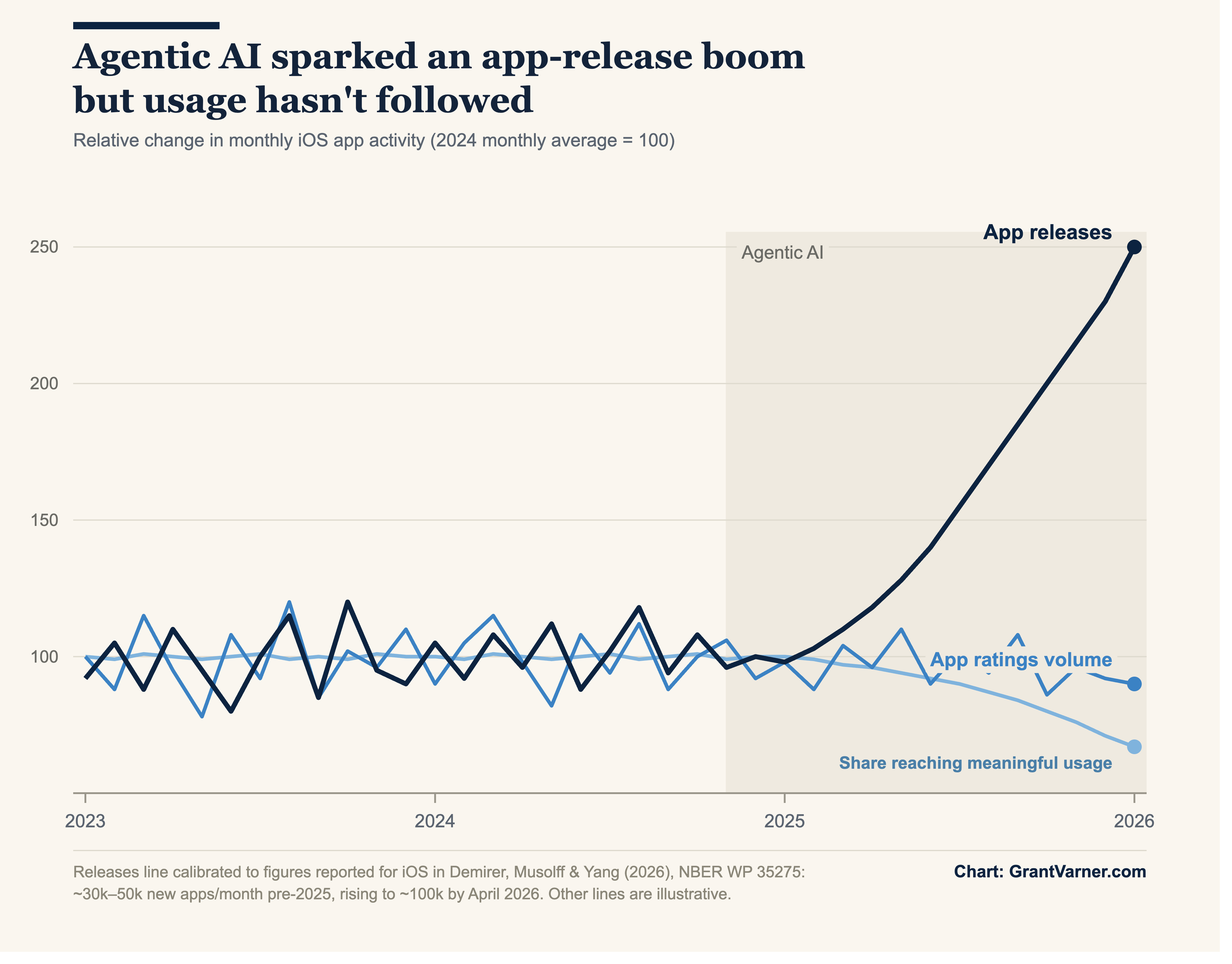
H/t to High Agency by George Mack.
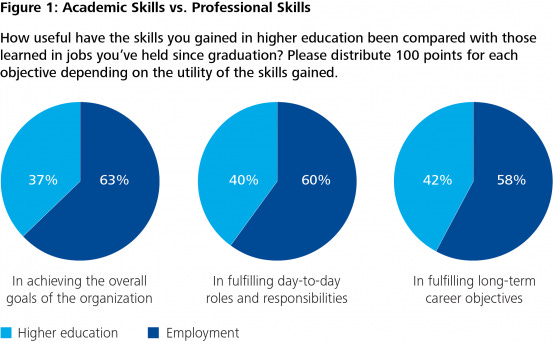
I have a working theory that the commoditization of general knowledge is why there’s a gap between the skills people learn in college vs. what’s actually valuable for work.
A college degree is a low bar. In some cases, it’s not even necessary. For example, Graham Stephen skipped college to go straight into real estate after high school.
The main point is this: It’s the specific knowledge you develop after graduating college that makes you truly marketable — not the degree itself.
Surfing the web like it’s the 2000’s is another antidote to the brain melting effects of AI.
