

Specialization may not actually be the best path to success. Becoming an expert in a wide of range of things gives you a unique advantage. Achieving range takes time — and foregoing a head start against your peers — but pays off in the long run by greatly increasing your odds of achieving a massively successful breakthrough.
Key Themes
Learn Slowly
Ironically, the best way to learn appears to be the slowest way to learn.
The average age of a founder is 45 years old — at company launch — for the fastest growing startups in the USA.
A 50-year old tech founder is 2x as likely to start a successful company than one who is 30 years old.
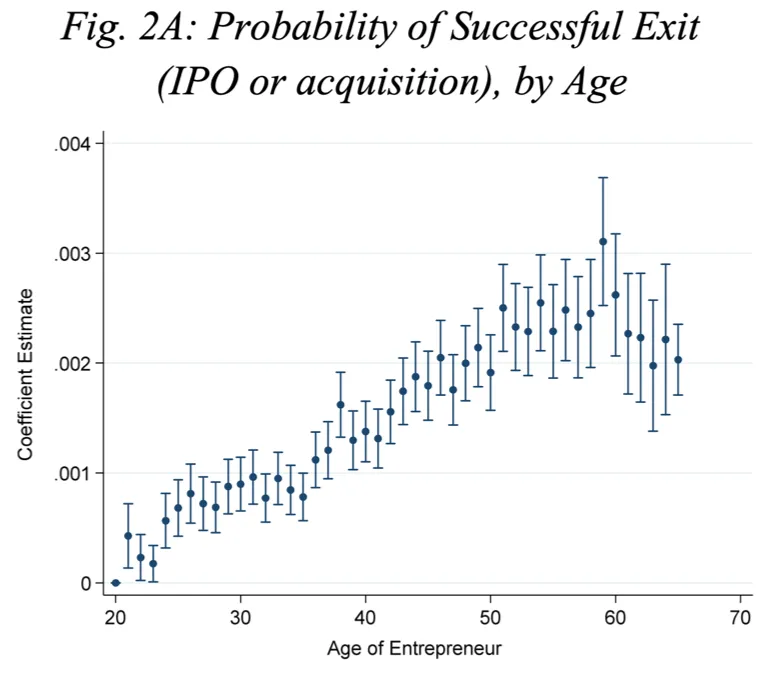
If you need a reminder on when to go full time with your side hustle, look no further:

Kind vs. Wicked Learning Environments
Experts in a wide array of fields distinctively recognize and act on patterns they’ve seen before.
In domains where patterns do not clearly repeat, repetition & experience are actually a disadvantage. This is known as Wicked Learning Environments.1
The unique strength of humans is our ability to integrate knowledge broadly, whereas AI has narrow specializations.
Breadth Leads to Success
High achievers tend to have broad interests. This breadth results in insights that couldn’t be achieved by having domain experience alone.
They take knowledge from one pursuit, and apply it creatively to the next.
They also use patterns from their previous domains of expertise to creatively solve problems.
Self-Knowledge
Match Quality is the fit between the work someone does and who they are.
It’s more important to gain self-knowledge than hard skills because having good Match Quality is more important than getting a head start on a defined career path.
Match Fit Leads to Success
To be successful, you need to work hard and have a singular focus.
This is why you need to consistently reflect about what you WANT in life, and what you need to do to achieve that. What you lack in IQ, you can make up for with grit in life to achieve success.2
People who are the most fulfilled spend immense time and energy figuring out their Match Fit.
Be a Problem Solver, Not an Expert
Don’t get lost in the details trying to be an expert in something. Instead, focus on finding solutions to problems.
The amount of times a creator has tried to solve a problem and failed is a predictor of their eventual success.
Thomas Edison had thousands of patents, failed experiments, and tossed away ideas. Because he tried so many times, his odds of a massive success were high.
Wicked Learning Environment: Domains where the rules are unclear or incomplete; in these environments, “experts” are at a disadvantage when presented with a novel problem because they recommend solutions from a deep, but narrow lense of expertise.
