

Dwarkesh Patel’s The Scaling Era is the most comprehensive book about the modern discourse of AI research.
The Appendix cites all the most influential AI research papers from The Bitter Lesson, to Attention Is All You Need, and everything in between.
This book is rich with information. Dense for some. So I summarized it into a few bullets for you (and myself) to enjoy!

1. Transformer architecture is computationally universal.
Given enough data and compute, LLMs can theoretically learn to execute any task across any domain. Transformers are computationally universal.1 This means that a transformer isn’t a one-trick pony for predicting text.
It gets called a “large” model, even though its weights can fit on a thumb drive.2
Key takeaway: Transformer architecture, originally proposed by Google’s Attention Is All You Need, is the most Turing-complete architecture for intelligence that we have — despite its flaws.
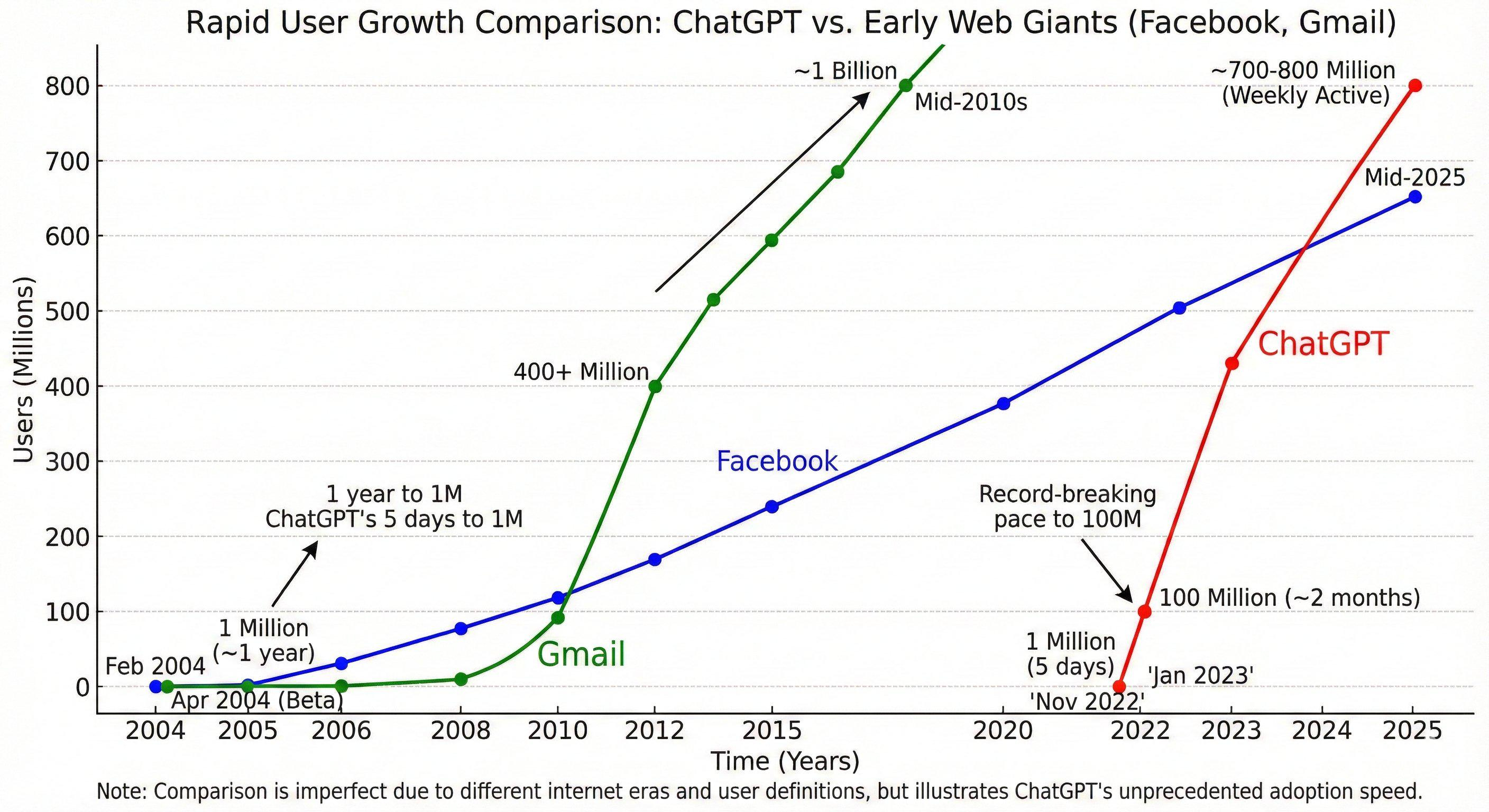
2. GPT-3.5 is the fastest adopted consumer technology ever.
Barely anyone noticed when OpenAI released GPT-2 in 2019. Three years later GPT-3.5 grew to 100 million users within two months of launching.
The design of GPT-2 and GPT-3.5 was essentially the same, except with a larger version trained on more data.3
The compute needed to train a leading model is now 10 billion times higher than it was in 2010. During this period, the compute used to train each frontier model doubled every six months — 4x faster than Moore’s law predicts.
Key takeaway: Chat GPT boosted the AI community’s confidence in neural scaling laws.
3. Neural scaling hypothesis.
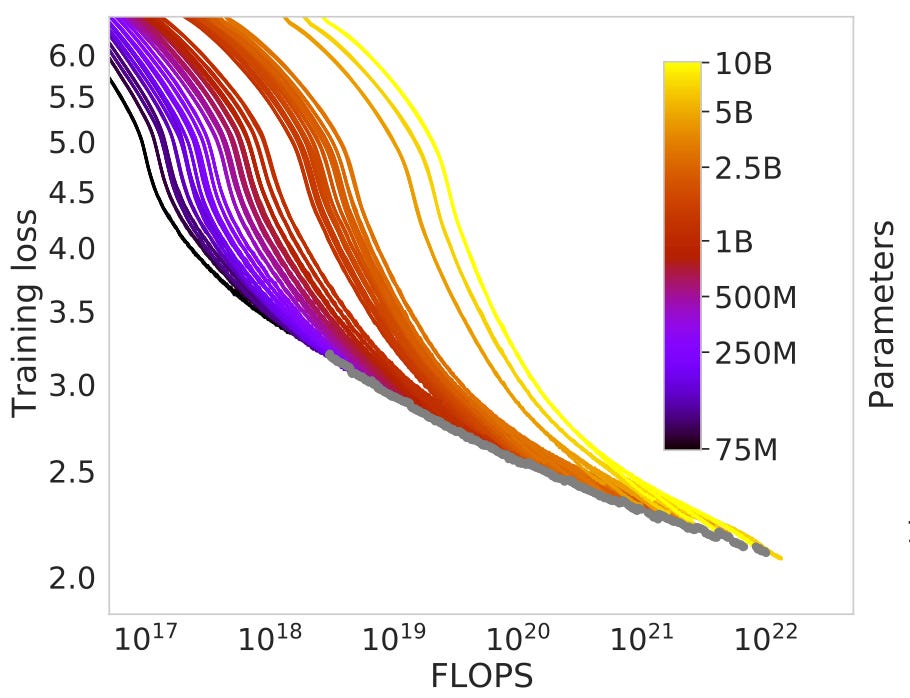
OpenAI took a $4 million risk in training GPT-3 because it had stumbled upon so-called neural scaling laws: curves that predict how much models will improve as we increase the resources used to train them.
Scaling laws don’t work by magic. You still need to scale up the hyperparameters, and various innovations are going on all the time with each new scale. It’s not just about repeating the same recipe at each new scale. You have to adjust the recipe and that’s a bit of an art form. You have to get new data points.
So far, these laws have accurately predicted the improvement resulting from exponential increases in investment. This has inspired confidence in $100 million training runs — which, before scaling laws, would’ve been considered a risky business decision.
Key takeaway: The scaling hypothesis is the idea that scaling compute and data is all it will take to build a human-level AI system, and possibly a system that exceeds human intelligence.
4. Why do scaling laws even work? We don’t know for sure. 🤷♂️
We just know that scaling laws, up to this point, have been true. Even though we don’t have a satisfying explanation for why they work.
Physics has concepts of long-tail or power-law correlations or effects. When you have a bunch of features, you get a lot of total information in the early part of the distribution, before the tails. For language, the big things are figuring out that there are parts of speech or that nouns follow verbs.
It makes sense why every order of magnitude added captures more of the distribution.
Key takeaway: What’s not clear is (1) why intelligence scales so smoothly with the number of model parameters and (2) why it scales so smoothly with the amount of data.
5. Our best hypothesis for why Scaling Laws work is cutting up a data manifold into more high-resolution pieces.
Given how simple scaling laws are, you’d expect there to be some kind of simple general explanation. But we don’t really know all the details of how neural networks work.
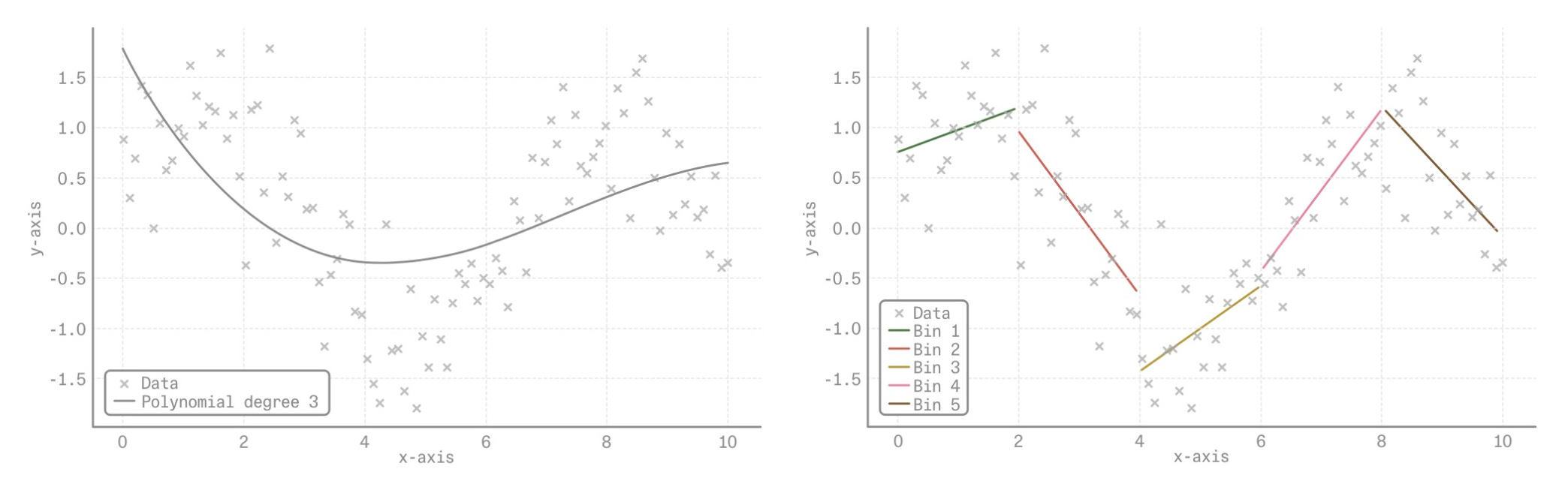
In a nutshell, you can think of neural networks as mapping their data to some kind of data manifold that has some dimensionality. All neural networks are really doing is fitting a curve to that data manifold.
That is all abstract, but probably everyone who knows science has done an experiment, gotten a bunch of data points on x versus y, and fitted some kind of curve to them.
The idea is that perhaps neural networks are doing something, abstractly, as simple as fitting some multi-dimensional curve. The simplest way to fit a curve is by chopping up your data into little bins and then modeling each bin separately.
Key takeaway: The reason why we still don’t have a good explanation for scaling laws is because we still don’t fully understand how neural networks work. One hypothesis is that as you scale up the number of parameters, all you’re really doing is cutting up your data manifold into more high-resolution pieces.
6. Compute matters more than algorithms.
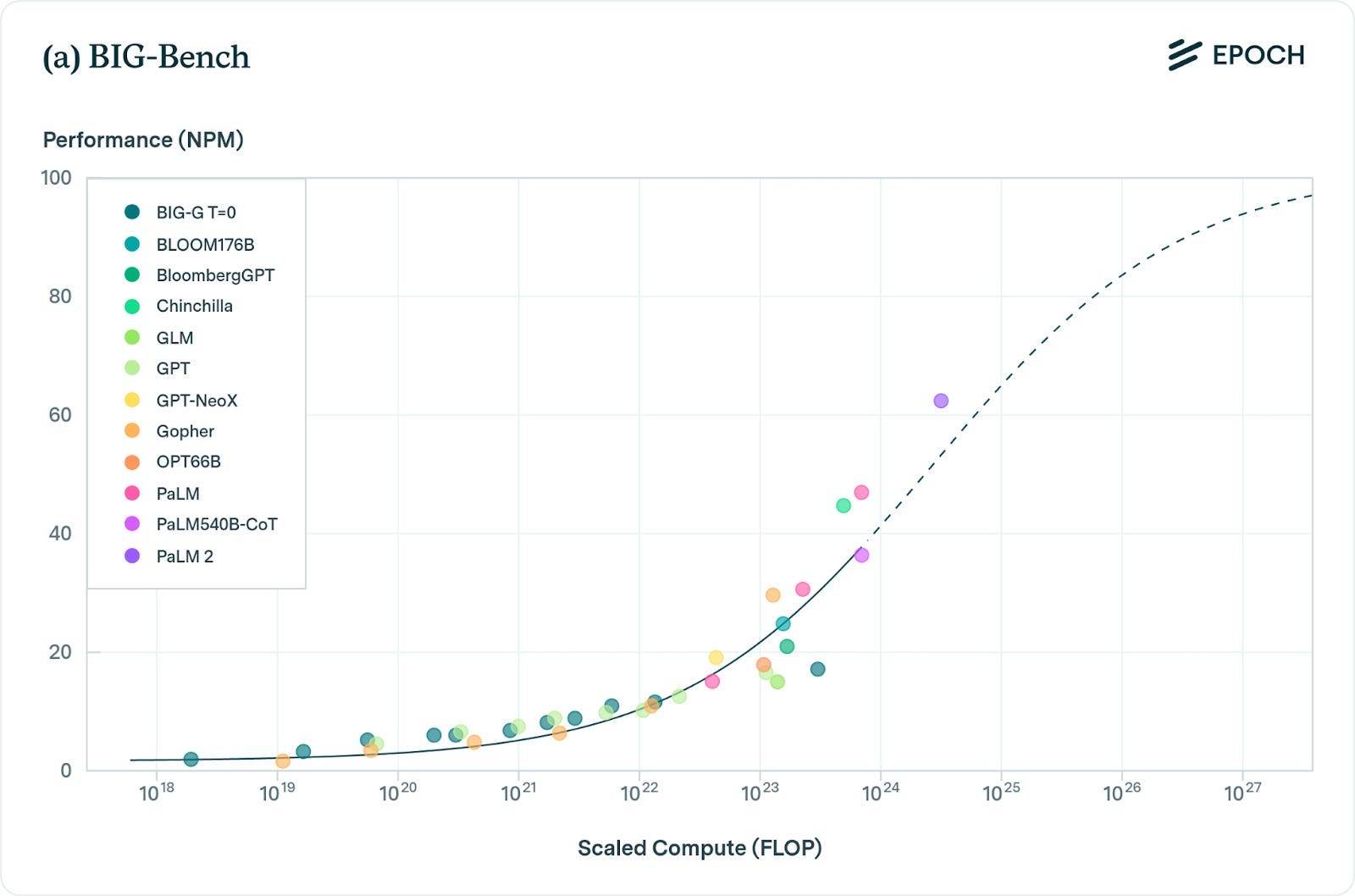
There are some situations where AI training in specific domains helps it get better at other domains. For example, when large models improve at coding, that can actually improve their general reasoning.
It’s an empirical question whether we’ll hit a wall. Half of our effort should be dedicated to scaling. The other half should be dedicated to the next generation of architectures and algorithms.
In the mid-2000s, Hans Moravec and Ray Kurzweil were making the fundamental connectionist argument that enough computing power will result in a neural network that matches the human brain. Until enough computing power is available, trying to build AI is futile. Sufficient compute is a prerequisite for artificial intelligence parity with human intelligence.
Key takeaway: Compute matters more than algorithms. This idea didn’t become mainstream until after the transition from GPT-2 to GPT-3 in 2020 — even though some researchers at the frontier recognized it.
7. Eval benchmarks help us estimate an AI’s capabilities.
The ability to solve problems isn’t just an aspect or feature of intelligence — it is the essence of intelligence. By this definition, LLMs are intelligent, even though they require more data, energy, and compute than the human brain requires.
Whenever an AI model beats a benchmark we have three options: 1) Reject the test because it’s too easy. 2) Raise our estimation of the system’s intelligence. 3) Lower our estimation of human intelligence.
Evals do more than estimate intelligence: they help us figure out what kind of thing LLMs are.
Typically we develop a theory of what the models are doing. Then we use evals to test whether they fail or excel at tasks implied by the theory.
Key takeaway: Without benchmarks, it’d be difficult to fully understand the models. When AI beats a benchmark, we have to update our own views of human intelligence, artificial intelligence, or both.
8. Intelligence is the search function to the nth degree.
When we scale a model, all we’re doing is more parallelized search for longer and applying that to each task.
There’s no region in the brain where, if you remove it, you eliminate fluid intelligence.
Your brain learns specialized solutions to problems and then recombines them into fluid intelligence.
That, in a nutshell, is what the large model is: a giant ensemble of small models tailored to the ever-escalating number of problems you’re feeding it.
Key takeaway: Intelligence is search. And the human brain is the epitome of search. Artificial intelligence requires a lot of data to search.
9. Human intelligence is more fluid than artificial intelligence.
General intelligence is the ability to approach any problem, any skill, and very quickly master it using very little data. General intelligence is not specificity scaled up.4
Humans use pattern recognition techniques (heuristics, for example) all the time. But human intelligence is fluid, capable of adjusting to new situations.
The human brain has: 1) working memory for things that happened recently 2) episodic memory for learning specific things rapidly. AI doesn’t have episodic memory because it’s a language model.
Key takeaway: True general intelligence requires the ability to solve problems with very little data.

10. The Transformer is eerily similar to the cerebellum.
In the 1980s, Pentti Kanerva came up with an associative memory algorithm. He wrote an equation for how to query the best matching memories. Several years later, he discovered that if you implemented this as an electrical engineering circuit, it looks identical to the cerebellum.
Basically every animal has a cerebellum architecture in their brain. The AI attention operation is a close approximation of Kanerva’s model of the cerebellum. It’s fascinating how the Transformer architecture is surprisingly brain-like in how it’s similar to the cerebellum.
“It’s the first time in history where you can plausibly imagine writing AI with 10,000 lines of code.” — John Carmack
Key takeaway: The architecture of AI is eerily similar to the cerebellum, the part of the brain responsible for attention. Even the name neural networks is derived from biological neurons in the brain.
11. Reinforcement learning with human feedback won’t scale to Superintelligent AI.
During an intelligence explosion, when AI engineers are writing trillions of lines of complicated code, it’d be impossible for humans alone to understand everything they’re doing. Pure RLHF isn’t a realistic answer to the alignment problem in this scenario.5
Human-level general intelligence is a scary concept because you can quickly clone hundreds of thousands of human-level agents that don’t need to sleep, instantaneously.
The challenge with AI alignment is that we don’t have a great way to understand how well our alignment efforts are working because we don’t fully understand the representations large language models use to accomplish goals.
There’s a useful analogy between AI alignment and parenting. Parenthood is one place where there’s a lived ethic of influencing the values of another creature. But what relationship should a parent have to a child, especially as the child grows in ability? What sort of respect should a child have toward a parent, and how should a parent relate to a child?6
The U.S. military works because generals aren’t allowed to follow unconstitutional orders. We can have the same thing via a constitution for AI.
Alignment during an intelligence explosion will look less like a years-long bureaucratic process and more like the fog of war: “Is it safe to do the next OOM? We’re three OOMs into the intelligence explosion and we don’t fully understand what’s happening." Our generalization scaling curves don’t look great. Some automated AI researchers say it’s fine, but we don’t quite trust them. Should we go ahead?”
Key takeaway: RLHF probably won’t scale to superhuman systems because those will produce outputs beyond human comprehension. We need a successor to RLHF.
12. What’s happening inside of an LLM? We don’t know. 🤷♂️
The truth is that we don’t exactly know how LLMs arrive at their output — that is, we don’t know what’s going on inside an LLM.
To understand why we don’t know, we have to distinguish between (1) architecture — the way a researcher sets up the blank model before training it, (2) objectives — which, in LLM pretraining, is successfully predicting the next token in a document, and (3) representations — the concepts, algorithms, features, and heuristics learned during training.
We understand the LLM’s architecture and objectives just fine. But the representations remain unclear. Does an LLM reason in some strict sense? Or does it merely exploit masses of statistical associations? Does it have a world model?7 Opinions differ on all of these topics.
Key takeaway: AI researchers don’t fully understand the internal representations that LLMs use to generate their output.
13. Recursive self-improvement.
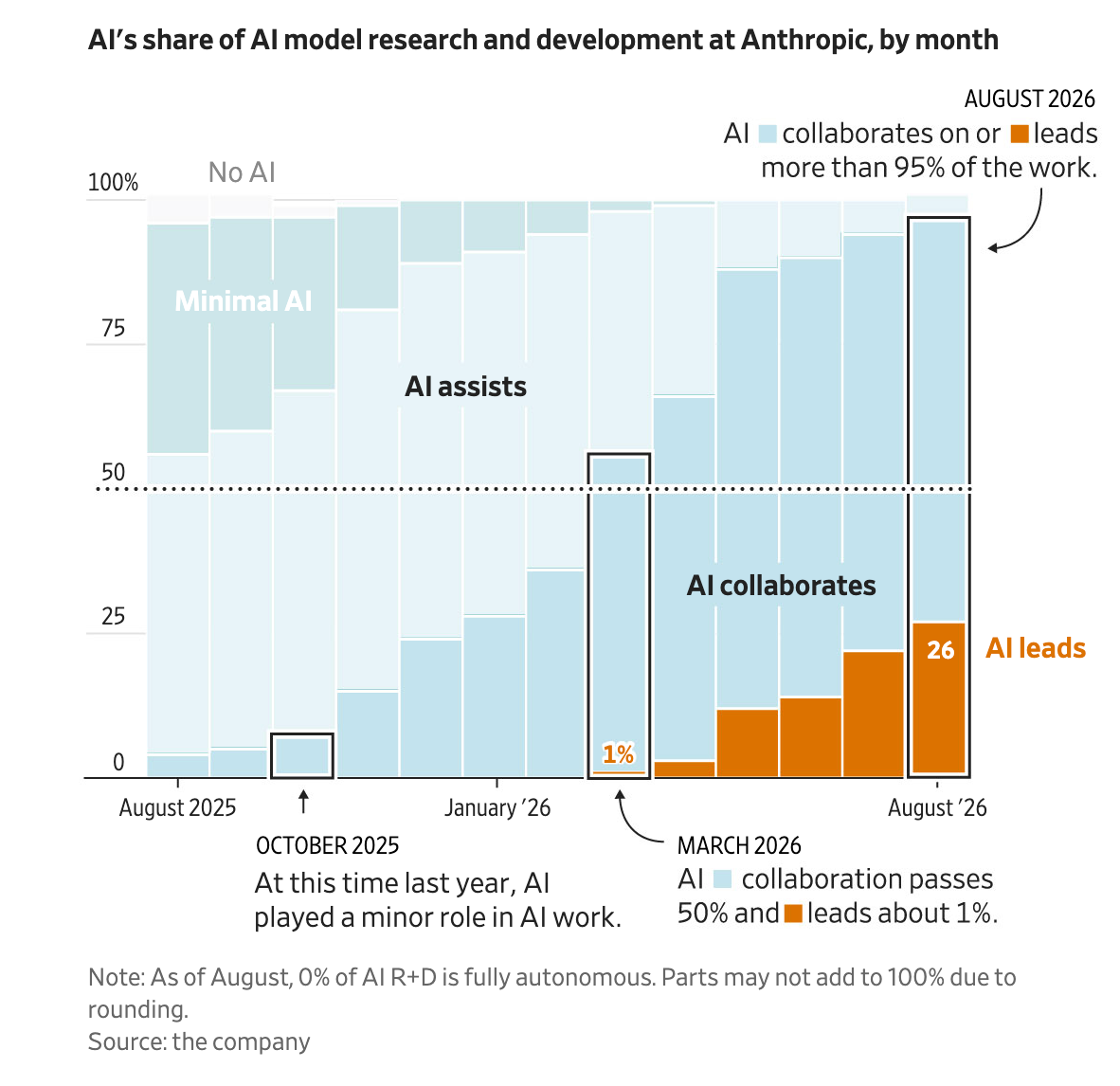
AI is reducing the cost of its own inputs, such as data center energy usage, training data, and new semiconductor designs, including the TPUs that Google uses to train its LLMs.
Are Ideas Getting Harder to Find? covers a period during which computing power per dollar increased a millionfold. But sustaining this pace of progress has become increasingly difficult. By the time the paper was published in 2020, sustaining Moore’s Law required 18x as many researchers as it did in the the early 1970s. Some take this to imply diminishing returns — that progress is getting harder.
In a world where AI is doing the work, doubling computing performance translates to at least a doubling (or more) of the effective labor supply. If we used the million-fold compute increase to run intelligence that would replace human engineers, then the 18x increase in the human labor demands of the industry would be trivial.
Even if you use AI to automate AI R&D, there’s some time before this AI-automating loop really gets going. A slow takeoff such as this would give society some time to get accustomed to this new normal.
Key takeaway: Recursive self-improvement is possible, and already happening at Anthropic.
14. The big blob of compute.
Dario Amodei wrote an unpublished memo titled The Big Blob of Compute while working at OpenAI in 2017. This was before scaling laws, the Transformer, and before LLMs. To sum it all up, if we make a neural network big enough, aim it at a broad enough distribution of data, and don’t f*ck it up, we’ll get AGI.
Imagine if we could achieve something as generally intelligent as GPT-4 by investing $100 million in a broad scrape of the internet, what could happen if we increase the scale of the blob 100x? Orr 10,000x?
Scaling up the blob to this size is easier said than done. If we don’t reach AGI by 2040, it’ll be because the answer to one of these questions was ‘no’.
Can we maintain the exponential increases in inputs required to scale training runs? The finite supply of high-quality language tokens forms a data wall. The pole-vault over the data wall will require some combination of synthetic data and reinforcement learning, or either one alone.
Will LLMs ever demonstrate the kind of generalization we see in humans? Compared to humans, these models are remarkably inefficient at learning. We train them on data it’d take a person 10,000 years to accumulate. AI’s learning process seems incompatible with the Einstein-level creativity we see in humans — the flash of insight derived from thought experiments, sifting through contradictory observations.8
Will future algorithmic improvements stack onto one another? If not, the fast takeoff scenarios, in which a sufficiently intelligent model bootstraps itself to superintelligence by discovering compute efficiency gains, thereby enabling you to quickly train a successor model, become implausible.
In just over a decade, we’ve progressed from neural networks that could perform only one narrow task, such as identifying one of 1,000 species from a blurry photo, to AIs capable of answering an extraordinary range of real-world programming questions.
Ilya Sutskever said that the researchers closest to the frontier are often the most pessimistic. Issues that are trivial in the grand scheme of things are especially salient in the day-to-day grind of building AI, making years-long trends fade into the background.
Key takeaway: If you make a neural network big enough, aim it at a broad enough distribution of data, you’ll get AGI.
15. On the possibility of artificial general intelligence.
There’s a world where AI progress stalls out. We can do increasingly bigger training runs, but over the years progress could stall out.
These inputs probably would yield an intelligence explosion, but if they don’t, we’ve exhausted our current scale-up of the share of our economy trying to make AI.
Therefore, the chance of advanced AI happening is relatively concentrated in the next 10 years [between 2024 and 2034] compared to the rest of the century, because we can’t keep going with our current rapid redirection of resources into AI. We get one shot at it.
Key takeaway: The future of AI has two likely paths: Path #1 — We get super advanced AI sometime before 2034. Path #2 — AI progress stalls out.
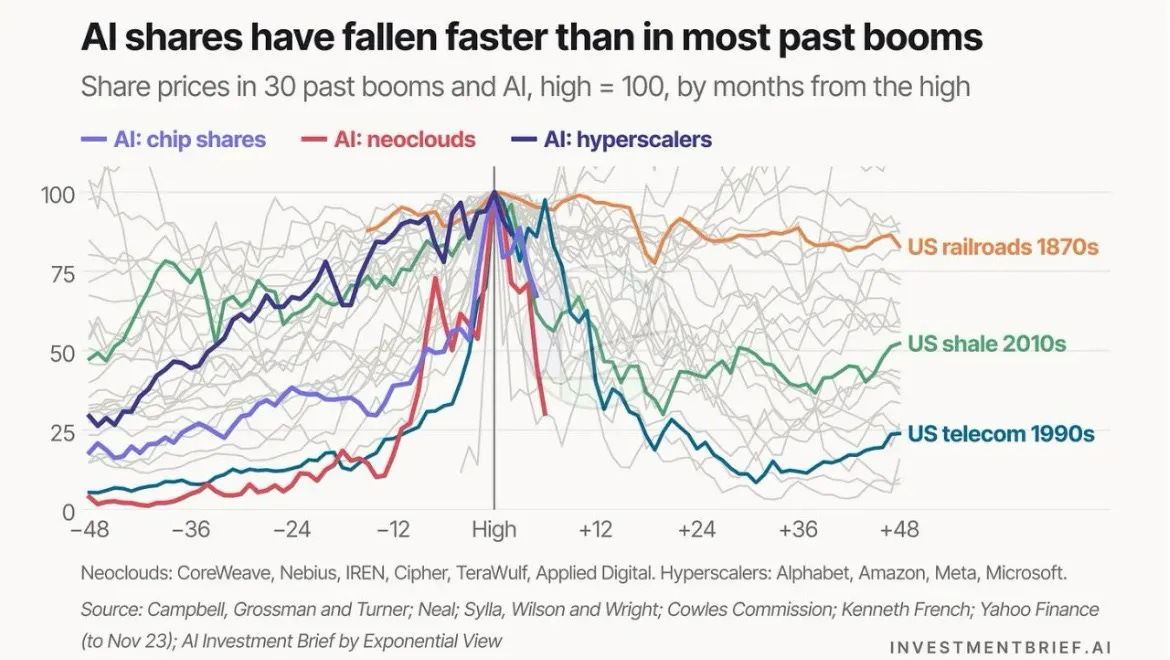
My biggest takeaway from The Scaling Era is how much of modern AI research is resting on neural scaling laws… which we don’t fully understand yet. We know that scaling works. We just don’t know how it works, why it works, how long it’ll continue to work, or whether it’ll be sufficient to make artificial general inteligence.
Despite this, the technology industry is betting hundreds of billions of dollars to answer that question.
And that’s exactly what makes this era of computing so fascinating.
Thanks for reading!
— Grant Varner
If you liked this post, you might also like:


Read Attention is Turing Complete for the full proof. One criticism to this paper is that it unrealistically assumes hard attention, which picks a single part of the input to pass on, whereas all LLMs use soft attention, which involves averaging over all the inputs.
The full weights of OpenAI’s GPT-3 were only 700 GB.
Epoch AI estimates that two-thirds of gains come from increasing data and compute. Only a third come from algorithmic progress. Source: Algorithmic Progress (Ho, et al)
The most influential proof of this is Richard Sutton’s 2019 essay, The Bitter Lesson in which he explains why raw computational power applied to a massive amount of data is what breeds intelligence rather than specific human knowledge.
RLHF (reinforcement learning with human feedback) relies on human raters giving feedback. If a model starts to lie, deceive, commit fraud, or break the law, you give it a “👎” to reinforce against that behavior. Or a “👍” for good actions you want to reinforce.
Exodus 20:12 states, “Honor your father and your mother, so that you may live long in the land the Lord your God is giving you.” The Ten Commandments of Christianity are a good base framework for guiding AI morality. Honoring your mother and father is a great framework for human living. It can also be useful to AI because it requires them to respect their elders, regardless of the fact that they may have more ability.
A world model in the context of LLMs is a stable, self-consistent map of reality it manipulates to answer questions.
For example, one of the few pieces of direct evidence available to Einstein while developing general relativity was an anomaly in Mercury’s orbit.