

I’ve seen some of kyla scanlon’s videos pop up in my YouTube Reels algorithm. When I stumbled upon her book at Barnes & Noble, I figured I’d give it a shot. 10/10, would recommend. Here’s an attempt to distill all the learnings about the ‘vibe economy’ contained in her book into 2,500 words. (Along with a few thoughts of my own.)
I. The Vibe Economy
Our feelings about the economy have a big impact on how the economy behaves. Stock market rallies yield irrational exuberance. Grim headlines yield uncertainty. When prices go up, consumer sentiment decreases, and vice versa. But there’s nothing new about sentiment driving the economy. Back in 1936, John Maynard Keynes coined the term animal spirits to describe how emotions influence people’s decisions and market behavior.
Half a century later, Kahneman and Tversky’s Prospect Theory (1979) asserted that emotions drive financial decisions, opening up Pandora’s Box of behavioral economics. Because the economy runs on human emotion, facts don’t always equate to truths about the economy.
II. How Money Works
Back in the good ‘ole days (3500+ B.C.E.), early societies operated on principles of communal sharing. Over time, as civilizations grew, standardized mediums of exchange became necessary.1 The Mesopotamians established the first formal monetary system in 3500 B.C.E. via clay tokens. In fact, we know that the Mesopotamians charged interest on loans before they discovered how to put wheels on carts.2
Since the Mesopotamians’ clay token system in 3500 B.C.E., many currencies have come and gone, but the principle is this: Money is a medium of exchange, backed by trust in an institution. 5,000 years later, the U.S. dollar is now the dominant currency globally. Since its inception until 1971, the U.S. dollar was tied to the value of gold.3 President Richard Nixon ended the gold standard through an executive order called the “Nixon Shock” which suspended the dollar’s convertibility into gold to battle inflation.
We haven’t turned back, which makes the U.S. dollar a fiat currency — which means it’s entirely backed by the full faith of the U.S. government.
Recently there’s been worry over the dollar maintaining its status as the federal reserve currency.4 The speculation is that hyperinflation will drive down the purchasing power of the dollar. But most countries’ debts to other countries are denominated in dollars, so the currency won’t blow up anytime soon.
III. How Money Is Measured
The price we pay for things is determined by demand (how many people want it) and supply (how much is being produced).
When demand is low and supply is high, prices go down. And versa. This is called the supply and demand curve.
GDP is the total market value of all finished goods and serves produced within a country’s borders. Think of it like a scorecard of a country’s economic heath, represented by this equation:
GDP = Consumption (what people buy) Government Purchases (money the U.S. government spends) + Investment (capital spending) + Net Exports (exports minus imports)
Historically, rising GDP has been a signifier of economic growth. But as populations age, we may need to look for new ways to measure economic success.5 The Federal Reserve bank of Dallas wrote in 2022:
“As trend GDP growth slows due to aging demographics and slower productivity gains, there may be more frequent periods of negative GDP growth without an increase in unemployment, making the distinction between increasing slack and declining activity more relevant than in the past.”
The Labor Market
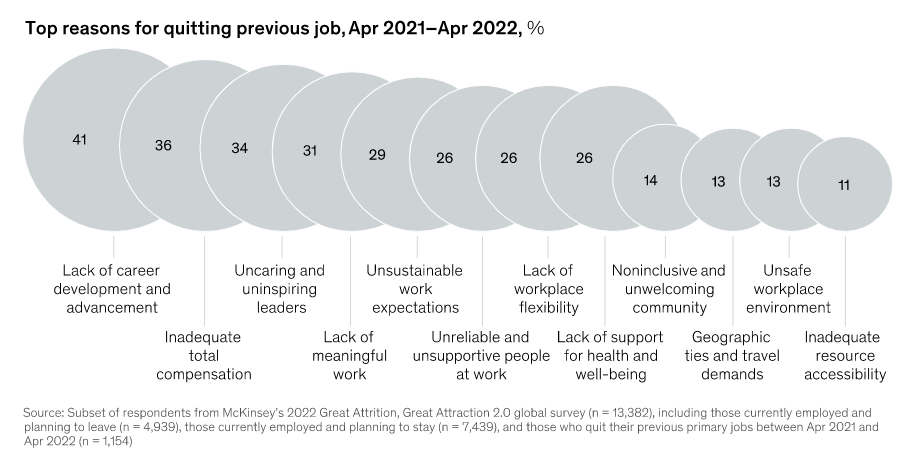
Back in the day, you could buy a new house out of college, work at the same company for forty years, and raise 3 kids with one working parent. Today, most 20-something’s can barely afford guac on their Chipotle burrito. (Half joking.) The labor market has changed a lot. People want to work, but the options for growth today are limited. According to McKinsey & Company, the main reason people leave their job is because of limited opportunities for career advancement.
The Housing Market
Back in 1950, you could buy a home for 3x your annual salary. Now an entry level home costs 11x your salary. What happened?
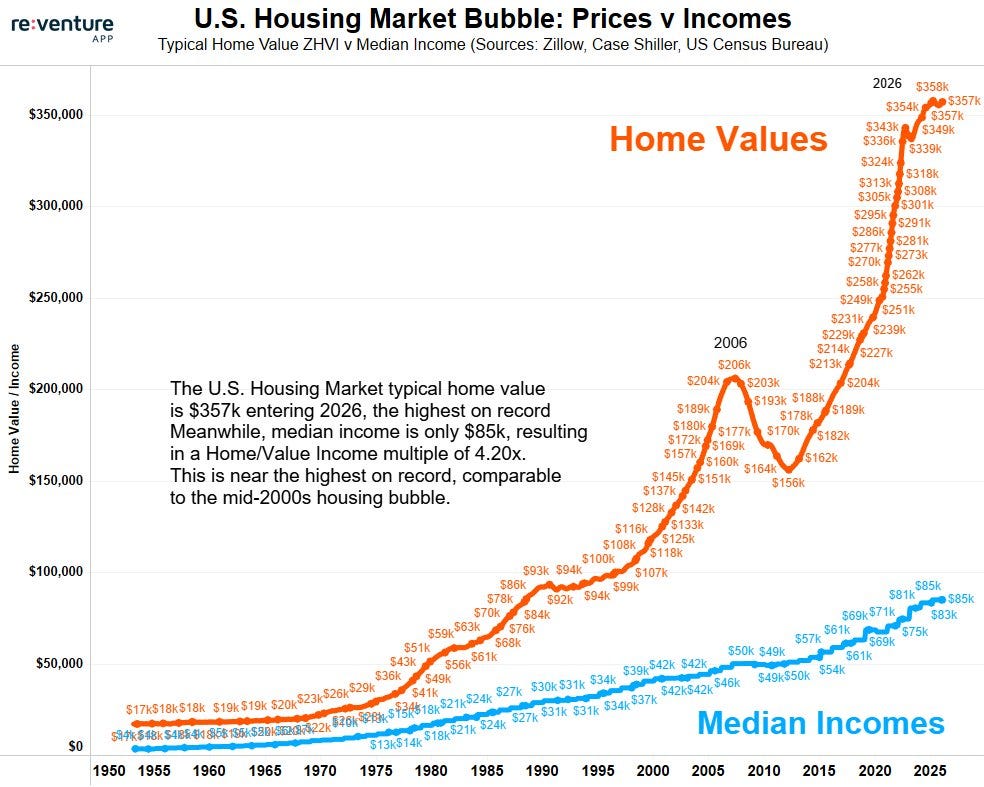
Why housing has gotten so expensive is a topic for another day. Put simply, it’s a supply issue. But the tides are starting to turn in some regions of the United States. Rent prices in some sun belt cities have fallen drastically since the market’s peak in 2022.
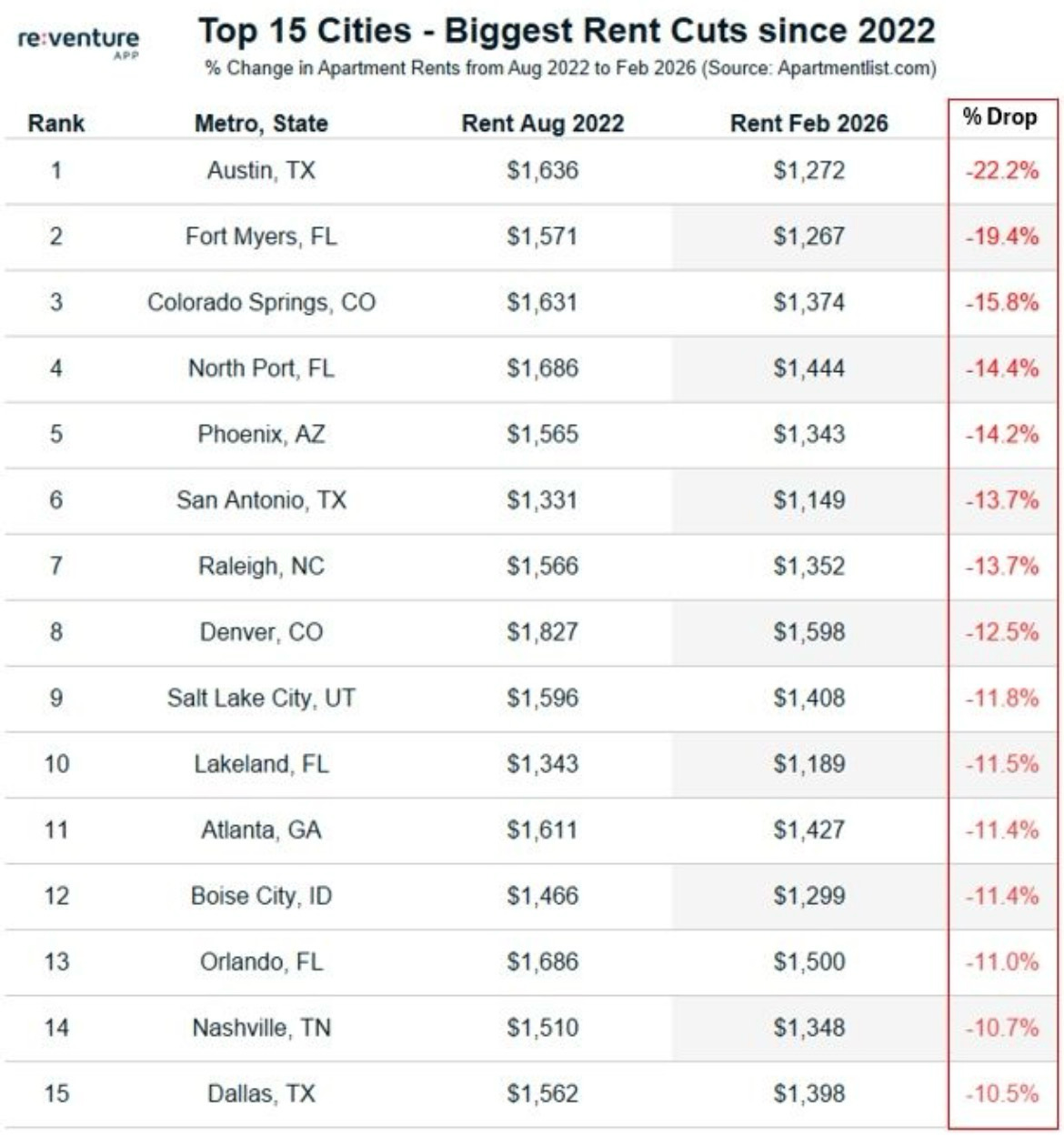
Regardless, the housing market is shifting underneath our feet. Because housing data is a lagging indicator of the current state of the market, the tides may have completely shifted in some regions.

The Stock Market
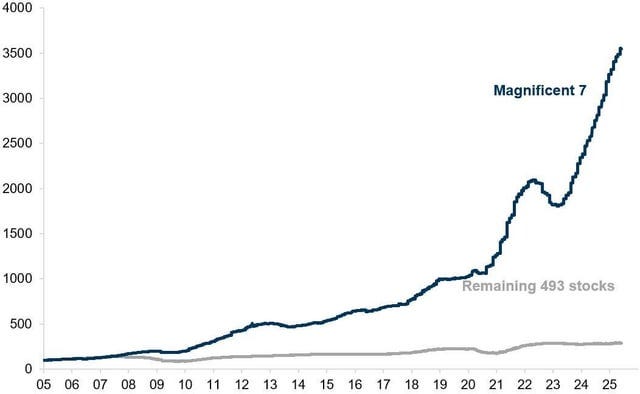
Market concentration is a characteristic of the stock market in recent years. In the early 2020’s, the Magnificent 7 (Apple, Microsoft, Amazon, Alphabet, Meta, Tesla, and Nvidia) accounted for most of the S&P500’s gains.6
In a world dominated by passive investing, index providers, like the S&P Dow Jones, have an incredible power to redirect billions of dollars of investment by reclassifying a single company.
We saw it when in May 2025, Moody’s downgraded the U.S. debt rating to AA1.
We also saw it when Tesla’s addition to the S&P 500 Index led to a price surge.
We’re seeing it now as S&P Dow Jones considers changing its rules to admit SpaceX, after an IPO.
Small companies are staying private, because as Jamie Dimon put it, “the governance of major corporations is evolving into a bureaucratic compliance exercise instead of focusing on its relationship to long term economic value.” Put differently, there’s a lot of hoops corporations have to jump through that privately owned companies don’t have to.
Recessions
Recessions are subjective and occur when the economy shifts from expansion to contraction. In the United States, the National Bureau of Economic Research (NBER) decides whether we’re “officially” in a recession. James Hamilton put the subjectivity of recessions eloquently:
“The NBER’s dates as to when U.S. recessions began and ended are based on the subjective judgement of the committee members, which raises two potential concerns. First, the announcements often come long after the event. For example, NBER waited until July 17, 2003 to announce that the 2001 recessions ended in November, 2021. Second, outsiders might wonder (perhaps without justification) whether the dates of announcements are entirely independent of political considerations.”
Because economic data is a lagging indicator, we don’t even know we’re in a recession until after it’s already happened. Since a recession isn’t made “official” until later on, sometimes your gut can tell you whether we’re in a recession or not.
IV. How Money Moves
Fiscal Policy
The debt ceiling is the cap set by Congress on how much the government can borrow. It’s often compared to a credit limit.
The original intention was to promote fiscal responsibility. But in practice, the debt ceiling has become a tool for politicians to advance their own agenda at the expense of the nation’s well being. Exhibit A: O’Hare’s TSA lines during the government shutdown.
By eliminating this arbitrary limit on spending, Congress could focus on more meaningful debates about spending and revenue without the bi-partisan showmanship.
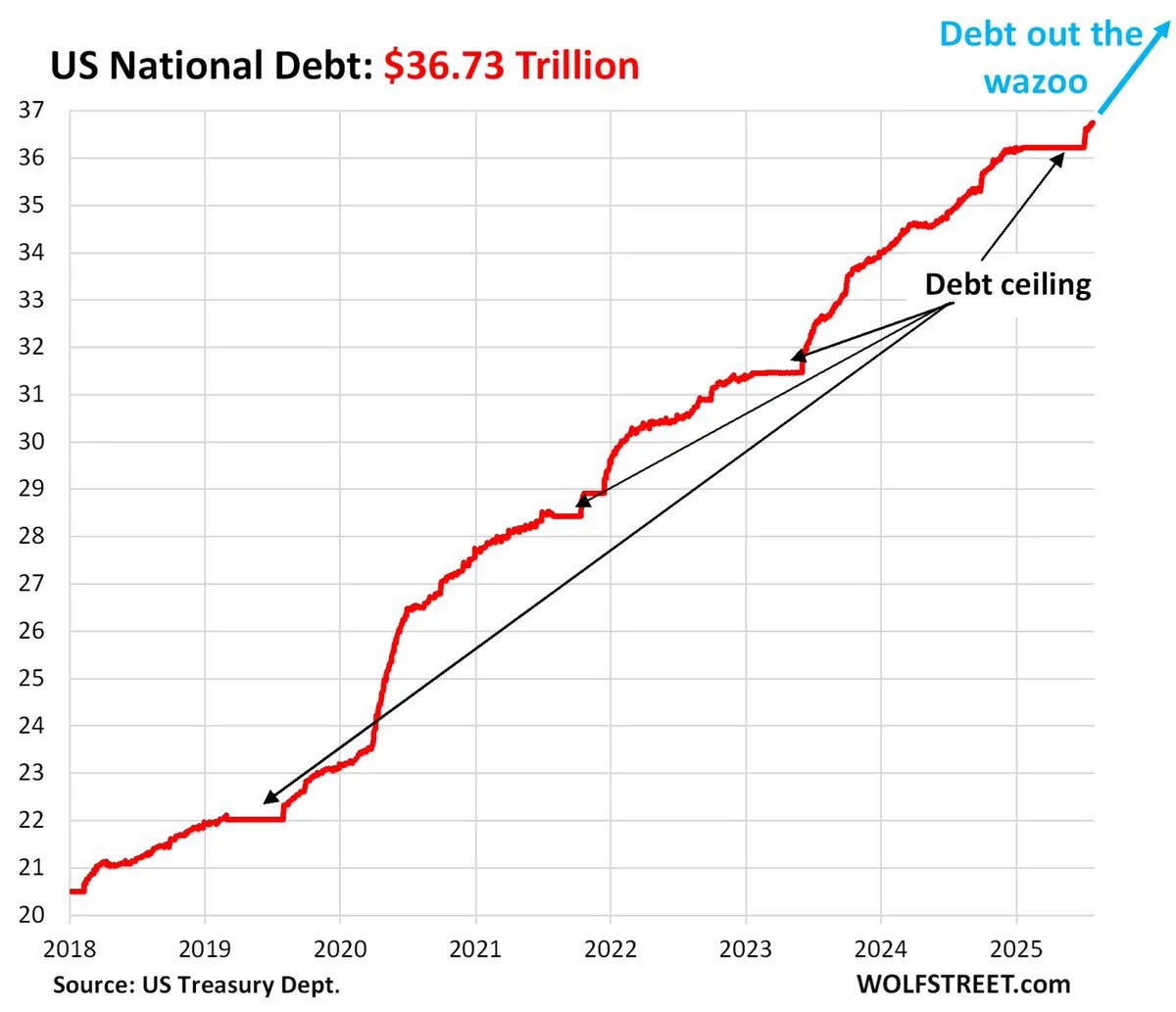
Since 1960, Congress has moved the debt ceiling seventy-nine times. Every time the U.S. approaches the debt ceiling, anxiety spikes about the prospects of not hitting it. It’s unlikely that’ll ever happen because it we did breach the debt ceiling:
The Treasury would stop functioning. That’d end payments to federal workers, agencies, Social Security beneficiaries, delay Medicare providers. There’s likely be a ripple effect through the markets, too.
The United States would go into default. This has never happened, so we can only speculate. The U.S. dollar is the premier reserve currency because America has the biggest, most stable economy.
The Federal Reserve
The Federal Reserve reports to Congress, but it’s not really part of the government. That’s why the Fed’s actions (monetary policy) are different than the government’s (fiscal policy). The Fed gets bi-partisan pressure from politicians, and it’s up to the Fed alone to make sure policy keeps the economy stable.
Since the United States is the most powerful global economy, the Fed has immense power on a global scale. To quote Uncle Ben from Toby McGuire’s Spider Man: “With great power comes great responsibility.” The Fed’s great power came with two great responsibilities:
Price stability. The Fed’s goal is to keep inflation at a steady 2%.
Maximum employment. Which historically has been a 4-5% target.
When interest rates go down, stonks go up. When you can make more money from your interest in the bank, it might make sense to do that. When interest rates increase, the opposite happens. This is where the TINA (“There Is No Better Alternative”) principle gets its name. When interest rates are near zero, might as invest in Pokémon cards.
V. Theories, Problems, and Opportunities
In Fight Club, Tyler Durden said “the things you own end up owning you.”
Things don’t define you as a person. The mere desire for things can enslave you. Character speaks louder than what you own.
Problems
The current global mental health crisis has a big impact on the economy. This impact is reflected in both absenteeism and presenteeism at work — where individuals are less effective in their jobs due to mental health issues.
“Lost productivity as a result of two of the most common mental disorders — anxiety and depression — cost the global economy $1 trillion USD each year. In total, poor mental health was estimated to cost the world economy approximately $2.5 trillion per year in poor health and reduced productivity in 2010… a cost projected to rise to $6 trillion by 2030.”
— The Lancet Global Health
The pandemic also caused many 20- and 30-something’s to have a new relationship with work — haunted by their early adulthood not going aa expected. For example, Gen Z has already lived through three major economic downturns, despite being in their mid-twenty’s. Young professionals who started their careers in remote-first environments are playing catch-up:

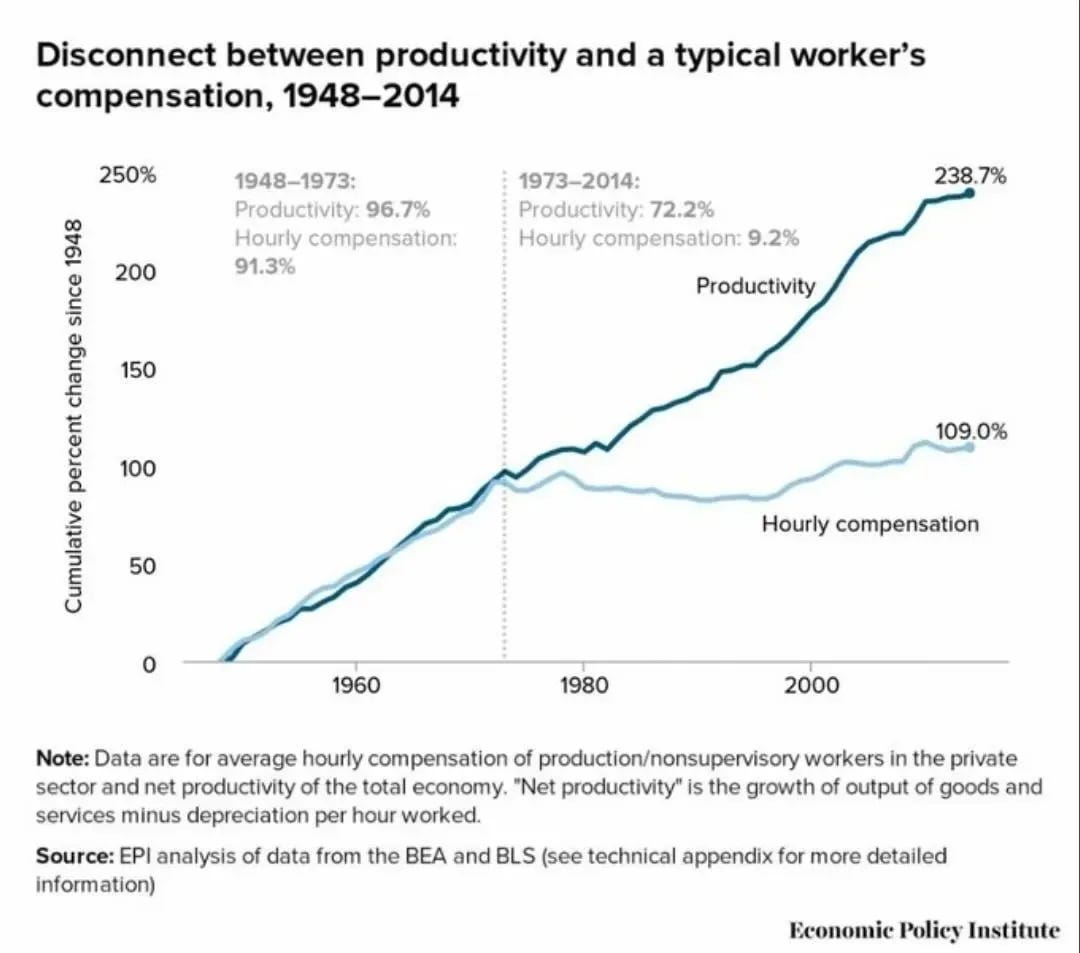
An image of their parents struggling to make ends meet during the 2008 recession is making many re-think their relationship with work. Many more are coming around to the idea that work isn’t the primary source of fulfillment. For the past 40 years, productivity has increased while wages have remained stagnant. Minimum wage remained stagnant, while living costs skyrocketed.
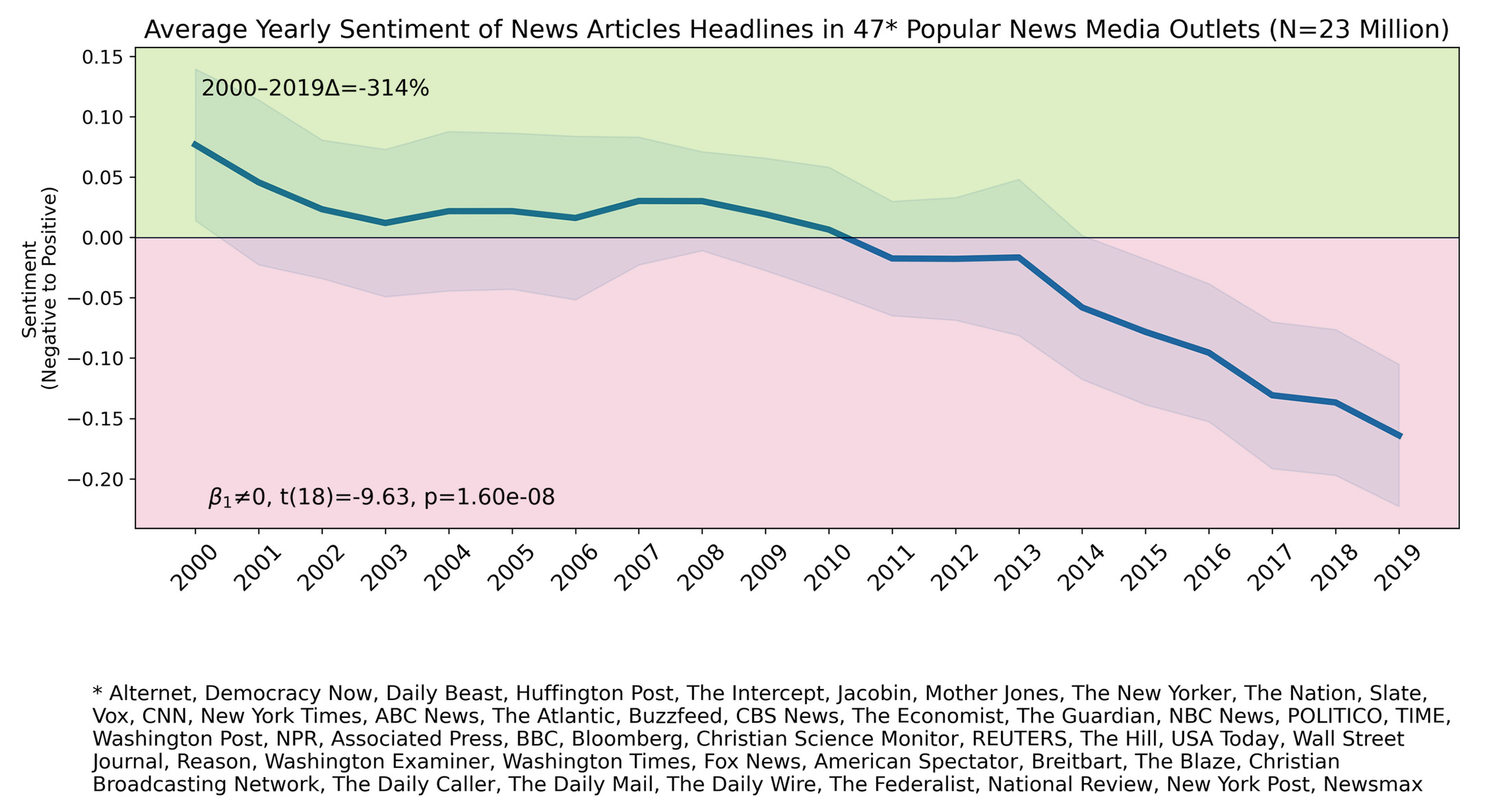
The attention economy — whose shoulders upon which nearly the entire American economy stand — are built to monetize on our eyeballs. In order to drive clicks, media must resort to increasingly extreme stories. Just look at the sentiment towards news article headlines in the last 25 years:
The economy is rough right now, but there’s hope.
Opportunities
In a 2022 article published in The Atlantic, Derek Thompson highlights what he calls an “abundance agenda”, which spans healthcare, immigration, and housing.
Healthcare. Our current healthcare systems is designed to over diagnose and keep people sick. As Juan Enriquez wrote in Scientific American in 2022:
“The U.S. uses a fee-for-service model, which patients pay for the procedures that doctors perform, not for the outcomes they achieve. This financing structure has led to a health-care system that has advanced, technological interventions for the very sick, but poor public-health infrastructure. Fee-for-service has distorted health-care priorities in favor of more expensive treatments for people who are sick, rather than measures to keep them from getting sick in the first place.”
Immigration. Typically, the best of the best legally immigrate into the United States. My wife is one of them. Just look at Ohio, where immigrants make up 4.8% of the state’s population, yet account for 11.8% of the STEM workforce.
Housing. In recent years, homes have gone from a use asset to an investment. In 1945, John Dean taught the peril’s of this line of thinking in his book Homeownership: Is It Sound?:
“For some families some houses represent wise buys, but a culture and real estate industry that gives blanket endorsement to ownership fail to indicate which families and which houses.”
Half a decade later in 2022, Jerusalem Demsas wrote a piece echoing a similar sentiment:
“Wealth building through homeownership requires selling at the right time, and research indicates that longer tenures in a home translate to lower returns. But the right time to sell may not not line up with the right time for you to move… People want to live near family, near good schools, near parks, or in neighborhoods with the types of amenities they desire, not trade their location like penny stocks.”
Home ownership is forced savings. They shouldn’t be your sole source of wealth — although for many, it is. just “forced savings”. We need to encourage more stock ownership.
I hope you had as much reading this as I did writing it! Kyla’s book is thorough, and I learned a lot about the vibe economy.
As always… thanks for reading!
— Grant Varner
David Graeber made this argument in “Debt: The First 5000 Years”. I’ve not read it, but it’s on my reading list because it stares me in the face at my Barnes & Noble whenever I come to pickup “In This Economy” to read and write this book summary.
As Edward Chancellor wrote in “The Price of Time”.
Alexander Hamilton established the First Bank of the United States in 1791. After a brief period where states adopted their own currency, Congress chartered a Second Bank of the United States. That lasted about twenty years, until Andrew Jackson, established the Free Banking era, where states made their own regulation… which, as you can imagine, was a nightmare for anyone trying to do business across state lines.
I wrote about my own perspective on de-dollarization and the possibility of the U.S. Dollar losing global reserve currency status here:

Ray Dalio has talked extensively about the possibility of economic influence shifting to China.
Which is ironic because in his Essay on Population (1798), Thomas Malthus explained that:
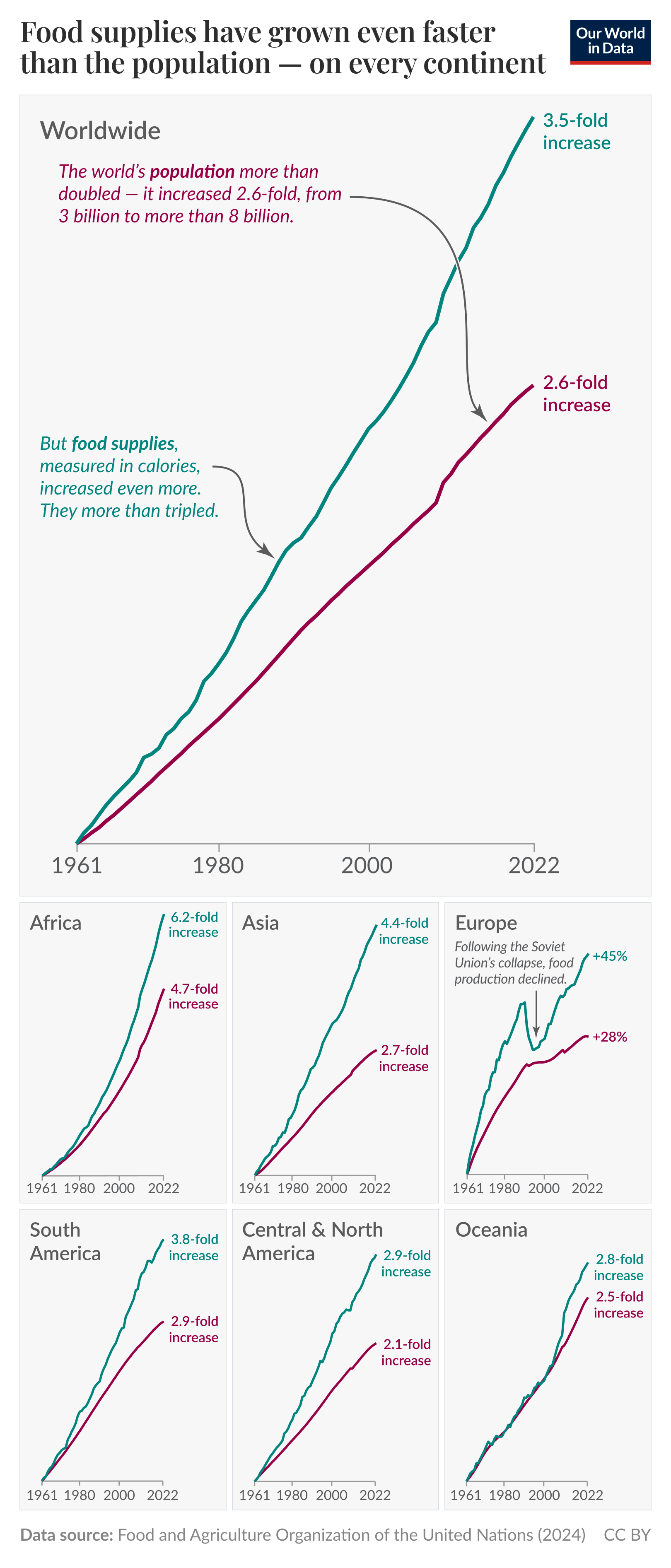
“Without these periodic checks [of famine and pestilence], the birth rate would so far exceed the death rate that the multiplication of mouths would nullify any increase in the production of food.”
One of the greatest thinkers in the 18th century worried about whether the food supply could keep up with population.
Today we know that food supply did keep up:
And that a leading fear among economists is how the declining birth rate in developed nations will affect the economy.
Because it’s so hard to pick the right stocks, it’s often best to just buy the entire S&P500, and focus your energy on increasing your skills and income.

Great write-up, all good points, and I love Kyla’s work. She’s one of the more reliable economic sources I go to for info because she seems to understand the academic discipline of economics, but also be able to connect with a younger audience.
Love Kyla and her work! In line with the trends around media consumption however, maybe not surprisingly, I have seen a lot of her content but have not read her book - maybe I should check it out.