

My reading mix has a profound impact on my thoughts, writing, and actions. This past year, I’ve leaned heavily into history and economics — which is fun to nerd out about. But not ideal if the goal is to be a better husband. This upcoming year, I’m shifting my reading mix to:
40% faith & philosophy.
40% marriage.
20% productivity (psychology, career, wealth, fitness).
I read 15 books in 2026 — beating my annual average of 14.5 books annually since 2017!
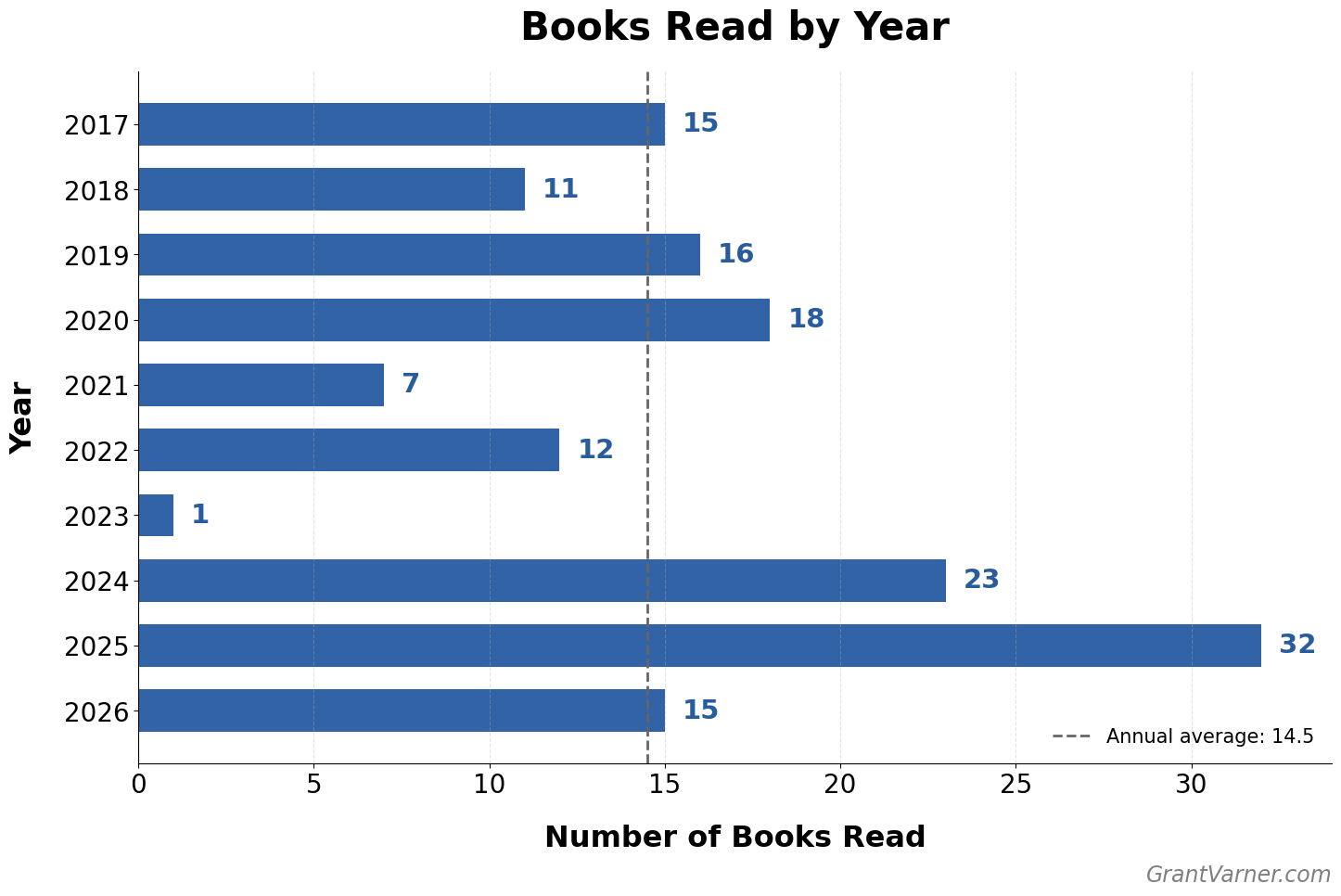
Here’s what I read so far in 2026 (in the order I read them).
Just Keep Buying (Nick Maggiulli)
I’m recommending this book to my wife so that she can learn about investing. My biggest ‘aha’ moment from the book is when Nick proves — with data — why, if you have money to invest, you should invest it.
I’m notorious for buying the dip throughout my 20’s. Now that I’m 29 going on 30, it’s a good reminder that it’s mathematically optimal to invest as much as I possibly can for my risk tolerance.
This book also brokerage-pilled me into the benefits of investing more in my taxable brokerage vs. a 401(k) — particularly because I’d like the option to retire early one day.
The Lessons of History (Will and Ariel Durant)
I bought The Lessons Of History on a whim. I didn’t expect much. It’s an ambitious book for how short it is (only about 100 pages), detailing the principles that repeatedly emerge throughout human history.
In that sense it reminds me of the academic version of Same As Ever by Morgan Housel.
My biggest takeaway? Technology moves faster than man has time to evolve. As a result, all technological advances are merely new means of achieving old ends.

Superintelligence (Nick Bostrom)
Elon Musk put Superintelligence on the map in 2014 when he endorsed it on Twitter (now X).

This, along with The Scaling Era are two books I’d love to summarize at some point. The best way I can describe this is a steelman argument of all the ways AI could kill us all.
And if you’re into the blogosphere, like I am, you’ll find that this book is eerily similar to Tim Urban’s The AI Revolution: Our Immortality or Extinction.1 That’s a feature, not a bug. Superintelligence was worth the read if you’re trying to go deep into the super-scary AI alignment problem.
Democracy in America (Alexis de Tocqueville)
I’m not sure how else I’d have stumbled upon Democracy in America if not for my dad bringing it up 100 times during our phone calls. To keep up, I picked up an abridged copy.
I agree with the premise: that democracy is something baked into the ethic of the American people rather than something that’s codified into the Declaration of Independence, Constitution, or Bill of Rights. But in my opinion, even the abridged version was too long. This book could’ve been a couple of paragraphs.
My favorite part was the author’s note at the beginning where he explained the trip itself. The description of Tocqueville’s travels from France to America, and across the colonies reminded me of a banger Substack post you might find on here. A bit reminiscent of Jasmine Sun’s No Data Centers In My Backyard. Even though Democracy in America is a classic, you’re probably better off reading the Spark Notes AI-generated summary.
The Effective Executive (Peter Drucker)
Have you ever broken out in a cold sweat when your boss asks you what you’ve been spending your time on? If yes, this book’s for you. The Effective Executive is concerned with how you spend your time to be as effective as possible. And it doesn’t just apply to executives.
This book was useful to me as a Solution Engineer. I could see it being useful to any knowledge worker. This is another one of those books that you could pick up in any season of life, and you’d find new ways to apply the learnings. If I’m ever a parent (God willing), I’d reread this book to see what else I could learn.
My biggest takeaway from the book was the sheer amount of time we tend to waste in the average day. Drucker’s recommendation is to physically track your day — every single minute — to see where you’re spending your time. Like an audit, but for your time, seeing where you spend every single minute is revealing. That way you can decide whether your time is well spent, and if you need to cut.
Humans tend to follow the path of least resistance. Where you spend your time follows this pattern. Spend some time to audit your time. It’ll be well worth it.
Mindset (Carol Dweck)
Mindset is one of those books that I try to revisit biennially. It’s another one of those books where every time you read it, you see new ways to apply the learnings. This time around my biggest takeaway was the importance of a growth mindset in marriage.
I have a tendency to catastrophize bumps in the road of marriage. Instead of letting small challenging marital moments crush me (read: Fixed Mindset), it’d be better to see setbacks as opportunities to grow (read: Growth Mindset).2
An amazing book by Carol Dweck, which discusses why a growth mindset is better than a fixed mindset. There’s a small handful of books that I’d consider part of my “core canon” list — books that are so foundational that they’re worth revisiting biennially.

The Porn Trap (Wendy & Larry Maltz)
To access pornography, Millennials had to download porn with slow dial-up internet on a desktop. Gen X had physical Playboy magazines. But Gen Z was the first generation to grow up with iPod touches with access to high-speed internet pornography.3
Online pornography of the 21st century is more dangerous because it has the three A’s: Accessibility, Affordability, and Anonymity.
The three-headed hydra of the three A’s makes online porn very challenging for a young, growing male brain to resist. and will likely ripple into many Gen Z marriages for years to come. This book discuss why online pornography is so bad and strategies for avoiding it.
If you prefer video, this Ted Talk gives a great synopsis.
In This Economy? (kyla scanlon)
I raw dogged In This Economy? at Barnes & Noble over the course of a few trips, writing this book summary as I went instead of writing notes into the margins. But I felt bad because I read the book without buying it. Then I got a shot at redemption when I attended a talk that she moderated in Chicago, buying a signed paperback in the process. I told Kyla about it, while she was signing my book. She half-jokingly said she was glad that I was able to rectify the situation. Balance in the Force restored!
On a serious note, the best part about In This Economy? was the coinage of ‘vibe-session’, which is a sort of modern-day Gen Z rebranding of Keynes’ concept of ‘animal spirits’.
The paperback edition also features a new afterword about the impact of tariffs on affordability, the AI bubble, and the challenging labor market for fellow Gen Z’ers. If you already read the hardcover, I reckon the paperback is worth the purchase.

Atomic Habits (James Clear)
This was my third time reading Atomic Habits by James Clear. This book is a masterpiece. Every time I’ve read it I’ve found new, different ways to apply the learnings to my own life. What’s more is that James Clear is from Bexley, Ohio — just stones throw away from my hometown. In many ways, I see myself in him.
During my first read-through of Atomic Habits back in 2019 I vowed to one day start writing online. The blog you’re reading right now started as a tiny seed of an idea.4 I can say with sincere honesty that it’s a life changing book.

Sapiens (Yuval Noah Harari)
I started reading Sapiens back in 2019, and didn’t finish until 2026. No particular reason why other than the fact that I fell out of love with history, and fell deeply in love with the self-help genre of books. This year changed that.
I dusted off my copy of Sapiens from my parents’ house, and picked up right where I left off — the Scientific Revolution. Even though history isn’t my typical jam, this book was flawlessly executed. The colored text and images on each page pop, and the writing tells an ambitious story of the entire history of humankind in a compelling way. Consider this like the best exhibit at the Natural History museum, but in book form.
My biggest takeaway from Sapiens was the three milestones in the evolution of mankind:
Cognitive Revolution (70,000 B.C.)
Agricultural Revolution (12,000 B.C.)
Scientific Revolution (1500 A.D.)
Young Money (Jack Raines) 🎧
You should listen to this in audiobook form. If you’ve listened to some of Jack Raines’ podcast appearances, you’ll immediately recognize his voice — and it translates so well to the audiobook format.
My best description of this would be Rolf Potts’ Vagabonding if it was written by an MBA grad. 10/10 — fantastic listen.
I was listening to Young Money when I booked our trip to Italy. So consider my post about Italy a direct result of listening to Young Money.

Leisure: The Basis of Culture (Josef Pieper)
A few years ago I consumed Josef Pieper’s The Four Cardinal Virtues. I adored that book so much that I decided to revisit another book of his: Leisure: The Basis of Culture. I picked this book up at a time when I was struggling to find a good balance between work and life. Candidly, I still haven’t quite found it yet, but am improving.
Leisure reads surprisingly like a modern self-help book about how to have work-life balance, except with a lot more citations from Saint Thomas Aquinas and Aristotle. I most likely won’t revisit this book, but it was a good book for this particular time in my life.
The Dip (Seth Godin)
Seth Godin is a blog wizard. He’s published a daily blog post since 1995 — over 25 years. He finally reached his 10,000th post milestone last April. Absolute animal on the keyboard.
The Dip explains what I grapple with every day writing on this blog: Winners don’t mindlessly persevere through everything nor do they quit out of panic. By ruthlessly quitting the wrong things, you free up your time and focus to become the best in the world at the right things.
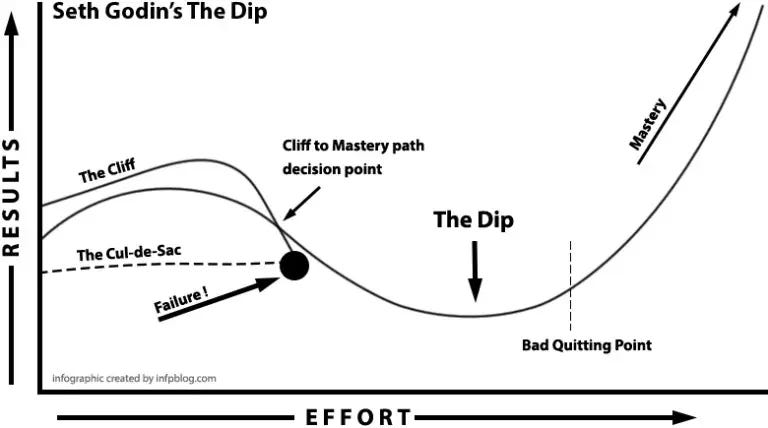
He calls this the rule of “The Best In The World”. The market disproportionately rewards #1 and ignores the 10th best. You should only stick with a "Dip" if you have the realistic potential to become the best in your niche. If you can’t be #1, you should quit early rather than suffer endless mediocrity.5
Mere Christianity (C.S. Lewis)
If there was ever a book of the ‘blocking and tackling’ the Christian life, this would be it. C.S. Lewis builds the case for what he calls “Mere Christianity”, or the principles that every Christian can agree on — from first principles. His argument starts with objective morality. He eventually transitions to the four cardinal virtues and the three theological virtues.
He also makes a great case that Christianity is like a hallway where each denomination is a different room in that hallway. And that it doesn’t matter which room you enter. Only that you enter a room and get cozy there. This argument actually led me to question my dogmatic beliefs in Catholicism, and to open my heart to Coptic Orthodox Christianity, the church that I happily married my wonderful wife in.6
The Scaling Era (Dwarkesh Patel)
Last and certainly not least: The Scaling Era. Beyond the fact that this book is beautiful (shoutout Stripe Press with the lay flat binding), the actual content of the book is superb. As mentioned earlier, this is a book I would love to write a summary on.
Essentially, in all the hype of AI, I was immensely interested in digging into the actual details of how large language models work. What I quickly came to realize is that the frontier AI labs have become increasingly closed in recent years due to competitive pressures causing a rift in knowledge sharing between industry and academia.7 Since then, I’ve found Dwarkesh Patel’s podcast useful in learning the mechanics of large language models from those in the industry.
What I like most about the book is that it’s extremely well cited, making it an excellent resource to revisit and double-click into specific AI research papers.
That’s all folks for 2026 reading! I hope you enjoyed learning a bit more about the books I’m reading. As always, thanks again for reading, safe travels over the holidays, and if you found this post useful, please share it with a friend!
— Grant Varner
Superintelligence came out on July 3, 2014 and Tim Urban’s The AI Revolution: Our Immortality or Extinction came out on January 27, 2015. It could be coincidence, but both read eerily similarly. Maybe AI Alignment was a hot topic then just like it is now?
The two other times I read Dweck’s Mindset, I was in my early 20s and unmarried. At the time, I was deeply focused on starting my career on the right foot (still am, but marriage takes higher precedent now). As a result, when I read it then I noticed all the applications of a growth mindset to career. But now I’m noticing ways to have a growth mindset in marriage. I guess attention is all you need.
Nowadays “gooning” is a derogatory slang term for someone who watches too much online pornography. And honestly, in a similar spirit as “bring back bullying”, making fun of gooners is a good thing. It’s an implicit signal to young people that falling deeply into online pornography is bad for you because it’s low status.
On a more hopeful note, I also think that how common “gooners” are in society makes it easier than ever to stand out. For example, only 2% of men don’t watch porn, gamble, or play video games. One in eight young men aged 18–29 do all three every day. It’s never been easier to stand out.
The only reason I didn’t start writing online until two years ago is because I didn’t feel like I’d accumulated enough knowledge via reading. Now, almost a decade of consistently reading, I’m finally writing online! I’m glad that I focused deeply on reading during my 20s so that I could have a latticework of mental models to write deeply researched essays that you (hopefully) enjoy reading.
The lessons from The Dip are why I’m still writing. Early in my journey writing online, I used to get unsolicited feedback from strangers across the world who were reading my newsletter. That signaled to me that my writing is good (but always room to improve!). I’m far from #1 in my niche but I have the potential to become #1 — which tells me that I’m experiencing a “dip” rather than a “Cul-de-Sac” of eventual failure.
To be clear, I still do love Catholicism. I have a deep appreciation for the Sistine Chapel and many of the Catholic theologians that came out of that tradition: Josef Pieper, Saint Francis de Sales, and Thomas Merton to name a few.
GPT-3 was the last large language model with public information about their pre-training data.

Good list! I’ve never read The Effective Executive, I’ll give it a go. My time is highly unoptimized